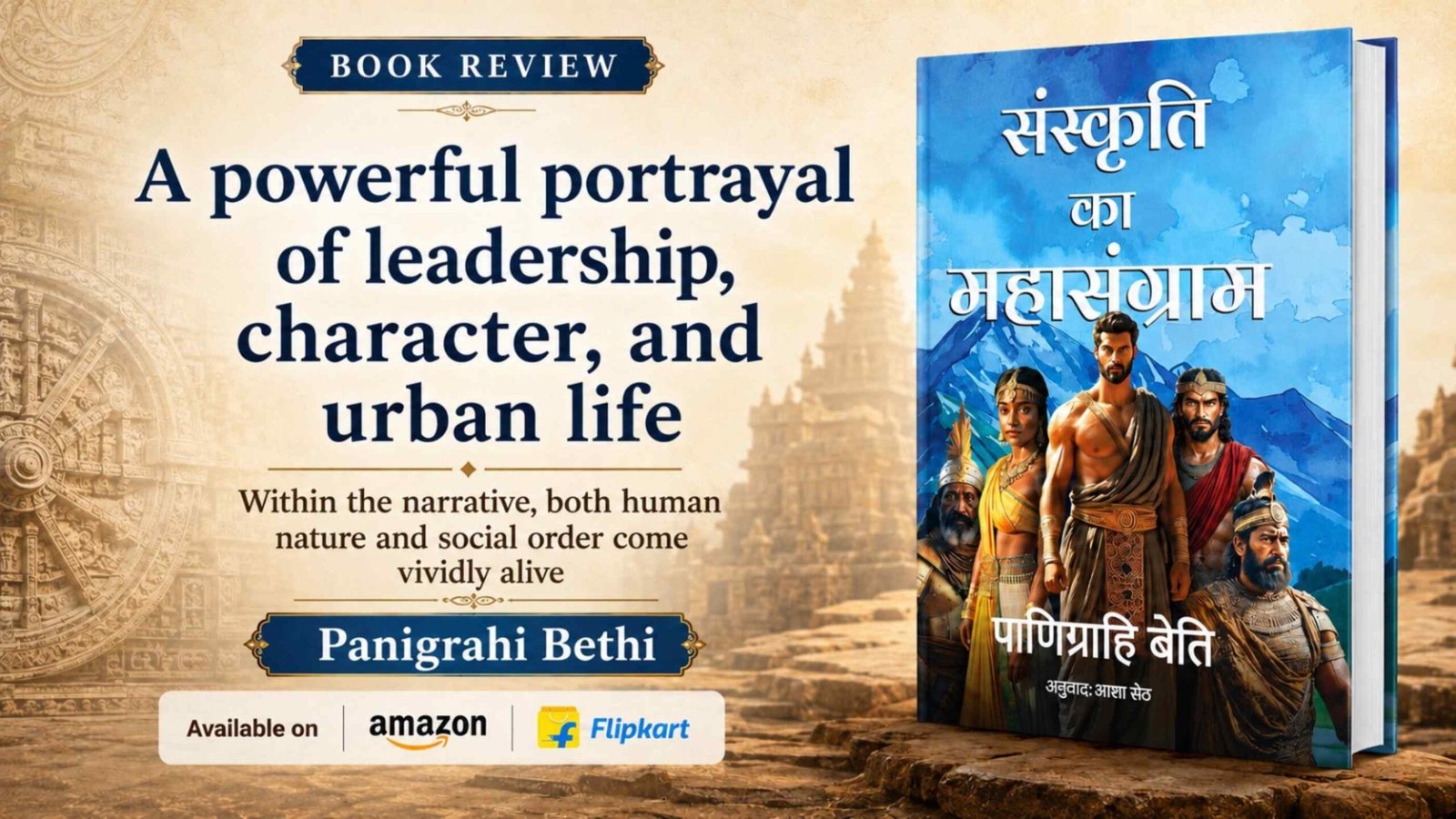
A character-centred review of a historical novel that restores ordinary life to an ancient civilisation
Sanskriti Ka Mahasangram | Panigrahi Bethi | Hindi Translation: Asha Seth
Ruins preserve walls, streets, seals, pottery, tools, and fragments of systems. They rarely preserve voices. The challenge of historical fiction is therefore not simply to describe an ancient city accurately, but to imagine the emotional lives that once moved through it. Sanskriti Ka Mahasangram succeeds because Panigrahi Bethi does not treat Harappa as a museum display. He allows it to breathe.
The novel, presented in Hindi through Asha Seth’s sensitive translation, imagines the meeting of the Harappan civilisation and the Aryan tradition. It contains political tension, cultural uncertainty, philosophical debate, and the pressure of historical change. Yet its deepest power comes from something quieter: the sense that every civilisation is ultimately made of people who love familiar streets, worry about family, trust inherited systems, fear displacement, and try to understand strangers.
A City Built from Everyday Values
Harappa is often remembered through its archaeological achievements: planned roads, standardised measures, drainage systems, trade, craftsmanship, and sophisticated urban organisation. Bethi incorporates these details, but he does not present them as a catalogue of accomplishments. He turns them into lived experience.
The drainage system matters because it shapes health and dignity. Trade matters because it connects families, artisans, and distant communities. Public spaces matter because they reveal how citizens understand one another. Grain storage, water management, streets, workshops, and civic organisation are woven into the characters’ assumptions about normal life.
This is what makes the setting persuasive. The people of Harappa do not constantly praise their city’s sophistication. They simply live inside systems they consider natural. Their attachment to the city is therefore not abstract patriotism. It is a relationship with a way of organising life.
When that order comes under pressure, the reader understands what is at stake. The threatened loss is not merely architectural. It is the possible disappearance of habits, knowledge, trust, and a shared civic imagination.
Baguhara and the Burden of Leadership
Baguhara is one of the novel’s most compelling figures because he embodies the difficulty of governing during transition. He is not a ruler placed above society; he is a man responsible for preserving a complex urban world. His decisions affect not only territory but also trade, safety, social confidence, and the continuity of institutions.
The novel wisely avoids making him either infallible or weak. Baguhara has wisdom, experience, and devotion to his people. He also has limitations created by the world that formed him. When a civilisation has survived through stable systems, the instinct to preserve those systems can be both strength and danger. Bethi uses Baguhara to explore a question relevant far beyond the ancient setting: when does loyalty to tradition become resistance to necessary change?
Because Baguhara’s dilemma is treated seriously, the novel does not turn historical decline into spectacle. Leadership becomes an emotional burden. Every choice protects something and risks something else. The reader feels the loneliness of authority when there is no decision without loss.
Armita: Memory with a Human Face
Armita gives Harappa its most intimate emotional presence. She is intelligent, observant, courageous, and deeply connected to the structures of her civilisation. Her knowledge is not decorative. She understands how the city functions and why its systems matter.
This makes her grief specific. She does not mourn an idealised past; she recognises the exact network of relationships and practices that may disappear. Through her, the novel gives historical loss a human face. Archaeology can tell us that a city changed or declined. Armita allows us to imagine what that change might have meant to someone who knew the city as home.
Her relationship with Purush is important because it never completely absorbs her identity. She is not present only to transform him. She carries her own loyalties, intelligence, and moral agency. The connection between them works because it is built through attention rather than convenience. They do not instantly overcome difference. They learn to see the world from positions they did not previously understand.
Purush and the Discipline of Curiosity
Purush represents the possibility of change without self-erasure. He enters the Harappan world with assumptions shaped by the Aryan tradition. His growth begins when he becomes curious enough to observe rather than judge.
The novel handles this transformation patiently. It does not depend on a dramatic speech or a sudden rejection of his past. Purush changes through repeated contact with another way of life. He sees a city organised around principles unfamiliar to him. He listens to people whose knowledge challenges his own. He discovers that difference is not proof of inferiority.
This gradual development gives the book emotional credibility. Bethi understands that cultural learning is often uncomfortable. It requires a person to recognise that inherited beliefs may be incomplete. Purush becomes interesting not because he abandons his identity, but because he develops the capacity to hold more than one truth.
Ashwin and Varun: Ideas Given Voices
The conversations between Ashwin and Varun add intellectual structure to the novel. They discuss authority, tradition, movement, social organisation, belief, and the meaning of progress. These passages could easily have become lectures, but they remain effective because the ideas emerge through character.
Ashwin and Varun do not merely represent opposing positions. Their debates reveal the tensions within communities. A civilisation is never completely united in its understanding of itself. Internal disagreement is part of cultural life, and the novel treats that disagreement as a source of development rather than weakness.
The presence of these philosophical dialogues also expands the book’s appeal. Readers looking for an engaging historical narrative will find suspense and relationships. Readers interested in ideas will find questions that remain open after the plot has ended.
The Harappan and Aryan Worlds Without Caricature
One of the easiest ways to create drama in historical fiction is to divide communities into heroes and villains. Sanskriti Ka Mahasangram refuses this shortcut. The Harappans are sophisticated, but they are not perfect. The Aryans bring disruption, but they also bring knowledge, mobility, courage, and evolving thought.
This moral balance allows the reader to understand the encounter from within both worlds. It also prevents the novel from becoming trapped in contemporary ideological simplification. The book respects the emotional reality of cultural loss while acknowledging that history is made through movement, exchange, conflict, and adaptation.
The result is a story in which no civilisation remains untouched. The meeting changes everyone. That is historically convincing and emotionally richer than a simple conquest narrative.
A Translation that Preserves Character
Asha Seth’s Hindi translation deserves recognition not only for linguistic fluency but also for preserving differences in voice. Historical fiction depends heavily on tone. Leaders, young people, thinkers, and members of different communities must sound distinct without appearing artificially modern or excessively formal.
The Hindi version carries the novel’s emotional warmth, philosophical seriousness, and narrative movement. It feels accessible without becoming simplistic. This is particularly important because the author has indicated that teenagers and young adults were among the intended readers. The translation creates a welcoming entry point while respecting the story’s complexity.
Why This Book Works for Young and Adult Readers
Sanskriti Ka Mahasangram makes history approachable because it begins with people rather than dates. Younger readers can enter the story through relationships, suspense, discovery, and conflict. Adult readers can engage with its deeper questions about governance, identity, coexistence, and historical memory.
The book does not require specialist knowledge of archaeology. It encourages interest in that history by giving the reader something more immediate: characters worth caring about. Once Harappa becomes a home rather than a chapter heading, its history becomes harder to forget.
Final Verdict
The strongest achievement of Sanskriti Ka Mahasangram is its restoration of human presence. Panigrahi Bethi transforms an ancient civilisational encounter into a story about individuals carrying the weight of change. Baguhara, Armita, Purush, Ashwin, and Varun make history intimate without making it small.
Asha Seth’s translation ensures that the Hindi edition retains this emotional and intellectual texture. The result is a historical novel that feels researched but not burdened by research, philosophical but not inaccessible, and culturally significant without becoming polemical.
Readers do not simply observe Harappa in this book. They inhabit it long enough to understand why losing a civilisation is never only the loss of buildings. It is the loss of a way people learned to live together.
| 5 / 5 | Recommended for readers of Indian historical fiction, ancient civilisations, cultural studies, and thoughtful literary narratives. |
Available on Amazon: https://www.amazon.in/dp/9349988852