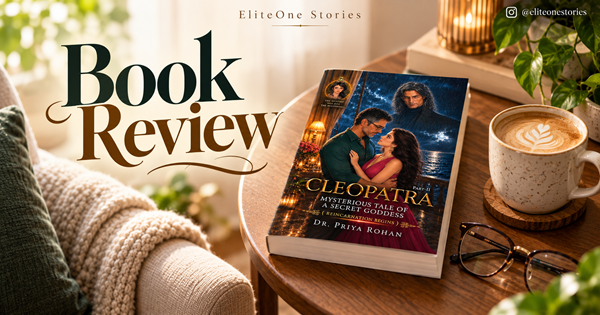
What if history is not a record of what has ended, but a fragmented account of something that continues to exist beyond the boundaries of time? What if the identity of one of the world’s most enigmatic queens was never confined to a single lifetime? These unsettling possibilities form the imaginative foundation of CLEOPATRA: Mysterious Tale of a Secret Goddess: Part II Reincarnation Begins by Dr. Priya Rohan. Blending historical intrigue, supernatural suspense, psychological exploration, and spiritual speculation, the novel presents an ambitious vision of existence in which memory, consciousness, and destiny may transcend death itself.
Rather than approaching Cleopatra merely as a historical figure celebrated for her beauty, intelligence, and political influence, Priya reimagines her as the centre of a story whose implications extend far beyond ancient Egypt. The novel challenges the conventional understanding of identity. Could an individual consciousness survive the dissolution of the physical body? Could the emotional and spiritual experiences of one lifetime find expression in another? These questions give the narrative its distinctive character.
At the heart of the story is Devi, a young girl growing up in rural India whose unusual maturity and composed temperament suggest an inner life far more complex than her surroundings might indicate. Rural India, with its cultural traditions and spiritual associations, provides an evocative setting for a narrative concerned with reincarnation and inherited consciousness. Devi’s presence becomes particularly intriguing because her significance appears to lie not simply in who she is, but in what her existence might reveal about the continuity of identity.
Buy Now: https://www.amazon.in/CLEOPATRA-Mysterious-Secret-Goddess-Reincarnation/dp/937686767X/ref
One of the novel’s most interesting literary dimensions is its movement between ancient and contemporary worlds. This duality allows the story to explore the relationship between historical memory and present experience. Ancient Egypt represents a civilisation surrounded by enduring questions about divinity, death, power, and immortality, while modern India introduces a cultural landscape in which reincarnation and spiritual continuity possess deep philosophical roots. By bringing these worlds together, Priya connects two civilisations separated by geography and centuries.
The treatment of love, obsession, and possession adds another layer of psychological complexity. In conventional romantic fiction, love often functions as a source of emotional fulfilment or personal transformation. Here, however, affection appears intertwined with darker human impulses. The distinction between devotion and control becomes especially significant when relationships are considered against the possibility of connections extending across lifetimes. If two individuals feel inexplicably drawn toward one another, does that attraction represent destiny, unresolved memory, or psychological projection? Such uncertainty adds to the suspense.
The archaeological dimension further strengthens the novel’s premise. Archaeology traditionally seeks to reconstruct the past through physical evidence, documented history, and material remains. Yet the phenomena encountered by archaeologists in this story suggest the possibility of events that resist straightforward historical explanation. This tension between empirical investigation and supernatural possibility creates an engaging conflict. It invites readers to consider the limitations of established knowledge without requiring them to abandon critical thinking.
Perhaps the most distinctive aspect of Priya’s approach is her interest in the human mind itself. Her background as a neurointegrative mental health specialist and mental health researcher adds a unique perspective to the novel’s exploration of memory, identity, perception, and the complexities of the human mind.
The narrative’s themes invite psychological as well as metaphysical interpretations. Experiences that appear supernatural might also raise questions about the subconscious mind, emotional inheritance, and the human tendency to seek patterns connecting past and present.
The title itself deserves attention. Mysterious Tale of a Secret Goddess suggests that Cleopatra’s significance may extend beyond the familiar historical image of a powerful monarch. The notion of a hidden divine identity transforms the queen into a symbol of something enduring and potentially universal. Meanwhile, Reincarnation Begins signals that the narrative is concerned less with final answers than with the unfolding of a much larger story. As the second instalment in a series, it opens new possibilities in which earlier assumptions may acquire unexpected meanings.
Such an ambitious combination of genres also presents an artistic challenge. Historical fiction, psychological suspense, romance, mythology, and supernatural storytelling each possess distinct narrative expectations. Their successful integration depends on maintaining emotional credibility while allowing extraordinary possibilities to unfold. The novel’s broader ideas are most effective when they deepen the human drama rather than overshadow it.
What makes Reincarnation Begins particularly thought-provoking is the unsettling suggestion that the past may not be entirely separate from the present. History, in this imaginative framework, becomes more than a sequence of vanished events. It becomes a possible reservoir of unresolved relationships, emotional attachments, and connections waiting to be understood.
Priya’s novel will appeal to readers attracted to metaphysical fiction, historical enigmas, and psychologically layered suspense. Its central appeal is not simply the possibility that Cleopatra might return through another existence, but the deeper question such a possibility raises: if memory disappears, the body changes, and centuries pass, what, if anything, remains of the self?
Ultimately, CLEOPATRA: Mysterious Tale of a Secret Goddess: Part II Reincarnation Begins brings together history, mythology, love, obsession, and the enduring human desire to understand what lies beyond the visible and the known. For readers who have followed the first book, this second instalment offers an opportunity to revisit familiar threads and discover how they connect with a new generation, a different world, and an extraordinary young girl whose life may hold the key to understanding Cleopatra’s legacy.
For those who enjoy historical fiction with supernatural elements and characters whose lives are connected across time, Devi’s journey offers much to think about. The appeal lies not only in uncovering what happened centuries ago, but also in discovering how those events might shape the lives of people who know little about the past they may carry within them. And perhaps that is what will stay with readers after the final page: the feeling that they have only begun to understand the connection between Cleopatra and Devi, and the desire to follow that story wherever it leads.