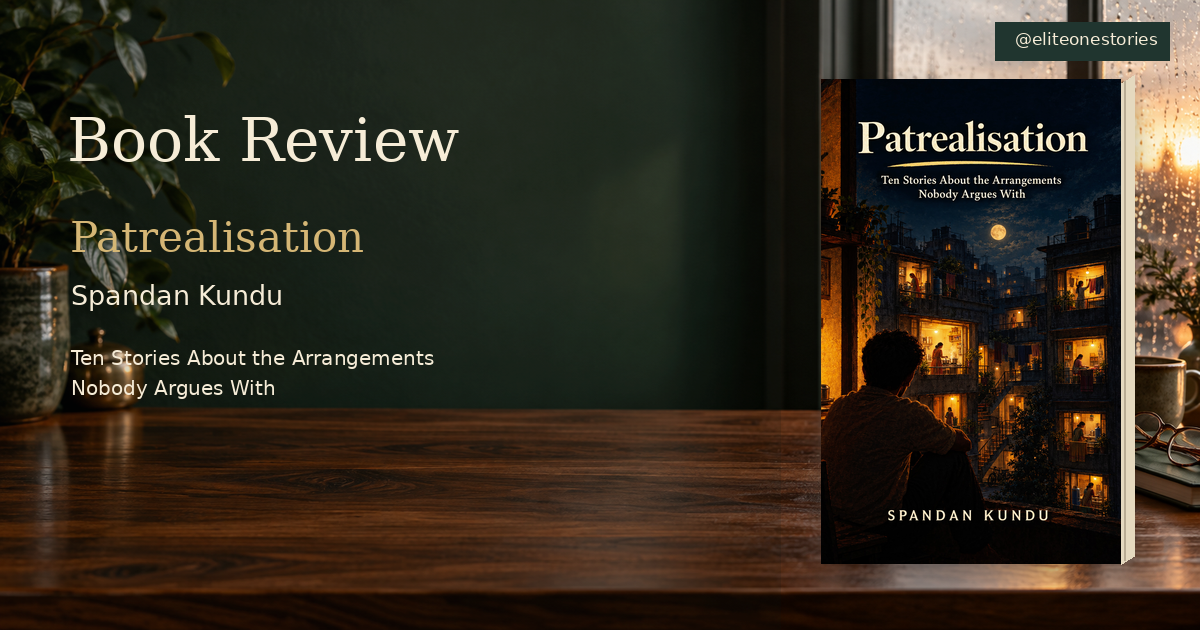
Patrealisation by Spandan Kundu
Ten Stories About the Arrangements Nobody Argues With
Who gets the larger helping, who has time to study and who must explain a purchase? Patrealisation by Spandan Kundu makes such practical questions central to its treatment of gender. Subtitled Ten Stories About the Arrangements Nobody Argues With, the collection follows the distribution of comfort and opportunity through homes, workplaces and public journeys. Its social world is held together by objects that look unremarkable until the stories establish who pays for them, who uses them and whose work keeps them available. Kundu’s attention to that material detail gives the collection a firmer basis than general declarations about fairness could provide.
Food is one of its most persuasive measures. In Purdah Biryani, the narrator’s encounters with curtains and veils eventually return him to a family meal, where women prepare the food and eat after the men. The largest piece of fish arrives on his own plate. The progression moves from something he can examine at a distance towards an advantage he enjoys at home. An earlier plate of cold rice and the almost closed kitchen door make the unequal timetable visible. The meal has not ceased to be affectionate or hospitable; those qualities are precisely what make its allocation of labour harder to question.
The Name I Never Knew offers a related distinction between generosity and recognition. Maashi’s employers help with expenses, and the narrator gives her money from his first salary. These acts matter within the story, but they coexist with his failure to learn her name and with a neighbourhood wage arrangement that nobody wants to disturb. Her husband, who cooks after illness forces him to stop his former work, also complicates a predictable portrait of domestic roles. The collection is more interesting for allowing such variations. It examines unequal conditions without requiring every individual relationship to fit one simple description.
Money becomes an especially uncomfortable subject in Vahini and Dhaakini. The bus driver chooses work that pays adequately and on time; the musician asks what her performance will earn. Both practical concerns frustrate the narrator’s inclination to admire these women as exceptional figures. The musician’s physical effort is described through the instrument’s weight and the mark of its strap. When she yields the leading role at Sandhi Puja, the change in position has a force that an abstract account of exclusion would lack. Skilled work is visible to everyone, yet the recognition attached to it remains conditional.
Kundu follows the cost of that conditional belonging into paid employment in Mrs Tripathi. Madhu’s day is already crowded before she reaches the office, where the discussion of her team’s performance carries an implication about maternity leave. The story’s domestic scenes establish what professional judgments leave out. Breakfast, a late nanny and the meal left uneaten are demands on the same finite hours. Madhu’s later decisions provide a welcome shift in the collection’s emotional register. Even here, however, the framing dinner conversation exposes the ease with which men can enjoy a story about a woman’s independence while another woman continues serving them.
Two Boxes gives the movement of household goods a more threatening meaning. A bride’s brother brings appliances while the neighbours accept explanations for her absence and injuries. Repetition changes the meaning of the deliveries: objects associated with domestic convenience become signs of pressure on the woman’s family. The story is disturbing because the surrounding colony keeps functioning. People eat, gossip and offer reasons not to become involved. Its violence is not presented as an unexplained eruption outside ordinary life. It is accommodated within the same social exchanges that make the neighbourhood feel familiar, and the narrator benefits from those exchanges too.
The collection is also attentive to the terms on which people become visible. In Diastereomers, a train encounter gradually gives Shabnam a name, an education and a wished-for profession beyond the narrator’s initial fear. Her help at the washbasin arrives before he is ready to reconsider his assumptions. A chemistry lesson supplies the story’s organising analogy, linking changed arrangements to his altered perception. The device makes the idea accessible, although the larger force comes from the specifics of the conversation. Shabnam is most compelling when she speaks about work and asks the boy why he wants to become an engineer.
Conviction closes the ten stories by examining what a family expects its young male provider to carry. Neel’s salary supports other people’s needs while his own entrance-exam preparation stays folded in his bag. At a marriage visit, questions about income and future plans require a performance he struggles to sustain. The story’s tenderness towards his private interests broadens the collection without making every form of disadvantage interchangeable. The issue is how an approved role can grant status while narrowing the life inside it. His small gift to a child offers relief, but the larger obligations remain in place.
Kundu’s prose is readable and concrete, particularly when it follows a movement, a purchase or an unfinished meal. The stories often gain force by delaying the meaning of an object until it returns in another setting. Their shared method also creates a limitation: the retrospective narrator’s recognition can become so expected that the reader anticipates the moral turn. The strongest scenes resist being reduced to that turn, allowing awkwardness and affection to coexist. An explanatory epilogue gathers the sociological ideas behind the collection. It may help readers name what they have encountered, though it leaves less room for uncertainty than the stories themselves.
For readers interested in domestic realism and the relation between gender and everyday work, Patrealisation offers a focused, discussable collection. Its most useful question is not whether the characters possess good intentions, but what those intentions actually change for the person cooking, earning or waiting. The subtitle’s emphasis on arrangements proves apt because many of these burdens are accepted before anybody makes an explicit demand. Kundu makes their cost legible in meals, money, time and small choices. The book earns its strongest effects by bringing attention back to those particulars, where a comfortable explanation may no longer be enough.