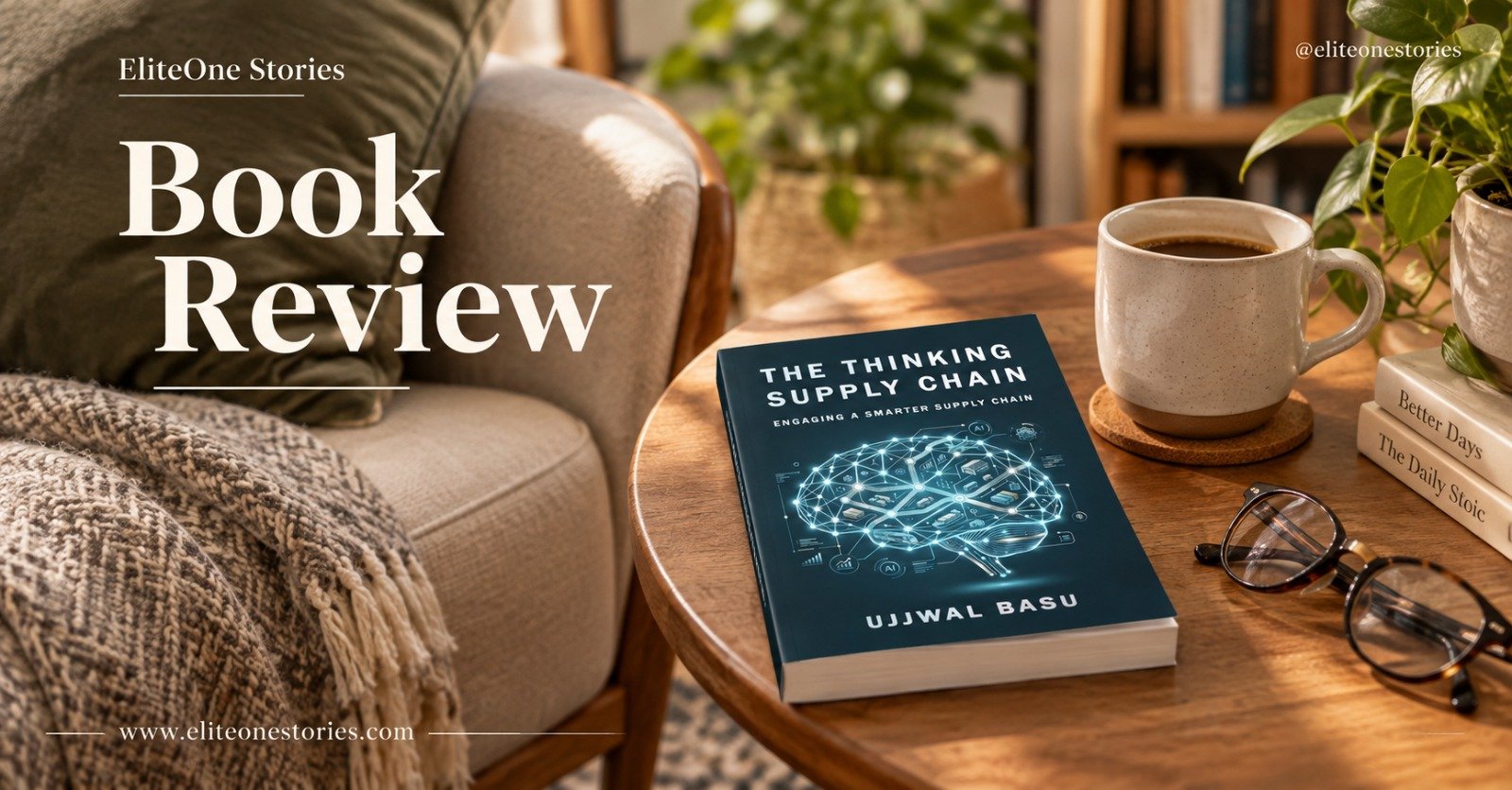
Artificial Intelligence has moved from being a subject of technological curiosity to becoming a strategic consideration for businesses across industries. Yet, between acknowledging the importance of AI and understanding how it can actually be used lies a considerable gap. Ujjwal Basu’s The Thinking Supply Chain attempts to address this gap by placing Artificial Intelligence within a practical business context, specifically the increasingly complex world of supply chain management.
The book begins with an important observation: AI is often understood through extremes. It can appear too technical for business professionals to engage with, or it can be presented as an autonomous solution capable of making decisions without meaningful human involvement. Neither perspective adequately reflects how AI can function within an organisation. Basu’s approach is to move the conversation away from these assumptions and toward a more practical question: where can AI genuinely create value for supply chain functions?
This makes the book particularly relevant at a time when supply chains are expected to become more responsive, data-driven, and resilient. Modern supply chains operate across multiple variables, from procurement and inventory to logistics, production planning, forecasting, and customer demand. Decisions in these areas increasingly depend on the ability to process information quickly and identify patterns that may not be immediately visible through conventional methods. AI, in this context, is presented not as a replacement for managerial thinking but as a tool that can strengthen it.
One of the book’s notable strengths is its attempt to make AI accessible to its intended audience. Rather than approaching the subject primarily through technical terminology, The Thinking Supply Chain focuses on strategic understanding. This distinction matters because successful technology adoption does not begin with technology alone. It begins with identifying a business problem, understanding the desired outcome, and then determining whether a particular technological solution is appropriate.
Basu’s professional background gives this perspective additional weight. With more than two decades of experience in supply chain management across the India Subcontinent, Asia Pacific, the Middle East, and the United States territories, he brings experience from both operational and strategic environments. His work has involved transformation initiatives across procurement, logistics, inventory management, and production planning. Consequently, the book emerges not simply as a discussion of an emerging technology but as an attempt to connect that technology with the realities of organisational decision-making.
The emphasis on practical application is perhaps the book’s most significant contribution. AI can generate considerable interest when discussed in terms of innovation, automation, and future possibilities, but organisations ultimately need to understand what those possibilities mean for their own operations. Where can AI improve forecasting? How can it support better decisions? Which processes are suitable for AI-enabled intervention? What value can reasonably be expected from implementation? These are the kinds of questions that determine whether digital transformation moves beyond experimentation.
The book also encourages readers to think about AI adoption with appropriate expectations. Technology does not automatically produce better outcomes. Its effectiveness depends on the quality of data, the suitability of the use case, organisational readiness, and the ability of people to work with new systems. By positioning AI within a broader framework of decision-making and operational improvement, Basu avoids reducing transformation to a technology purchase.
Another interesting aspect is the book’s relevance to leadership. Supply chain professionals today are increasingly expected to understand not only their operational responsibilities but also the technological changes influencing their functions. This does not necessarily mean becoming AI specialists. Instead, leaders need enough understanding to identify opportunities, ask informed questions, assess potential value, and guide implementation. The Thinking Supply Chain speaks directly to this requirement.
The title itself captures this philosophy effectively. A “thinking” supply chain suggests an environment where data and technology contribute to better decisions rather than simply increasing automation. It shifts attention from machines performing tasks to organisations becoming more intelligent in how they interpret information and respond to changing conditions. This distinction gives the book a broader relevance beyond AI alone.
At the same time, the book’s practical orientation means its greatest value will likely be found among readers who are directly involved in supply chain management, digital transformation, consulting, or business leadership. Readers looking for an intensely technical examination of AI may find the book less focused on algorithms and technical architecture. That, however, appears consistent with Basu’s stated objective. The purpose is to create strategic clarity rather than turn business professionals into technology specialists.
Ultimately, The Thinking Supply Chain presents AI as an enabler rather than an end in itself. Its central message is timely: organisations need to move beyond simply recognising AI as important and begin understanding where it can solve meaningful business problems. For supply chain professionals navigating increasing complexity, this shift from awareness to application is particularly significant.
Ujjwal Basu draws on his extensive professional experience to create a conversation between two domains that are increasingly interconnected—technology and supply chain management. The result is a book that seeks to demystify AI while keeping its discussion grounded in business realities. The Thinking Supply Chain is therefore not merely about adopting a new technology; it is about developing the clarity to understand when, where, and how that technology can contribute to better supply chain decisions.