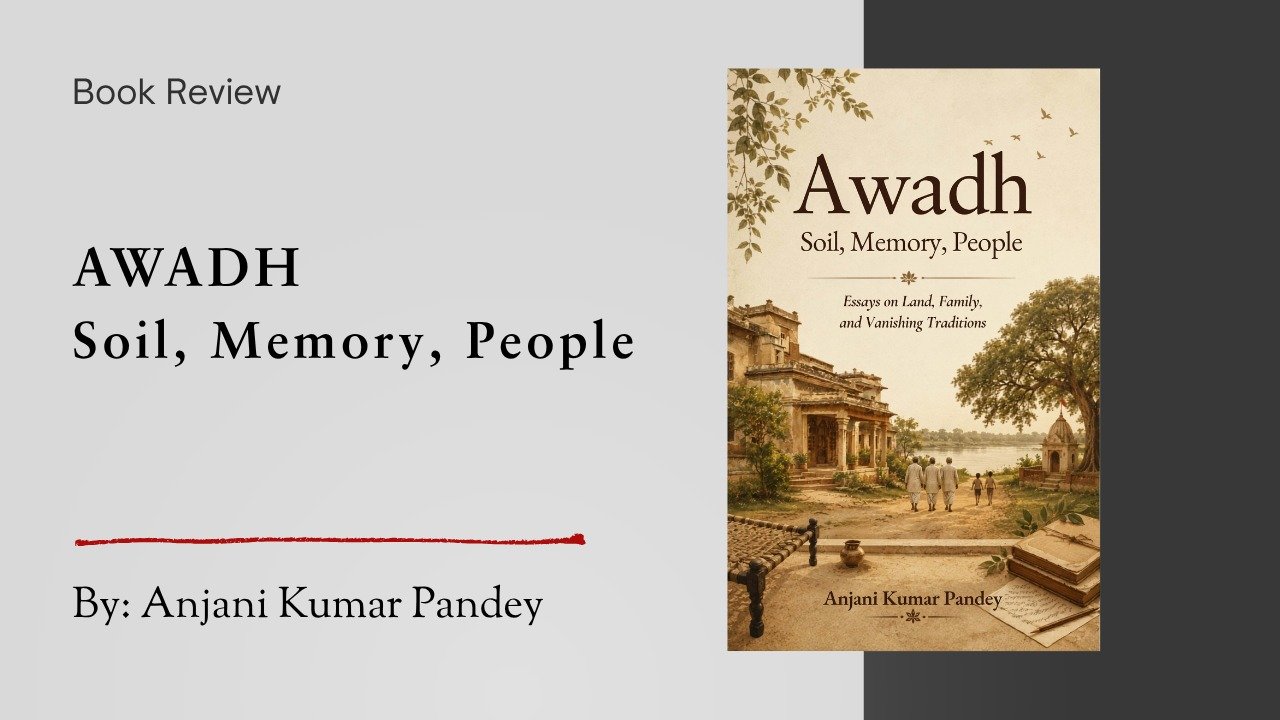
Title: Awadh: Soil, Memory, People
Author: Anjani Kumar Pandey
Publisher: Evincepub Publishing
The most memorable achievement of Awadh: Soil, Memory, People lies in its people. Although the title names a region, Anjani Kumar Pandey builds that region through human faces: fathers, mothers, grandparents, labourers, widows, village elders, returning migrants, priests, farmers, craftsmen, and children. By the end of the book, Awadh is not simply a geographical location. It becomes a network of remembered relationships.
Many of the finest chapters are miniature portraits. “Remembering Dhanai” presents a man who possesses almost nothing materially but is remembered for labour, honesty, faith, compassion, and a philosophy of contentment. “The Weight of Responsibilities” turns Khelawan the carpenter into a figure of endurance within the joint family. “Jigna Bua” is especially moving because the woman at its centre is not remembered through wealth or status; she is remembered through voice, presence, widowhood, service, and the way a village continued to care for her.
“Badki Maai” similarly shows how authority and affection could coexist in the senior woman of an extended household. “Bahira Aaji” gives poverty a face rather than treating it as an economic abstraction. These portraits reveal Pandey’s strongest literary instinct: he knows that a culture survives in the memory of particular people.
The author also uses objects and places as emotional triggers. A tiny bowl found in an old mother’s trunk becomes a symbol of the breakdown of brotherly unity. A soop becomes inseparable from a mother and a seasonal ritual. A tamarind tree becomes a school, meeting point, resting place, landmark, and memory-bank. A peepal tree becomes both sacred presence and social centre. Punjab Mail becomes far more than transport; it carries separation, migration, wages, letters, homecoming, and the emotional cost of earning a living away from one’s village.
These are effective narrative choices because they allow memory to attach itself to something tangible. Pandey repeatedly demonstrates that what appears insignificant from the outside may carry the history of an entire family or neighbourhood.
One of the book’s most accomplished pieces is “The Joyride.” The chapter begins in the present with the author’s younger daughter enjoying a car ride, then opens into his mother’s memory of her first train journey to Allahabad as a teenager in 1968. Her excitement at seeing a train and cycle rickshaw is gradually overtaken by the discovery that her own mother is seriously ill with cancer. The return to the present, with a child noticing a cycle rickshaw from the car window and the narrator watching it disappear in the rear-view mirror, is restrained and emotionally effective. Here the book does not need to insist that time has changed; the image itself says everything.
Pandey’s recurring theme is duty. People are admired because they carry responsibility even when resources are scarce. Parents sacrifice for children, older siblings hold families together, villagers care for one another, and elders embody continuity. His respect for ancestry is established very early in the book, where he describes identity, body, and land as inheritances from those who came before. This moral framework gives the book sincerity and coherence.
Yet it can also make some characters feel more like examples of virtues than fully complicated individuals. Once a person is introduced as hardworking, selfless, greedy, courageous, or responsible, the narration sometimes organises every anecdote around that defining trait. Human beings are generally more contradictory than moral portraits permit, and allowing more ambiguity might have made some characters even stronger.
There are also moments when the physical description of villagers is unusually blunt—teeth, clothing, bodies, smells, poverty, and roughness are described without much softening. At times this produces vivid realism; at other times it risks turning people into rustic “types.” The book is strongest when humour and affection complicate these descriptions, as in the story of Balai, whose greed, misadventure, and later change make him more than a simple moral example.
The emotional register can also become repetitive. The reader repeatedly encounters the idea that older relationships were warmer, that cities isolate people, that younger generations are forgetting elders, and that prosperity has weakened contentment. These beliefs are clearly heartfelt, but a lighter editorial hand would make the emotional peaks stand out more sharply. Some essays could end a paragraph or two earlier and gain power through implication.
Still, there is something generous in the book’s refusal to reserve remembrance only for famous people. Pandey writes about those who would rarely enter official histories. Labourers, elderly women, local characters, railway passengers, village cooks, and family caretakers are granted narrative permanence. That is the book’s quiet democratic achievement.
The sequence of portraits also widens the meaning of family. Blood relations matter greatly, but so do neighbours, village daughters, labourers, elders, boatmen, and other figures bound together by habit and mutual dependence. This broader social family is one reason the later disappearance of communal routines feels consequential rather than merely sentimental.
Awadh: Soil, Memory, People therefore works beautifully as a gallery of remembered lives. It is not flawless, and its nostalgia occasionally simplifies the past, but its human portraits carry genuine emotional force. The book reminds us that family history is often preserved not in archives but in repeated stories—who fed whom, who waited at the station, who kept the family together, who sat beneath a tree, and who continued to be remembered long after the house had fallen silent.