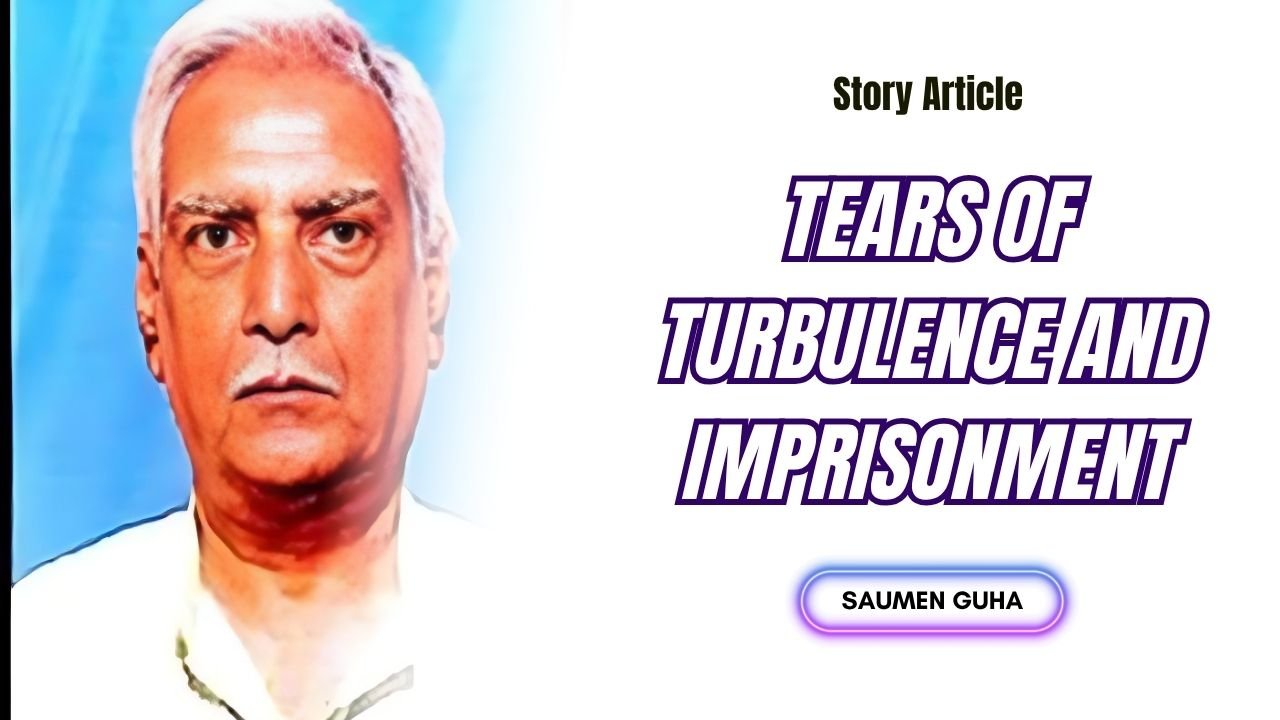
Title: Tears of Turbulence and Imprisonment
Author: Saumen Guha
ISBN: 9789373356594
Publisher: Evincepub Publishing
Some poets write about dreams. Some write about love. Some write about nature. But there are a few whose poems come directly from real life, filled with struggle, sacrifice, courage, and hope. Saumen Guha belongs to that rare group of writers. His poetry is not created from imagination alone. It is shaped by the hardships he faced, the people he met, and the painful experiences that changed his life forever.
His book Tears of Turbulence and Imprisonment is much more than a poetry collection. It is a journey through history, human emotions, social struggle, and personal memories. Every poem carries the weight of lived experience while still offering hope, compassion, and faith in humanity. Reading this book is like walking beside the author through different stages of his remarkable life.
A Childhood Built on Struggle
Saumen Guha was born in 1947 in East Pakistan, which is now known as Bangladesh. His family later moved to West Bengal as refugees during difficult times. Like many refugee families, they had to begin life again with very little. Poverty became a part of everyday life.
Growing up in such conditions teaches lessons that no classroom can provide. Instead of comfort, young Saumen learned endurance. Instead of luxury, he learned simplicity. These early experiences helped him understand the pain of ordinary people, especially those who struggled for food, shelter, and dignity.
Many writers spend years trying to understand human suffering through observation. Saumen Guha experienced it from childhood. This gave his writing honesty and emotional depth that cannot be created artificially.
Science, Engineering, and a Different Calling
Although his childhood was difficult, Saumen believed in education. He studied science and engineering and eventually secured a respectable position as an Engineering Overseer (Mechanical and Electrical) at the Calcutta Metropolitan Development Authority.
For many people, such a job would have been the final destination. It offered security and stability after years of hardship. Yet Saumen Guha chose a completely different path.
He left his government job in 1970 because he felt a stronger responsibility toward poor peasants living in villages. He joined the Communist revolutionary movement, commonly known as the Naxalite movement, believing that society needed deep change to achieve justice for ordinary people.
Whether readers agree or disagree with his political beliefs, one thing is clear. He followed his convictions with complete honesty. He was willing to sacrifice personal comfort for what he believed was right.
Years That Changed Everything
The most painful chapter of Saumen Guha’s life came in 1974.
Because of his political involvement, he, his wife, and several members of his family were arrested. They suffered severe torture while in police custody before spending three years in prison.
These experiences left permanent marks on his life. Yet instead of allowing bitterness to control him, he transformed those painful memories into literature, reflection, and the continuing search for justice.
Many poems in Tears of Turbulence and Imprisonment carry the emotional weight of those difficult years. They speak about fear, loneliness, hope, courage, and survival without becoming hateful. The poems invite readers to think about human dignity rather than revenge.
This emotional balance makes the collection especially meaningful.
Fighting for Justice Beyond Prison
For many people, imprisonment would have ended their public life. For Saumen Guha, it became the beginning of another important journey.
He became the architect of the internationally known Archana Guha Case, one of the world’s longest legal battles against torture in police custody. The case became an important symbol in the fight for human rights and justice.
Even after many decades, Saumen Guha has continued working toward justice through legal efforts and public awareness.
This commitment shows that his writing and his life follow the same values. The compassion, courage, and concern visible in his poems are not separate from the person himself. They are part of the same lifelong mission.
A Mind That Never Stopped Learning
Saumen Guha is much more than a poet.
He is a devoted reader, writer, painter, and music lover. Throughout his life he has written and edited several books and contributed articles on human rights, music, cinema, literary biography, socio-economics, nuclear pollution, and many other important subjects.
Such wide interests have enriched his poetry.
His poems often move naturally between personal memories and larger social questions. One moment he speaks about loneliness, love, or nature. The next moment he reflects on injustice, humanity, peace, or the future of society.
This variety keeps the collection fresh and meaningful from beginning to end.
The Voice Inside Tears of Turbulence and Imprisonment
The title itself tells readers what to expect.
Tears of Turbulence and Imprisonment speaks of emotional storms, social unrest, painful memories, and the strength required to survive difficult times.
The collection includes poems on many different themes and emotions. Along with new poems, it also presents English versions of some of the author’s earlier works that reflect social, human, and revolutionary ideas. The final section contains poems written during his imprisonment in the 1970s, making the book an important literary as well as historical document.
The poems explore subjects such as love, friendship, sorrow, hope, loneliness, truth, patience, freedom, justice, and compassion.
Readers will notice that the language remains simple, yet the emotions are powerful. Saumen Guha does not depend on complicated literary tricks. Instead, he allows honest feelings to speak directly.
His poetry encourages readers to pause and reflect on life rather than rush through it.
Poetry Born from Experience
One of the greatest strengths of this collection is its authenticity.
Many poems today are beautifully written but feel distant from real life. In contrast, Saumen Guha’s poems grow naturally from lived experience.
His childhood as a refugee, his years among poor villagers, his political commitment, imprisonment, and lifelong struggle for justice all appear in different forms throughout the collection.
This does not mean every poem tells a personal story directly. Instead, these experiences shape the emotions beneath the words.
Readers can sense that every line has been earned through experience rather than created only through imagination.
That gives the poems lasting emotional power.
Humanity at the Centre
Although the collection discusses suffering, it is never a book filled only with sadness.
Again and again, the poems return to humanity.
They remind readers about kindness, forgiveness, friendship, empathy, hope, and the possibility of a better future. Even while describing darkness, the poems continue searching for light.
This positive outlook prevents the collection from becoming emotionally heavy.
Instead, readers finish many poems with quiet reflection and renewed faith in human strength.
A Bridge Between History and Literature
One important feature of Tears of Turbulence and Imprisonment is its ability to connect personal history with literature.
Readers who enjoy poetry will appreciate its emotional richness.
Readers interested in history will discover valuable insights into an important period of modern India.
Readers interested in human rights will understand the emotional cost of political conflict.
Very few poetry collections manage to connect these different worlds so naturally.
That makes this book valuable for both general readers and serious students of literature and history.
Continuing the Literary Journey
Tears of Turbulence and Imprisonment is the author’s second English poetry collection.
His first English collection, Deep in the Broken Words, introduced readers to his poetic voice.
Today, Saumen Guha continues working on the English version of his prison memoir, Bright Darkness, along with a compilation of documents related to the Archana Guha Case.
His dedication to writing remains as strong as ever.
Even after decades of personal struggle, he continues creating literature that encourages readers to think deeply about justice, humanity, memory, and hope.
A Book That Speaks Beyond Borders
Although many poems are connected to Indian history and society, their emotional message is universal.
People across the world understand loss, separation, injustice, love, friendship, hope, and courage.
That is why the poems speak beyond national boundaries.
Whether a reader knows the historical background or not, the emotions remain understandable and meaningful.
This universal quality is one of the reasons Saumen Guha’s poetry deserves wider attention.
Final Thoughts
Saumen Guha’s life is itself an extraordinary story.
From a poor refugee child to an engineer, from a revolutionary activist to a political prisoner, from a survivor of torture to a human rights campaigner, and finally to an internationally respected writer, his journey reflects remarkable courage and determination.
Tears of Turbulence and Imprisonment preserves that journey through poetry.
It is a collection filled with memory, reflection, compassion, resistance, and hope. The poems remind readers that suffering may leave deep wounds, but it can also create wisdom, strength, and meaningful art.
For readers who appreciate poetry with emotional honesty and historical depth, this collection offers a rewarding experience. It encourages us to value freedom, defend human dignity, and never lose faith in the power of words. Saumen Guha has shown that poetry is not only about beautiful language. It is also about truth, courage, and the ability to transform pain into something that can inspire generations to come.