Title: I Can’t Tell You
Author: Leena Singh
ISBN: 9789373354316
Publisher: Evincepub Publishing
Some books are written to tell a story, while some books are written because the writer has too many feelings that cannot be kept inside anymore. I Can’t Tell You by Leena Singh belongs to the second kind. It is a deeply emotional poetry collection that explores love, separation, grief, longing, loneliness, pain, and the difficult process of living with memories. From its very beginning, the book makes it clear that these poems have come from a deeply personal emotional space. Singh describes the collection as a voice for people who often fail to express what they feel, and this becomes one of the strongest qualities of the book. The title itself carries this idea. There are things that remain unsaid because they are too painful, too complicated, or simply impossible to explain. Instead of speaking them directly, the poet turns them into verses. The book is divided into two broad sections, “Love” and “Melancholy”, with the first section further moving through “Loving You”, “Missing You”, and “Still Loving You”. This structure gives the collection a natural emotional movement, beginning with affection and gradually moving towards absence, heartbreak, and the heavier side of memory.
What makes I Can’t Tell You engaging is the way Leena Singh looks at love from different sides. Her poems do not present love as only a beautiful or happy feeling. Instead, they show love as something that can bring courage, comfort, confusion, attachment, fear, and pain at the same time. One of the early poems, “Love as a sanctuary”, looks at the different ways people understand love. It moves from the affection someone has for an old guitar to romantic attraction and then to the painful idea of treating love as possession. This shows that the poet is not interested in giving a simple definition of love. She observes how people behave when they love, how they change after receiving what they wanted, and how respect can sometimes disappear when affection becomes possession. Another poem, “Love isn’t a synonym for suffering”, offers a different thought. Here, love is described as an act of courage rather than weakness. The poet sees fragile hearts becoming brave through love and accepts that even painful experiences can carry beauty. This balance is important because the collection does not simply say that love is wonderful or that love is terrible. Instead, it recognises the complicated truth that love can be both beautiful and painful.
The strongest emotional movement in the book comes with the theme of absence. Once love is lost, the poems become quieter but also heavier. “Missing You” captures the experience of longing through simple images from everyday life and nature. The poet compares missing someone to a sunflower missing sunlight, dry soil waiting for monsoon rain, and a farmer hoping for a golden harvest. These comparisons make the emotion easy to understand because they connect personal grief with things people already know. The poems also show how absence can remain present in ordinary spaces. A kitchen, a chair, a room, rain, the night, and even a familiar door can become reminders of someone who is no longer there. In one striking image, the poet imagines seeing the person making morning tea in her kitchen, showing how memory can make the absent person feel almost present again. The collection repeatedly returns to this conflict between knowing that someone has gone and still feeling their presence everywhere. This is where Singh’s poetry becomes especially relatable. Many readers who have experienced separation will recognise the strange way memories stay attached to ordinary objects and places.
Another important quality of I Can’t Tell You is its understanding of grief. Singh does not treat grief as something that disappears quickly. Instead, she presents it as something that can remain closely connected to love. The poems suggest that sometimes the story ends, but the feeling does not end with it. This idea appears strongly in the later poems of “Still Loving You”, where the poet explores the difficulty of letting go of someone while still carrying love for them. One of the most effective thoughts in this section is the idea that the deepest wound is not simply losing someone, but not knowing how to stop loving them after they are gone. The poems also question whether forgetting someone after loving them deeply would itself be unfair. This gives the collection an honest emotional quality. It does not force the speaker to move on simply because the relationship has ended. Instead, it allows her to admit that some memories take time to become less painful. At the same time, the collection also understands that the person who once felt like home cannot always be the person who provides healing, especially when that same person caused the hurt. This emotional conflict gives the poems their depth.
The section titled “Melancholy” takes the book into a more personal and serious space. Here, the poems move beyond romantic heartbreak and explore emotional wounds, trust, loneliness, the need for affection, childhood memories, fear, and the search for peace. The poet writes about a younger self who longed for love and about the lasting effect of not receiving the care one needed. This section makes the collection wider than a book about lost romance. It becomes a reflection on how past experiences can shape the way a person understands love, trust, safety, and even themselves. Poems such as “Yearning for peace” and “The little girl in me survived” show a speaker who is trying to understand where her pain comes from while also trying to live with it. There is a strong desire for a safe place, a place that feels like home rather than a cage. Yet the book is not completely without hope. One of its important messages is that pain does not have to destroy creativity. The poet writes that her agony knows how to replace itself with hope and turn into verses on the page. This is perhaps one of the clearest ways to understand the purpose of the collection. Poetry becomes not just an expression of sadness, but a way of giving shape to emotions that otherwise remain difficult to explain.
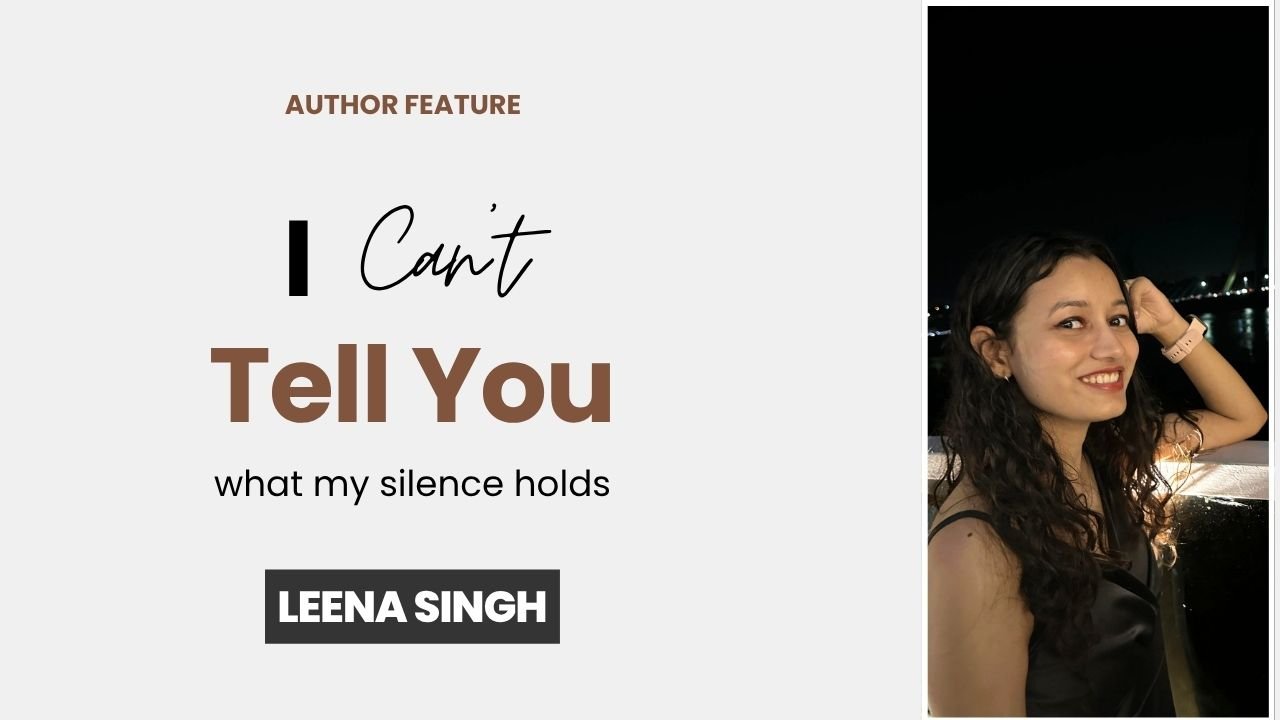
At the heart of I Can’t Tell You is Leena Singh herself, a writer who has been connected with poetry from an early age. As a content creator, writer, and poet, she has developed a strong interest in storytelling and the emotional power of words. Her journey reflects a long-standing belief that words can create something meaningful from even difficult experiences. The book’s acknowledgement gives an important insight into this journey. Singh writes that she has spent years alone with her thoughts and that her mind constantly creates stories and emotions. She has been writing poetry for a long time, but the idea of publishing her work became meaningful when poetry grew beyond being only a personal form of expression. She also acknowledges the people who supported her, including her professor and mentor Keertika Lotni, her sister Prerna Singh, her friends, her family, and her readers. There is also a particularly touching part of the book dedicated to Billu, her cat, whom she describes as the one who saved her life and brought light during a difficult period. The poem “My saviour” gives this bond a special place in the collection and shows that love in Singh’s writing is not limited to romantic relationships. It can also exist in companionship, care, loyalty, and the quiet presence of another living being.
Overall, I Can’t Tell You is a poetry collection for readers who understand that not every feeling can be explained in a conversation. Leena Singh writes about the moments when people love deeply, lose painfully, remember endlessly, and still try to find a reason to continue. Her language is direct and emotional, allowing the feelings to remain at the centre of each poem. The collection does not try to hide its sadness. Instead, it gives sadness a voice and allows it to sit beside love, memory, anger, loneliness, and hope. The book may be especially meaningful to readers who have struggled to express their emotions or who have carried unspoken feelings for a long time. Its central strength lies in this sense of recognition. While reading, one may feel that some of the poems are saying what they themselves could never say. That is the real value of this collection. I Can’t Tell You does not promise that every wound will disappear, but it reminds readers that their emotions deserve to be felt and expressed. Leena Singh takes the silence that often follows heartbreak and turns it into poetry, proving that sometimes what we cannot tell someone directly can still find its way onto a page.