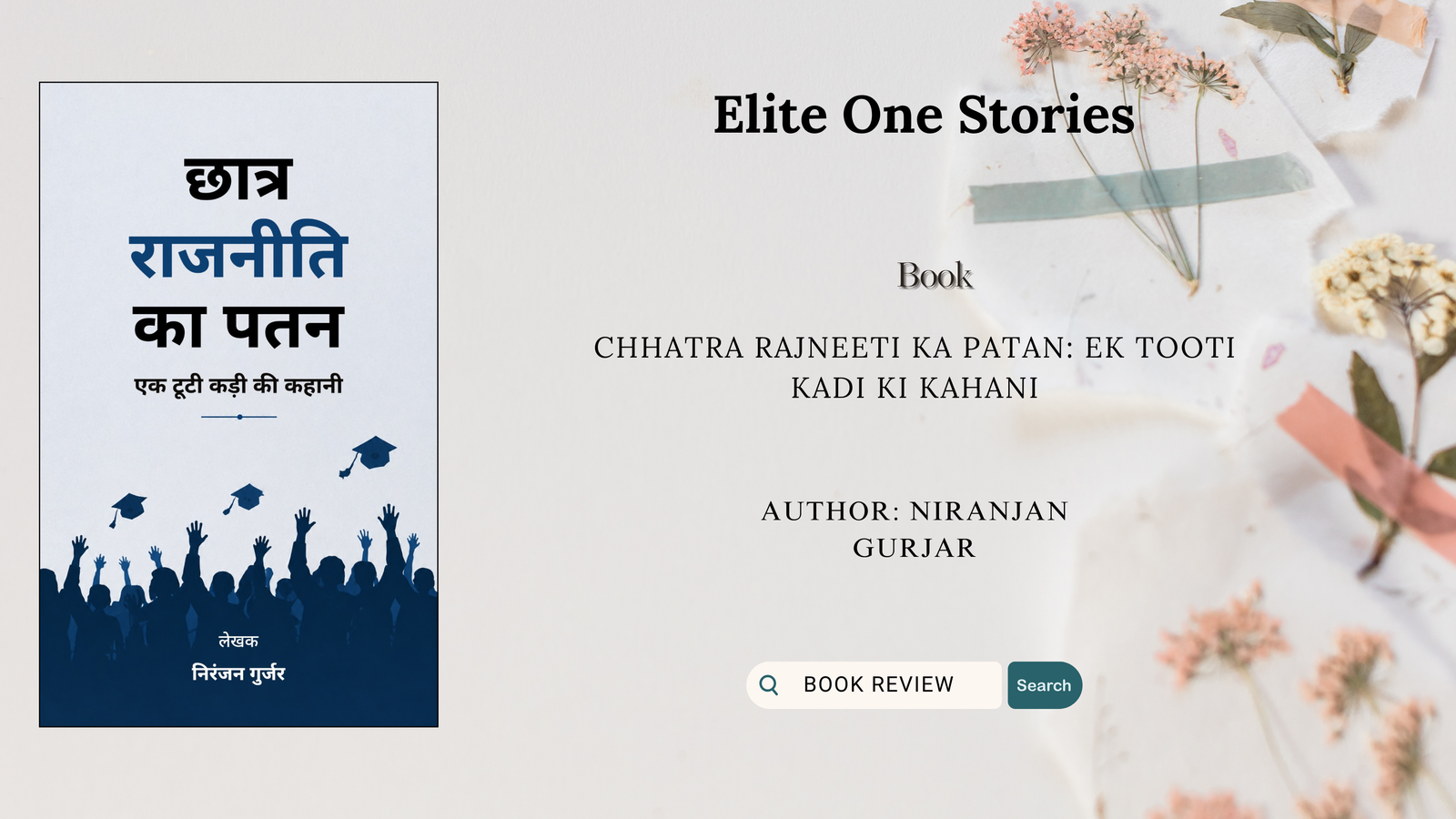
Chhatra Rajneeti Ka Patan: Ek Tooti Kadi Ki Kahani by Niranjan Gurjar is a timely and thought-provoking book that examines one of the less discussed but deeply consequential questions facing Indian democracy: what happens when young people lose meaningful opportunities to participate in politics? Focusing primarily on the prolonged suspension of student union elections in Madhya Pradesh, the book explores the resulting crisis of youth leadership and asks whether the weakening of student politics could eventually create a leadership vacuum in mainstream politics.
At the heart of the book is a simple yet powerful idea: political leadership does not emerge overnight. It is developed through participation, debate, responsibility, organization, disagreement, and direct engagement with public issues. Student politics has historically provided a training ground where young people learn these democratic practices. When such platforms disappear for years, an entire generation may lose an important opportunity to understand leadership through experience. Niranjan Gurjar’s work brings this concern into focus with urgency.
The author approaches the subject not merely as an observer but as someone personally affected by the absence of student elections. As a journalism and mass communication student at Devi Ahilya University, Indore, Gurjar had hoped to begin his own leadership journey through student politics. The suspension of elections therefore becomes more than an abstract political issue for him. It represents a missed democratic opportunity for students like himself. This personal connection gives the book an emotional dimension while also motivating its research-oriented approach.
One of the strongest features of Chhatra Rajneeti Ka Patan is the effort to understand the issue through conversations with prominent figures associated with student and youth politics. The author engages with leaders including Ravindra Singh Bhati, Manish Yadav, Jaivardhan Singh, Ashutosh Chouksey, and Vipin Wankhede. Their experiences and perspectives provide the book with valuable firsthand dimensions and help move the discussion beyond assumptions. Through these voices, readers gain a broader understanding of how student politics can shape political careers, ideologies, networks, and leadership abilities.
The book also succeeds in connecting student politics with the larger political system. It does not treat campus politics as an isolated phenomenon relevant only to universities. Instead, it argues that the health of student democracy can influence the future quality of mainstream democracy. This is an important perspective because universities are often among the first spaces where young citizens encounter organized political debate. If those spaces become inactive or inaccessible, political participation may be delayed, redirected, or diminished.
Another important aspect of the book is its attention to the consequences of prolonged suspension. The author suggests that the absence of student elections can create a leadership gap by depriving young people of opportunities to organize, campaign, debate, represent their peers, and experience electoral accountability. Whether one agrees with every conclusion or not, the questions raised are significant. What happens to political ambition when there is no democratic platform through which it can be tested? Where do young people learn the practical responsibilities of representation? And what kind of political culture develops when generations grow up without experiencing campus elections?
Gurjar’s writing is accessible and direct, making the subject understandable even to readers who may not have extensive knowledge of student politics. This is one of the book’s major strengths. Rather than turning the discussion into an excessively technical political analysis, the author focuses on the human and democratic implications of the issue. The result is a work that can appeal to students, educators, researchers, political observers, and citizens interested in the future of Indian democracy.
The book is particularly relevant because youth participation has become an increasingly important subject in discussions about political representation. Young people form a substantial part of India’s population, yet their pathways into formal political leadership are not always straightforward. By examining student politics as one potential entry point, the author encourages readers to reconsider the relationship between education and democracy.
At the same time, the book does not simply romanticize student politics. The larger significance of the discussion lies in recognizing both its possibilities and its problems. Student politics can provide democratic training, but it can also reproduce the conflicts, rivalries, and ideological divisions of mainstream politics. A meaningful restoration of student elections would therefore need to be accompanied by responsible institutional frameworks and an emphasis on constructive participation.
Ultimately, Chhatra Rajneeti Ka Patan is a call for conversation. It asks readers to look beyond the immediate question of whether student union elections should return and consider the larger question of how future political leaders are developed. Its central concern is not merely the disappearance of an electoral process but the possible weakening of a vital link between young citizens and democratic leadership.
Niranjan Gurjar has taken a personal concern and transformed it into a wider examination of youth, politics, education, and democracy. The book leaves readers with an important question: if an entire generation is denied the opportunity to participate in student democracy, who will build the leadership of tomorrow? In raising that question, Chhatra Rajneeti Ka Patan becomes more than a study of student politics. It becomes a reflection on the future of democratic participation itself.