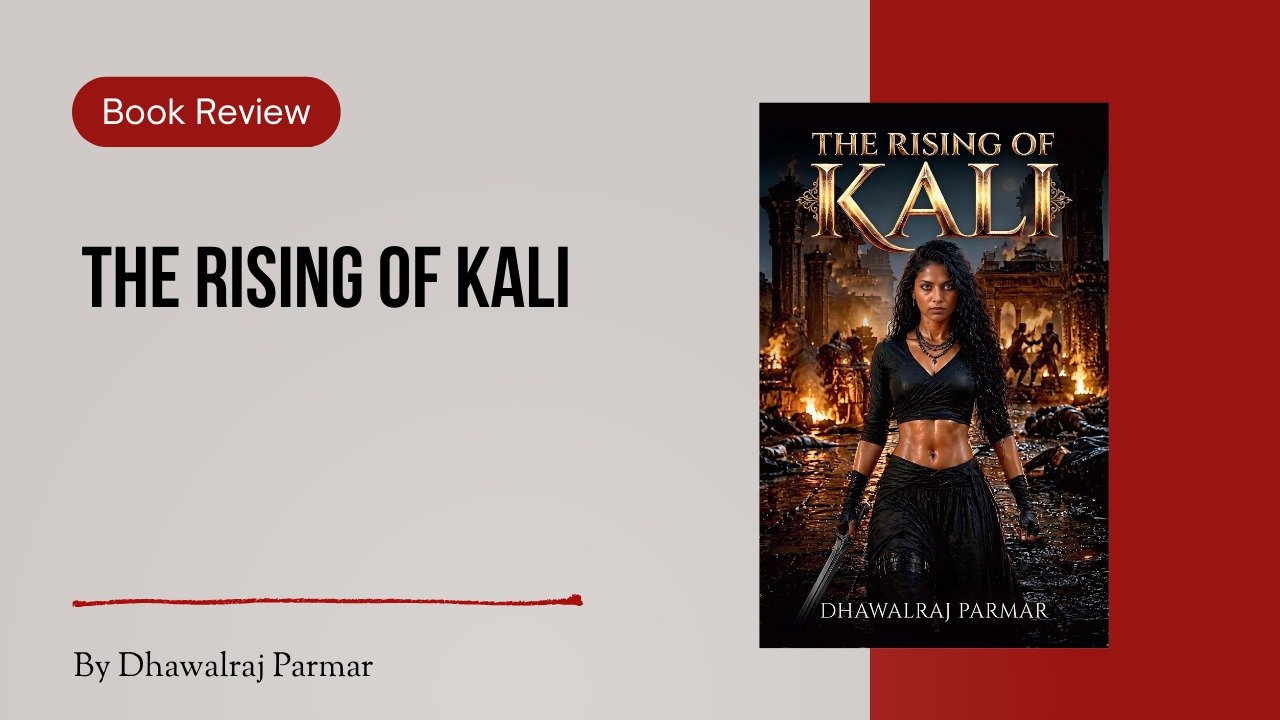
Title: The Rising of Kali
Author: Dhawalraj Parmar
Publisher: Evincepub Publishing
At first glance, The Rising of Kali by Dhawalraj Parmar appears to belong comfortably within the tradition of the action-driven mythological thriller. It contains sacred relics, prophecies, warrior traditions, criminal networks, secret institutions and spectacular confrontations. Yet its more compelling literary dimension emerges from the way these external conflicts mirror a deeply personal story of two sisters negotiating different meanings of strength, belonging and destiny.
The relationship between Saumya and Adhira is the novel’s emotional foundation. Their early interactions establish affection, rivalry and dependence simultaneously. Adhira is not merely Saumya’s elder sister; she is protector, competitor and aspirational figure. This makes her disappearance especially significant. The absence of Adhira becomes almost a character in itself, shaping Saumya’s training, her relationship with her father and ultimately her decision to enter a dangerous world beyond the Gurukul.
The Gurukul functions as more than a setting. Literarily, it represents inheritance: tradition, discipline, collective memory and an ethical system through which power is controlled. The Factory is its dark structural opposite. Where the Gurukul attempts to form warriors through restraint and responsibility, The Factory manufactures them through fear, violence and dehumanisation. This parallel gives the novel an effective spatial symbolism. Both institutions train bodies, but they cultivate radically different relationships between body, mind and power.
Saumya’s transformation into Kali grows directly from this opposition. The name invokes destruction and ferocity, but Parmar uses it primarily to dramatise a fractured identity. Kali is what Saumya needs in order to survive environments in which gentleness appears dangerous. Yet the narrative refuses to present brutality as uncomplicated empowerment. Every escalation in her capacity for violence raises the question of what that violence is doing to the person underneath.
Adhira deepens this theme because she is neither a conventional villain nor merely a lost sister awaiting rescue. Her earlier ambition, her violation of the sacred vault and her subsequent choices reveal how the desire to prove one’s worth can become self-destructive. At the same time, Saumya’s refusal to define Adhira permanently by her mistakes gives the novel an important moral dimension. Sisterhood becomes an argument for the possibility of return.
The mythological world-building is broad and imaginative. The divine sword Panchagni, the ancient Gurus, Parshurama, the Rakshini Sena, sacred vaults and legendary weapons enlarge the story beyond individual conflict. Myth here becomes a language through which questions of inheritance and responsibility are expressed. A weapon is never simply a weapon; it carries history, memory and ethical obligation.
From a craft perspective, Parmar is strongest in action and forward momentum. Battles are visually staged, dialogue moves quickly and chapters frequently conclude with unresolved danger. The approach creates a cinematic reading experience. Occasionally, however, the novel explains motives or mythology at length where dramatic revelation might have produced greater literary tension. Likewise, the extensive supporting cast sometimes competes with the central psychological journey.
The final confrontation successfully returns the sprawling narrative to its earliest philosophical premise. Saumya discovers that rage cannot defeat every form of power. She must recover the meditative stillness with which her journey began. Her refusal to deliver the final killing blow becomes therefore more meaningful than another physical victory would have been.
In literary terms, The Rising of Kali is ultimately a circular journey: Saumya travels through violence only to understand anew the wisdom with which she began. The warrior who returns is not the innocent girl who left, but neither is she merely Kali. She has learned that genuine strength lies in deciding when power must stop.
Buy on Amazon: https://www.amazon.in/Rising-Kali-Dhawalraj-Parmar/dp/9373356755