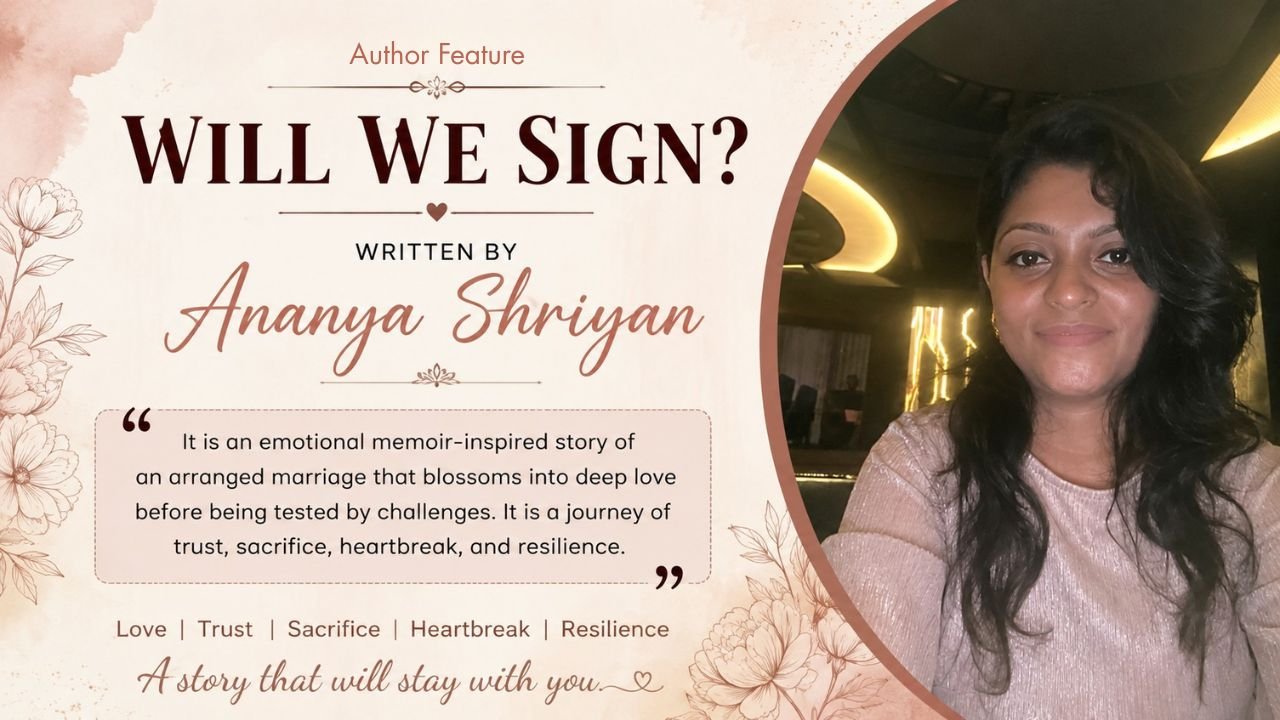
Title: Will We Sign?
Author: Ananya Shriyan
ISBN: 9789373356327
Publisher: Evincepub Publishing
There are some stories that begin with a simple meeting but stay with us because of everything that happens after that meeting. Will We Sign? by Ananya Shriyan is one such story. It begins with an arranged marriage proposal, two strangers meeting for the first time, and a quiet feeling that neither of them fully understands. What starts as a family-arranged meeting slowly turns into a relationship built through conversations, trust, hope, and emotional closeness. The story takes readers into the life of a woman who believes she has found a partner with whom she can build a happy future. Their first meeting takes place in a simple setting, but the emotions that follow are anything but ordinary. She remembers small details about him, and later discovers that he remembers details about her too. A simple message saying that he likes her becomes the beginning of something meaningful. Their conversations slowly become a part of everyday life. They talk about their families, childhood, dreams, fears, likes, dislikes, and the things that make them who they are. In a world where people often expect love to begin with grand gestures, this relationship grows through something much simpler: communication. Their bond becomes stronger because they learn to listen to one another and understand each other. Even a period of fourteen days without communication becomes an important lesson for them, showing how easily misunderstandings can grow when people stop talking. Eventually, they reconnect and understand that their distance was not caused by a lack of affection but by a lack of communication. This early part of the story makes the book relatable because many readers will recognise the emotions of waiting for a message, overthinking silence, and wondering what another person is feeling.
As the relationship moves forward, Will We Sign? becomes more than a love story. It begins to explore what happens when love meets real life. The couple gets engaged, and the engagement becomes a symbol of their hopes for the future. The ring represents trust, forgiveness, and a promise to choose conversation instead of silence. The wedding preparations bring another side of the story to life. Family members come together, responsibilities are shared, and the bride’s home becomes filled with shopping bags, jewellery boxes, wedding discussions, laughter, music, and excitement. These scenes are especially familiar to Indian readers because they capture the emotions and traditions surrounding a family wedding. The wedding itself becomes one of the most emotional parts of the book. The bride leaves behind the home where she grew up and enters a new family with hope in her heart. The rituals, the blessings of elders, the seven sacred promises, and the tying of the Mangalsutra are presented not simply as customs, but as moments filled with personal meaning. One particularly touching memory is the quiet moment when the groom whispers that he loves her while tying the Mangalsutra, remembering a promise he had made before the wedding. These small moments show how love can sometimes live in simple actions rather than big words. After the wedding, the couple begins discovering married life together. Their early days contain shy conversations, playful moments, shared meals, travel, and the excitement of building a new life. Even an ordinary morning surrounded by green fields becomes a special memory. Through these details, Ananya shows readers why the relationship was important to her and why she believed in the future they were building.
However, every relationship is tested when dreams meet difficult choices, and this is where Will We Sign? takes a much deeper turn. After the wedding, the couple begins facing questions about careers, finances, family expectations, living arrangements, and personal boundaries. What once looked like a simple journey of two people building a life together slowly becomes complicated by decisions that involve more than the couple. One of the important parts of the story is the discussion about moving from Mumbai to Mangalore. For the couple, Mangalore initially appears to be a chance to create a more peaceful life together. Mumbai brings long working hours, difficult travel, and limited time with each other, while Mangalore seems to offer the possibility of a slower and more balanced life. The author also brings an important practical reality into the story. Marriage is not only about emotions. It is also about jobs, salaries, loans, responsibilities, career plans, and financial security. For Ananya’s character, moving cities would have serious financial effects because she was already working in banking and managing financial commitments. Yet, because she trusted the person she loved and believed in the future they had imagined, she was willing to consider sacrifices that she might not otherwise have made. The situation becomes more difficult when decisions that seemed to belong to the husband and wife begin involving family approval. This raises one of the central questions of the book: when two people get married, how much freedom should they have to make decisions about their own future? The story does not present this question as a simple fight between a wife and her husband’s family. Instead, it looks at the emotional struggle of trying to balance love, family responsibilities, respect, and the need for a couple to have their own voice.
What makes Ananya Shriyan’s storytelling especially engaging is that she does not present heartbreak as something that happens suddenly. Instead, the story shows how small moments, unanswered questions, unequal expectations, misunderstandings, and silence can slowly change a relationship. Before the wedding, concerns about trust and boundaries already begin to appear. Later, after marriage, other problems become harder to ignore. The narrator finds herself questioning whether the standards expected from her are also being followed by the person who expects them. She begins to understand that trust cannot exist on different rules for two people. At the same time, the book shows that family relationships can be complicated, especially when a person feels caught between being a son and being a husband. This is one of the most relatable parts of the story because many Indian families understand the challenge of balancing marriage with responsibilities towards parents. The author does not reduce the problem to a simple question of choosing one person over another. Instead, she asks whether it is possible to respect parents while also giving a marriage enough space to grow. The emotional conflict becomes stronger as the narrator realises that she is making sacrifices for a relationship while still questioning whether her own needs, feelings, and decisions are being given the same importance. Eventually, the relationship reaches a painful point where she has to step away. The separation is not shown as a dramatic ending filled only with anger. It is described as the loss of a future she had imagined, planned, and emotionally invested in. She is not simply walking away from a husband. She is also walking away from the life she thought they would have together. That makes the heartbreak more personal and more understandable to the reader.
At the heart of Will We Sign? is a larger conversation about marriage, respect, compromise, and the expectations placed on women. The book asks questions that many people may have thought about but never said aloud. Why is a woman often expected to adjust first? Why are daughters sometimes told to compromise to protect a marriage? Why should a wife’s silence be seen as ego while a husband’s silence can be accepted as dignity? These questions are not presented simply as an attack on men or families. Instead, they challenge a mindset that can make marriage unequal. The author asks readers to look at marriage not as a relationship where one family has authority over another, but as a partnership where both people deserve respect. This becomes particularly powerful because the narrator herself has tried to adjust, understand, forgive, communicate, and find solutions. She does not walk away without trying. She hopes for conversations. She hopes for change. She hopes that love will be enough to bring two people back together. But the story also shows an important truth: sacrifice cannot be the only foundation of a relationship. A healthy marriage needs mutual respect, communication, understanding, and the willingness of both people to stand beside each other. The final part of the book becomes especially emotional when the narrator receives a legal notice asking her to return to the marriage after months of silence. Instead of a personal conversation, legal words arrive first. This moment forces her to ask whether a marriage can survive when the two people at its centre slowly lose their own voices. The book’s final questions therefore reach beyond one marriage and invite readers to think about how society defines adjustment, duty, respect, and success in married life.
Behind this emotionally powerful story is Ananya Shriyan, an author whose journey into writing was not part of her original career plan. By profession, she is a banker and holds a degree in Banking and Insurance. Writing came into her life in an unexpected way, much like many of the important turns in the story itself. Her professional background gives an interesting contrast to her work as a writer. Banking is often associated with numbers, planning, responsibility, and practical decisions, while writing allows space for emotions, memories, questions, and personal reflection. In Will We Sign?, these two sides come together naturally. The story understands the practical side of marriage, including jobs, financial responsibilities, loans, career decisions, and relocation, while also giving equal importance to love, trust, hope, pain, and self-respect. This balance makes the book easy for readers to connect with. Ananya’s writing does not depend on complicated language or distant ideas. Instead, it takes readers through familiar emotions and everyday situations. Many readers may recognise the excitement of a first meeting, the happiness of receiving a message from someone special, the nervousness of marriage, the warmth of family celebrations, the pressure of expectations, and the pain of feeling unheard. Most importantly, the journey in Will We Sign? is not only about losing a relationship. It is about finding the courage to listen to one’s own voice when a relationship no longer feels like the partnership it was meant to be. The question in the title, Will We Sign?, therefore carries more meaning than simply asking whether two people will sign papers. It asks readers to think about what they are willing to accept, what they are willing to sacrifice, and where they should draw a line when love begins to cost them their own identity. Ananya Shriyan has turned that question into an emotional journey that encourages readers to look at marriage with greater honesty and understanding. For anyone who has loved deeply, waited for someone, made sacrifices for a relationship, or struggled to choose between holding on and letting go, Will We Sign? offers a story that may feel surprisingly close to home.