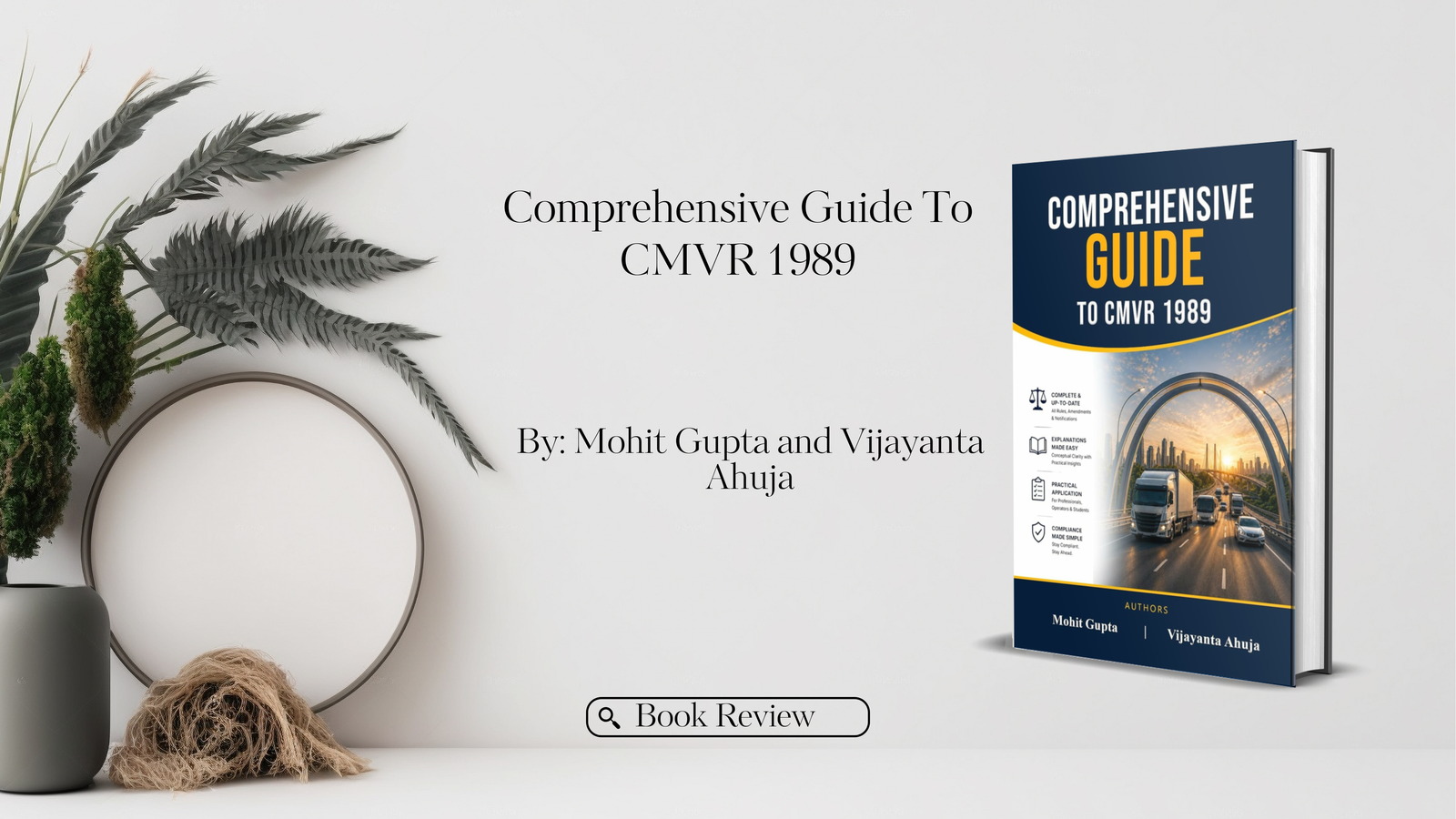
India’s automotive industry is evolving at an unprecedented pace. Advancements in vehicle technology, the rapid adoption of electric mobility, increasing emphasis on road safety, and continuous regulatory reforms have made compliance more complex than ever before. In this dynamic environment, Comprehensive Guide to CMVR 1989 by Mohit Gupta and Vijayanta Ahuja emerges as an authoritative and practical resource that simplifies one of India’s most significant legal frameworks governing motor vehicles.
Rather than functioning as a conventional legal publication that merely reproduces statutory provisions, this book serves as an interpretative guide designed to help readers understand the practical application of the Central Motor Vehicles Rules, 1989. It transforms legal language into structured, reader-friendly explanations while preserving the precision required by professionals working in the automotive and transport sectors.
One of the strongest aspects of the book is its logical organization. The vast body of regulations has been systematically divided into thematic chapters, allowing readers to navigate the legislation with ease. Whether someone wishes to understand licensing procedures, vehicle registration, transport regulations, technical standards, or road safety requirements, each subject is presented in a coherent and well-structured manner. This approach makes the guide significantly more accessible than relying solely on the official bare act.
The sections dealing with licensing and vehicle registration are particularly informative. The authors explain the legal requirements governing different categories of driving licences, registration procedures, documentation, and compliance obligations with remarkable clarity. These chapters are especially useful for transport professionals, vehicle owners, legal practitioners, and students who seek a practical understanding of regulatory procedures rather than simply reading legislative provisions.
Another highlight of the book is its detailed explanation of technical vehicle standards. Modern vehicles must comply with numerous safety and construction requirements covering lighting systems, safety glass, maintenance protocols, reflective tapes, equipment standards, and emission norms. These technical provisions are often difficult for non-specialists to interpret, yet the authors present them in a manner that remains both technically accurate and easy to understand. Their ability to bridge engineering concepts with legal compliance is one of the book’s greatest strengths.
The guide also provides extensive coverage of transport vehicle operations. Commercial transport is governed by an intricate framework involving permits, operational rules, vehicle classifications, and regulatory responsibilities. The authors carefully explain these provisions while offering practical context that enables readers to understand how the regulations function in real-world situations. This practical orientation makes the guide highly valuable for fleet operators, logistics professionals, transport authorities, and compliance officers.
Road safety remains a central theme throughout the book. Instead of treating regulations as isolated legal provisions, the authors consistently demonstrate how these rules contribute to safer roads, better vehicle standards, and improved public welfare. Discussions on modern safety mandates, emission regulations, vehicle scrappage policies, and accident-related provisions highlight the broader objective of the Central Motor Vehicles Rules in protecting both citizens and the environment.
An outstanding feature of this edition is its incorporation of recent statutory amendments, Government notifications, and relevant judicial developments. Transport legislation continues to evolve alongside technological innovation, making updated references essential for professionals. The inclusion of current regulatory changes ensures that readers receive reliable and contemporary guidance instead of relying on outdated interpretations.
The practical commentaries accompanying many provisions further enhance the book’s usefulness. Rather than overwhelming readers with dense legal language, the authors include concise explanations that clarify legislative intent and simplify procedural understanding. These insights allow readers to appreciate not only what the law requires but also why those requirements exist.
The credibility of the guide is strengthened considerably by the expertise of its authors. Mohit Gupta, with over twenty-five years of experience in automotive regulatory affairs, vehicle certification, and compliance under the Central Motor Vehicles Rules, brings exceptional technical and legal knowledge to the subject. His multidisciplinary academic background in engineering, management, and law is reflected throughout the book’s balanced and practical approach.
Vijayanta Ahuja contributes equally valuable expertise through her distinguished career in automotive policy and regulatory governance. Her experience in shaping regulatory frameworks, promoting sustainable mobility, and aligning Indian standards with international practices provides readers with a broader understanding of the evolving transport ecosystem. Together, both authors successfully combine legal interpretation, technical expertise, policy insight, and practical implementation into a single comprehensive resource.
The book is particularly beneficial for a diverse audience. Law students, automotive engineering students, transport administrators, insurance professionals, compliance officers, automobile manufacturers, certification agencies, and legal practitioners will all find valuable insights within its pages. The language remains professional while avoiding unnecessary complexity, allowing readers from various backgrounds to benefit from the content.
Perhaps the greatest achievement of Comprehensive Guide to CMVR 1989 lies in its ability to make a highly technical subject approachable without sacrificing accuracy. The authors have produced a guide that is educational, practical, and thoroughly relevant to today’s rapidly changing automotive landscape.
As India moves toward a future shaped by electric vehicles, intelligent transportation systems, stricter environmental regulations, and digital governance, knowledge of transport law will become increasingly indispensable. This book prepares readers not only to understand the existing regulatory framework but also to navigate future developments with greater confidence.
Overall, Comprehensive Guide to CMVR 1989 is far more than a legal reference. It is a comprehensive professional handbook that successfully connects legislation with practical implementation. Thoroughly researched, thoughtfully organized, and exceptionally well-written, it stands as an indispensable resource for anyone seeking a deeper understanding of India’s automotive regulatory system. Whether used for academic learning, professional compliance, or legal reference, this guide represents an outstanding contribution to automotive and transport literature.