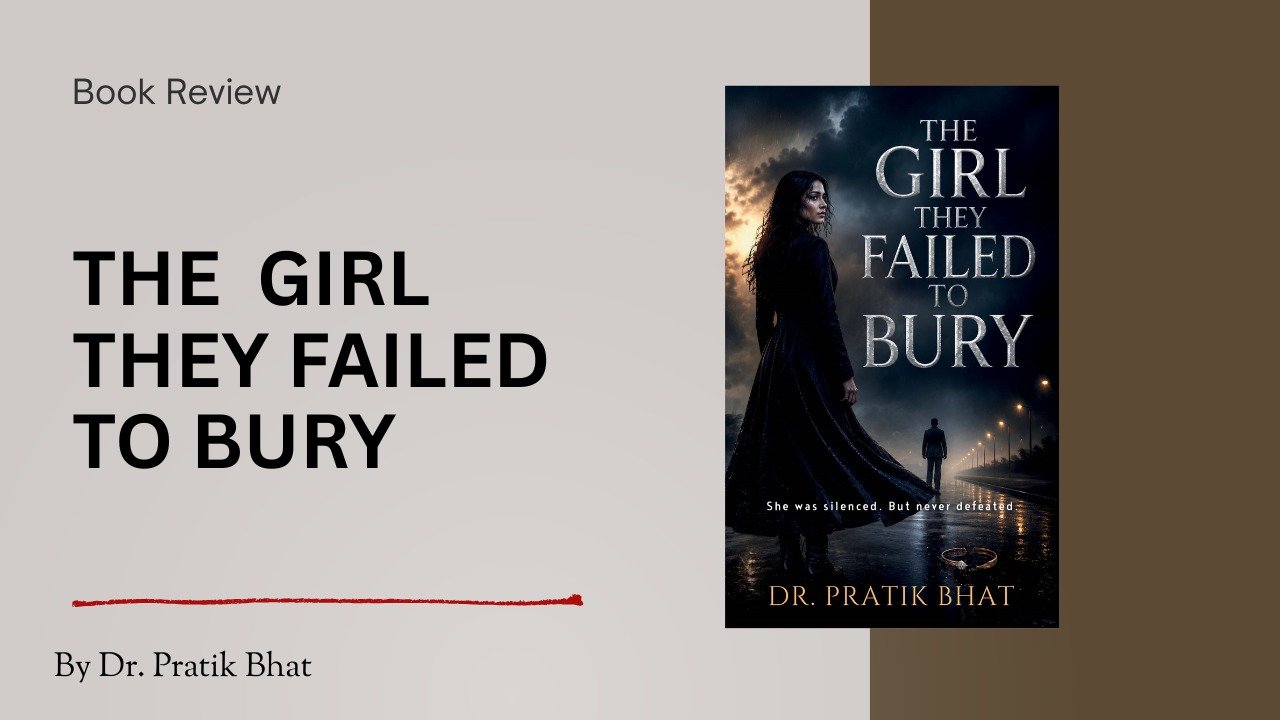
Title: The Girl They Failed To Bury
Author name: Dr. Pratik Bhat
Publisher:: Evincepub Publishing
When Love Hurts More Than It Heals
Not every love story is written to make readers smile. Some are meant to make us pause, reflect, and question our understanding of relationships. The Girl They Failed to Bury by Dr. Pratik Bhat is one such novel. Rather than celebrating romance through grand declarations and perfect endings, the book chooses a far more realistic path. It explores what happens when love slowly loses its honesty, when trust is repeatedly tested, and when one person’s unconditional devotion becomes another person’s opportunity to manipulate.
This is not simply a story about heartbreak. It is a thoughtful exploration of emotional dependence, betrayal, forgiveness, and the difficult process of reclaiming one’s identity after everything familiar begins to fall apart.
At the centre of the novel is Siya, a character whose simplicity immediately wins the reader’s sympathy. She is not portrayed as someone extraordinary. Instead, she represents countless individuals who believe that patience, loyalty, and understanding can overcome every obstacle in a relationship. Her dreams are modest – a peaceful marriage, emotional security, and a partner who remains constant through life’s uncertainties.
Raghav enters her life as someone who appears capable of offering exactly that. He is attentive, caring, and emotionally expressive in the beginning. Their relationship grows naturally, making readers invest in their future together. However, what makes the novel particularly engaging is that the collapse of this relationship is never abrupt. Dr. Pratik Bhat carefully builds the emotional tension through subtle changes – missed calls, emotional distance, defensive conversations, hidden truths, and broken promises. These seemingly ordinary moments gradually accumulate into something devastating.
The author deserves appreciation for resisting the temptation to sensationalise the story. Instead of relying on dramatic confrontations alone, he focuses on emotional realism. Readers witness how trust erodes little by little, often without either person openly acknowledging what is happening. This measured storytelling makes the emotional impact considerably stronger.
One of the novel’s strongest achievements is its understanding of human psychology. Siya’s repeated forgiveness may frustrate some readers initially. Many may wonder why she continues to trust someone who repeatedly hurts her. Yet this frustration reflects the uncomfortable reality faced by many people trapped in emotionally manipulative relationships. Love often convinces people to ignore warning signs that seem obvious only from the outside. The novel captures this painful contradiction with remarkable honesty.
Equally interesting is the portrayal of Raghav. He is neither presented as a one-dimensional villain nor unnecessarily glorified. His childhood experiences, insecurities, and emotional conflicts help readers understand the origins of his behaviour without justifying the choices he ultimately makes. This complexity prevents the story from becoming a simple battle between good and evil. Instead, it becomes a study of flawed human beings making decisions that permanently alter multiple lives.
Another noteworthy aspect is the novel’s narrative style. The language remains simple, conversational, and emotionally accessible throughout. Rather than relying on poetic prose or overly descriptive passages, the author allows conversations and internal reflections to carry the emotional weight. This straightforward approach makes the story easy to read while preserving its emotional intensity.
The book also handles difficult subjects with sensitivity. Emotional manipulation, infidelity, psychological abuse, self-doubt, anxiety, and trauma are presented not as isolated events but as experiences that slowly reshape an individual’s sense of self. Readers observe how repeated emotional wounds influence confidence, decision-making, and even physical well-being. These themes give the novel significance beyond its romantic storyline.
One particularly admirable quality is the way the novel treats healing. Many relationship novels end once betrayal is revealed or justice is served. Here, healing itself becomes the central journey. Recovery is portrayed as slow, uncertain, and deeply personal. The story reminds readers that rebuilding trust – whether in others or oneself – is often the most difficult part of surviving emotional pain.
The structure of the novel further enhances its readability. Short chapters maintain momentum while allowing emotional moments to breathe naturally. Each chapter contributes meaningfully to the larger narrative, encouraging readers to continue discovering how the characters evolve through suffering and self-reflection.
Beyond its emotional appeal, the novel also raises important questions about modern relationships. How much compromise is healthy? When does forgiveness become self-sacrifice? Can love survive without respect? At what point should someone choose self-worth over emotional attachment? Rather than providing easy answers, the novel encourages readers to reflect on these questions long after finishing the book.
If there is one area where some readers may have mixed opinions, it is the emotional intensity sustained throughout the narrative. The novel demands emotional investment and occasionally lingers on painful moments for extended periods. However, this also contributes to its authenticity. Trauma rarely follows a convenient timeline, and the story remains faithful to that reality.
Ultimately, The Girl They Failed to Bury succeeds because it refuses to romanticise unhealthy relationships. Instead, it offers a compassionate and honest portrayal of emotional resilience. It reminds readers that genuine love is built on trust, mutual respect, and emotional responsibility – not merely on promises or shared history.
Dr. Pratik Bhat has written a novel that is both emotionally engaging and socially relevant. Readers who enjoy relationship-driven fiction with psychological depth will find themselves deeply connected to this story. More importantly, they may also recognise parts of themselves – or people they know – within its pages.
This is a novel that entertains, but more importantly, it encourages reflection. And those are often the stories that remain with us the longest.
Rating: ★★★★★ (4.9/5)
Recommended For: Readers of contemporary fiction, emotional relationship dramas, women’s fiction, and novels exploring love, betrayal, resilience, and personal growth.
Buy on Amazon: https://www.amazon.in/Girl-They-Failed-Bury/dp/9373354698/