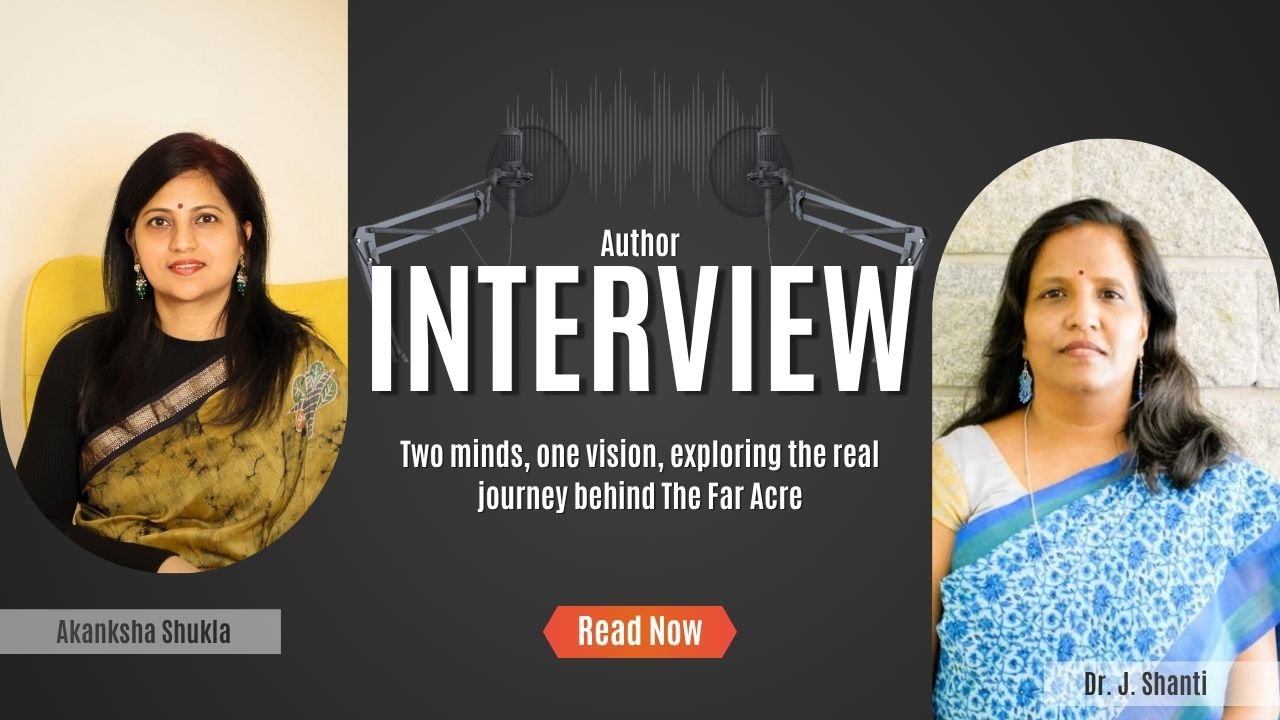
Title: The Far Acre
Author: Akanksha Shukla, Dr. J. Shanti
ISBN: 9789373350646
Publisher: Evincepub Publishing
About the Book
The Far Acre is a thoughtful and deeply human exploration of entrepreneurship that goes beyond success stories to focus on the courage it takes to begin. Through real and honest narratives of founders from diverse fields like agriculture, technology, rural development, and social innovation, the book captures what truly happens behind the scenes of building something meaningful. It highlights moments of doubt, failure, redirection, and quiet determination that often remain unseen but define the journey.
At its core, the book introduces the idea of the “far acre” as a space beyond comfort and certainty – a place where individuals step forward without a clear map, guided only by belief and intent. Rather than presenting fixed formulas or quick success strategies, it encourages readers to reflect on their own paths, choices, and definitions of courage. With its simple and immersive storytelling style, The Far Acre becomes not just a collection of entrepreneurial journeys, but a mirror for anyone who is standing at the edge of a new beginning and wondering whether to take that first step.
About the Authors
Akanksha Shukla is a social entrepreneur, storyteller, and the Founder and Director of Meraas Heritage Foundation, where she works to preserve Indian heritage crafts and empower grassroots artisans. She currently serves as the Vice President of the MANAGE Alumni Association and has built a diverse career across marketing, consulting, and social impact in India, Southeast Asia, and the Middle East. Her work has contributed to women’s empowerment and livelihood initiatives, earning global recognition including the UNV Volunteering Award and the World Bank Development Marketplace Challenge. With a strong inclination toward storytelling and community building, The Far Acre marks her first formal literary work, reflecting her passion for human journeys and meaningful change.
Dr. J. Shanti is an Associate Professor of Management at Alliance University, Bengaluru, with nearly two decades of experience in entrepreneurship, sustainability, and enterprise development. Holding a Ph.D. in Management, she brings a strong blend of academic knowledge and industry experience from her time with organizations like Xerox and Marico. As an educator and mentor, she believes in learning through real-life entrepreneurial journeys rather than just theory. Through The Far Acre, she extends her work beyond the classroom, presenting authentic founder stories that highlight resilience, growth, and purpose, making entrepreneurship more relatable and accessible for aspiring individuals.
Neel Preet: Akanksha Shukla, what inspired you to write The Far Acre and bring these stories together?
Akanksha Shukla: Over the past two years, while serving as Vice President of the MANAGE Alumni Association (MAA), I’ve had the opportunity to closely witness the strength and diversity of our alumni community. At MAA, our vision goes beyond connection; we aim to strengthen the institute’s legacy and create a sense of shared pride.
MANAGE Alumni Association represents graduates from the National Institute of Agricultural Extension Management (MANAGE), an institution that has been a pioneer in agribusiness education. What stood out to me was that many alumni are not only leading large organizations but are also building ventures from the ground up: often quietly, without their stories being fully known.
The idea for The Far Acre actually began as a casual conversation with my colleagues at MAA and my co-author, Dr. Shanti. We felt there was a gap; these journeys of resilience, risk-taking, and building from scratch deserved to be documented.
This book is our attempt to capture those stories, not just to inspire MANAGE alumni, but to reach anyone who is trying to carve their own path and needs to see that it’s possible to start small and still build something meaningful.
Neel Preet: Dr. Shanti, how did your experience in teaching and research shape this book?
Dr. Shanti: My time within the academic system has always been based on the principle that the act of education is truly meaningful when it connects to real-life experience. During my 18 years of teaching entrepreneurship, strategy, and sustainability, I have frequently observed that many students could understand the prescribed frameworks; however, they had difficulty internalising the reality of how it feels to create something from scratch. This realisation provided the impetus to write this book.
To demonstrate through narrative how to bring the classroom closer to the field, moving from discussing case studies and presentations as concepts to discussing their use through experiences of endurance. My research background has provided me with a framework through which to explore each story, providing them with a structured, rigorous, and in-depth approach; thereby, ensuring that they are more than inspirational, but also intellectually and analytically valuable.
Additionally, since I have been fortunate to act as a mentor, the way these stories were created has also been influenced by those experiences. I continuously asked myself, ‘What would a student or potential business owner find of value in this moment?’ or ‘What decision point is significant?’
Neel Preet: Akanksha, the title The Far Acre is very unique. What does it mean to you personally?
Akanksha Shukla: When we were thinking about naming the book, I found myself reflecting on my own learning through the process of writing these stories.
As an entrepreneur myself, I know that the hardest part is often taking that first step into uncertainty, without fully knowing what lies ahead. Before diving deep into these journeys, I used to place a lot of importance on having everything figured out in advance. But as I engaged in conversations with these individuals, I realized something important: we often underestimate the power of simply beginning.
These entrepreneurs didn’t wait for certainty. They moved forward, experimented, failed, adapted, and somewhere along the way, clarity started to take shape.
The Far Acre is a metaphor for that journey, the quiet distance between who we are and who we are meant to become. It represents the distant goal we all strive toward, and the courage it takes to walk toward it, step by step, before the path becomes clear.
Neel Preet: Dr. Shanti, how do you explain the idea of “far acre” to young readers?
Dr. Shanti: I would explain, “The Far Acre” is the time in one’s life when you leave your comfort zone, or the realm of the common and conventional, and enter into new territory where you are uncertain what exactly lies in store for you, but feel compelled enough by a particular impetus to step forward anyway. While it is something we cannot find on a map, it is a transitional state when our current situation feels insufficient, and the next step we want to take remains elusive.
For example, many young adults may find themselves now faced with major career decisions, whether they will create entrepreneurial ventures or simply dare to do things differently from the norm. The Far Acre represents the point in time when we begin to grow as individuals through the act of trusting oneself enough to take a leap of faith and move forward into uncharted waters. And, perhaps most importantly, there is nothing to fear about this process. The Far Acre is where we will start to form who we are truly meant to be.
Neel Preet: Akanksha Shukla, how did you select the entrepreneurs featured in the book?
Akanksha Shukla: The aim of this book was never to focus only on success, so the scale of operations was not a criterion for selection. Instead, we wanted to bring together stories of entrepreneurs at different stages of their journeys; some who have just started, some who have scaled their ventures, and others who have built and exited businesses.
Sector-wise as well, while all of them began their careers in agribusiness, their paths evolved in diverse directions- spanning agriculture, rural livelihoods, manufacturing, services, healthcare, and more.
What truly connected them was not what they built, but how they built it. Whether they created companies, movements, or quiet revolutions, there is a common thread across every story: a defining moment of decision-when they stepped into the unknown, embraced uncertainty, and chose possibility over comfort.
The selection criteria were primarily based on the human experiences of these individuals and the richness of their stories. These narratives do not portray them as extraordinary individuals, but as ordinary people who shaped their destinies through grit, conviction, and sheer belief.
Neel Preet: Dr. Shanti, what common quality did you observe in all these founders?
Dr. Shanti: Rather than lacking in fear, each of the entrepreneurs was characterised by their ability to persist despite challenges. In addition to their perseverance, these entrepreneurs also demonstrated the willingness to make necessary strategic pivots in response to circumstances and to continue working through times of uncertainty, lack of proof of progress, or other potential despondent conditions.
The most interesting thing about these entrepreneurs was not that they had the same level of intelligence or background, had access to the same resources, or had the same opportunities. Instead, the biggest similarity all the entrepreneurs demonstrated was their conviction. Each of these entrepreneurs faced their own moment of truth at which they had the choice of continuing with what they already knew or venturing into the unknown without any guarantee of success, and they chose to pursue the unknown.
The source of their unity is their collective ability to operate in a state of ambiguity. They didn’t start with perfect clarity about the future, nor did they follow a fixed path or pre-determined map. There was no one blueprint to follow. They had to adapt as they went, learn from their experiences, and grow through every obstacle they faced.
Essentially, these were ordinary people who made one extraordinary decision – to take that first step even when they couldn’t see what lay ahead. And it was this decision – to act in the face of uncertainty; to move forward without full confidence that defines an entrepreneur.
Neel Preet: Akanksha Shukla, many stories in the book feel very real and emotional. How did you capture that honesty?
Akanksha Shukla: We all come from the same community, sharing the same alma mater, MANAGE. Many of these founders were people we had known from campus or met frequently during reunions and alumni interactions, which naturally created a sense of trust and openness.
We didn’t rely on rigid, formal interviews. Instead, we approached these as conversations- casual in setting, but deep, reflective, and personal in nature. Our only instruction to the founders was simple: go beyond facts. We encouraged them to share their personal journeys, reflections, and defining moments. We asked them to focus more on reflection than narration, to think about legacy, and to balance stories of success with the struggles behind them.
The questions were dynamic and went beyond just their ventures: they explored their early years, their time at MANAGE, pivotal moments, setbacks, and turning points.
Our intention was not to create a linear narrative, but to craft engaging, human stories of these changemakers-stories that feel authentic, relatable, and ultimately meaningful for the reader.
Neel Preet: Dr. Shanti, how important is storytelling in teaching entrepreneurship?
Dr. Shanti: Storytelling serves as a bridge between the notion of knowing and being for many aspiring entrepreneurs or those just looking to embark upon something new. Storytelling, therefore, becomes crucial since Entrepreneurship is not a straightforward and sequential discipline. It involves a multitude of factors, including ambiguity, emotional expression, failure, and the ability to make decisions based on uncertainty; therefore, these aspects cannot be adequately captured using business models or frameworks.
Through storytelling, we can further humanize entrepreneurship. They help to provide context – the setting, the limitations, and the emotional state of founders behind decisions made. The Far Acre book is intended for readers of whom, when they engage in the stories contained within, they will see commonalities while also recognising that each founder has a specific and individualised journey.
Therefore, The Far Acre book was purposely developed in a narrative non-fiction format. The conversations and experiences are positioned such that the true essence of those experiences can be maintained, which allows readers to connect with the stories on a deeper emotional level and gain a greater sense of importance through their connection to the story.
Neel Preet: Akanksha Shukla, which story do you feel gives the strongest lesson to readers?
Akanksha Shukla: Each story in the book carries a unique message, and readers may connect with different journeys in their own way. However, if I had to choose one that offers a particularly powerful lesson on entrepreneurship, it would be Rajeev’s story.
Rajeev Saraswat, the founder of Solvera Consulting, challenges the conventional narrative around entrepreneurship. He doesn’t define it through risk-taking alone, disruptive ideas, rapid fundraising, equity dilution, or headline-making valuations. While these elements may appear in some journeys, they represent only a small part of the larger picture.
At its core, entrepreneurship is about ownership.
It is about creating something from nothing, thinking independently, staying persistent when momentum fades, and remaining resilient when outcomes don’t go as planned.
What stands out most is that this mindset is not limited to building a venture. One can embody entrepreneurship within a full-time role, as a freelancer, or while starting something from scratch. The form may differ but the mindset remains the same.
Neel Preet: Dr. Shanti, was there any one story in the book that deeply touched you?
Dr. Shanti: Each story within the collection encapsulates unique levels of emotional impact; however, it was the understated, those internal transformations that take place prior to any external transformation that have continued to resonate for me post-reading.
The story of Anand Chandra’s transformational experience: at one moment he realizes that farmers are not deficient in grain (as has been historically believed), but instead are deficient in time; this one insight does not only provide a short-term solution to a current predicament (i.e., creating more time) for millions of farmers worldwide, it actually recasts an entire delivery system into a new, more sustainable and equitable model based on abundance.
Similarly, the story of Sudha Rani Mullapudi deeply moved me differently. Her journey is not just about building an enterprise, but about building with purpose. What stood out was her decision to create something that preserved dignity, especially for rural women artisans. She chose to look beyond profit and focus on impact, ensuring that growth did not come at the cost of people’s identity and self-worth.
What touched me in both these stories was not just the outcomes, but how these realizations emerged from observation, empathy, and enduring experiences. These are not loud, dramatic breakthroughs. They are quiet, reflective moments that slowly shape the direction of an entire journey. Across the book, such moments appear repeatedly where individuals pause, reflect, and choose differently. And it is these moments of choice that stayed with me the most.
Neel Preet: Akanksha Shukla, your background is in social work and culture. How did that influence your writing?
Akanksha Shukla: My work in the development sector has always been rooted in understanding people before processes. Early in my journey, during my time with the Childbirth and Breastfeeding Foundation of Thailand, I worked on fundraising and evaluating NGOs. That role required engaging in deep, meaningful conversations to truly understand the intent, challenges, and stories behind each organization.
Later, while working with United Nations Volunteers (UNV) in Cameroon, I was involved in developing a women’s livelihood program in the Boyo region. That experience demanded an even deeper level of immersion-understanding the lived realities, struggles, and aspirations of rural women. Across all my roles, one principle remained constant: I always approached problems through a human lens before a business lens.
This perspective shaped my writing profoundly. Whether I was drafting or evaluating fundraising proposals, I learned that data informs, but it is emotion and authenticity that truly connect. The same approach is carried into this book. I focused on capturing the human experiences behind each journey, so that readers don’t just understand the stories, they feel them.
Neel Preet: Dr. Shanti, how did your corporate experience help you understand these journeys better?
Dr. Shanti: My four years of corporate procurement sales and customer relationship management (CRM) experience in both the Indian and global markets have allowed me to gain insight into how systems, decisions, and structures interact and where gaps exist within the respective environments. Through the interactions I had with the founders, I was able to see their backgrounds as they relate to my own experiences (corporately, operationally, or from a strategic perspective). Additionally, there were several trade-offs, constraints, and risks they experienced while attempting to find success in their enterprises.
This makes me capable of interpreting their experiences at a depth greater than what an observer would see because I can view their experiences both structurally and emotionally; therefore, understanding why certain aspects of the founder’s experience were effective, while others were not. I have also gained insight into connecting these experiences to broader systems, including markets, institutions, and ecosystems, which ultimately are essential to entrepreneurship.
Neel Preet: Akanksha Shukla, what challenges did you face while writing your first book?
Akanksha Shukla: One of the biggest challenges I faced was finding the right balance between saying too much and saying too little.
When you’re deeply immersed in conversations, research, and observation, you end up with a wealth of material. The real challenge is not gathering stories but shaping them. There were moments when the abundance of insights made it difficult to weave everything together seamlessly. At times, repetition crept in, and the narrative risked becoming heavier than it needed to be.
As a writer, especially in your first book, you tend to become emotionally invested in every detail. You want to preserve everything because each piece feels meaningful. But writing is as much about restraint as it is about expression.
I had to constantly step back and look at the story from the reader’s perspective, asking myself: Is this adding value, or just adding volume?
Learning to strike that balance between depth and clarity is still a work in progress, and it’s something I’m consciously carrying forward as I grow as a writer.
Neel Preet: Dr. Shanti, what was the most difficult part of shaping these real-life stories into a book?
Dr. Shanti: The biggest challenge was maintaining authenticity while doing so in a coherent manner. Journeys don’t happen linearly; they are full of detours, complexities, and changing choices. Writing that down into an organized storyline, but not simplifying the way I expressed it, was a very thought-provoking experience.
As authors, we had to determine what to include, the emphasis we placed upon each element, and the way we expressed events in a way that was enjoyable and truthful.
As stated in the book, some conversations or quotes were adapted in many ways to maintain the flow of the story, but the spirit and essence of each of the founders’ experiences were always kept intact. Perhaps the most difficult and demanding part of this process was the balance between storytelling through an authentic lens.
Neel Preet: Akanksha Shukla, what message do you want young dreamers to take from this book?
Akanksha Shukla:
“Clarity is built, not found.”
Clarity doesn’t arrive before action; it emerges through it. Again and again, we see founders step into situations without complete answers. They did not wait for certainty to present itself. Instead, they moved, engaged, tested, failed, adapted and in that process, understanding began to take shape.
What looks, from the outside, like a well-defined path is often the result of continuous refinement.
It was not clarity that guided action.
It was action that created clarity.
Neel Preet: Dr. Shanti, what advice would you give to students who want to start their own venture?
Dr. Shanti: My simple but powerful advice is to stop waiting for certainty, the biggest fallacy that holds so many people back from being entrepreneurs. You won’t write the perfect business plan on paper, you’ll be inspired to start your business because you have curiosity about how things work, you are paying attention to the environment around you, and you finally act and take the first step toward building your business.
Most people would probably say they did not have a viable business plan before they began their entrepreneurial journey. They simply had a few ideas, and those ideas created something out of pure curiosity and observation that they wanted to implement or pursue.
The best way for you to be a successful entrepreneur is to identify what the true challenges are in the environments you want to create change within. Spend more time observing, listening, and interacting to learn about the challenges and limitations of the current environments you want to work within. Then start slowly by building your network and refining your skills by testing, using patience as you build on each success. You also need to accept that no two people’s entrepreneurial journey will be the same, so be flexible, be persistent, and keep focused on your long-term purpose as you develop and grow your business.
Most critically, you must be prepared to venture off into your own ‘Far Acre’ that is, where significant journeys begin. Engage where you find real-world issues you wish to tackle. Go out on distant supply chains by shadowing farmers in rural areas if you find agritech intriguing, engage with artisans who have a lack of market presence, or evaluate inefficiency in the local food system. Listen intently about their difficulties without any preconceived ideas of solutions; therein lies where true opportunity exists.
Grow incrementally, keeping in mind patience should be your constant companion. Test small projects, have early users provide input and can pivot. There is no one-size-fits-all template. You will find in our book there were differences between Villgro creating an ecosystem, Arya.ag creating warehousing models, or Scimplify creating precision in specialty chemicals; each were successful because of adaptability, unrelenting perseverance, and an impact-driven purpose rather than a wins-first mentality.
Finally, begin your own journey into your ‘Far Acre’ where doubt will be at its greatest, but at the same time, where possibility will thrive. This is where individuals tend to transition to extraordinary founders, creating their legacy until they can experience success. You can begin today on the journey that you envision.
Neel Preet: Akanksha Shukla, how do you define courage in the context of this book?
Akanksha Shukla: In the context of this book, courage is not about the absence of fear, it is about moving forward despite it.
The stories in The Far Acre don’t portray courage as grand, dramatic acts. Instead, it shows up in quieter, more consistent ways-choosing to begin without certainty, making decisions when the outcome is unclear, and staying committed even when things don’t go as planned.
Courage, for these individuals, was not a one-time act. It was a series of small, deliberate choices- stepping into the unknown, taking responsibility, and continuing despite doubt, setbacks, or slow progress.
What stands out is that courage is deeply personal. It doesn’t always look bold from the outside. Sometimes, it’s simply the decision to try again, to hold on to belief, or to take one more step when it feels difficult.
In that sense, courage is not about having all the answers-it’s about having the willingness to move forward without them.
Neel Preet: Dr. Shanti, do you think entrepreneurship is more about skills or mindset?
Dr. Shanti: Entrepreneurship starts with an individual’s mindset, and the individual sustains their entrepreneurship through skills. Skills are acquired through education, experience, and practice, whereas one’s mindset is an individual’s most significant motivation for acting or starting a new venture.
The founding entrepreneurs featured throughout this book did not begin their entrepreneurial journeys with ultimate knowledge and resources but rather possessed a mindset that enabled them to endure uncertainty and risk. While pursuing their goals, founders learnt to face the challenges along the way.
As this book states, ultimately, entrepreneurship is about making a choice between comfort and possibility. When you cultivate an entrepreneurial mindset, every skill you acquire transforms into a powerful asset for crafting, nurturing, and scaling your business vision.
Neel Preet: Akanksha Shukla, after writing this book, has your own thinking about success changed?
Akanksha Shukla: Yes, writing this book has definitely reshaped how I look at success.
For many of the individuals in this book, success was not just about what they built, but about who they became in the process. It was about staying true to their intent, showing up consistently, and having the resilience to continue even when results were uncertain.
I realized that success is not always linear or loud. Sometimes, it’s quiet progress, difficult choices, or the courage to start again after a setback.
So yes, my definition has shifted, from viewing success as an outcome to understanding it as a continuous journey of growth, ownership, and self-alignment.
Neel Preet: Dr. Shanti, what kind of future projects or books can readers expect from you next?
Dr. Shanti: Going forward, I would like to continue building work that sits at the intersection of entrepreneurship, strategy, and real-world impact. The Far Acre was just the beginning of a larger effort to document journeys that carry deep learning value. One direction I am keen on exploring is a series of sector-focused entrepreneurial stories on social enterprises, rural innovation, and emerging digital ecosystems. Each of these spaces has powerful, underrepresented narratives that can inspire and guide future founders.
I am also interested in creating learning-oriented books and case-based compilations where entrepreneurial journeys are viewed from the aspects of decision points, dilemmas, and strategic insights, making entrepreneurship more accessible and actionable for young learners and readers.
Another area close to my heart is women entrepreneurship and inclusive enterprise building, capturing stories that highlight dignity, identity, and long-term impact, much like what we see in some journeys in this book. Beyond books, I see myself working on workshops and curated storytelling formats where academia and real-world entrepreneurship come together more meaningfully. At its core, my future work will continue to focus on one idea: not just telling stories of success but understanding and sharing the journeys of entrepreneurs that shape it.