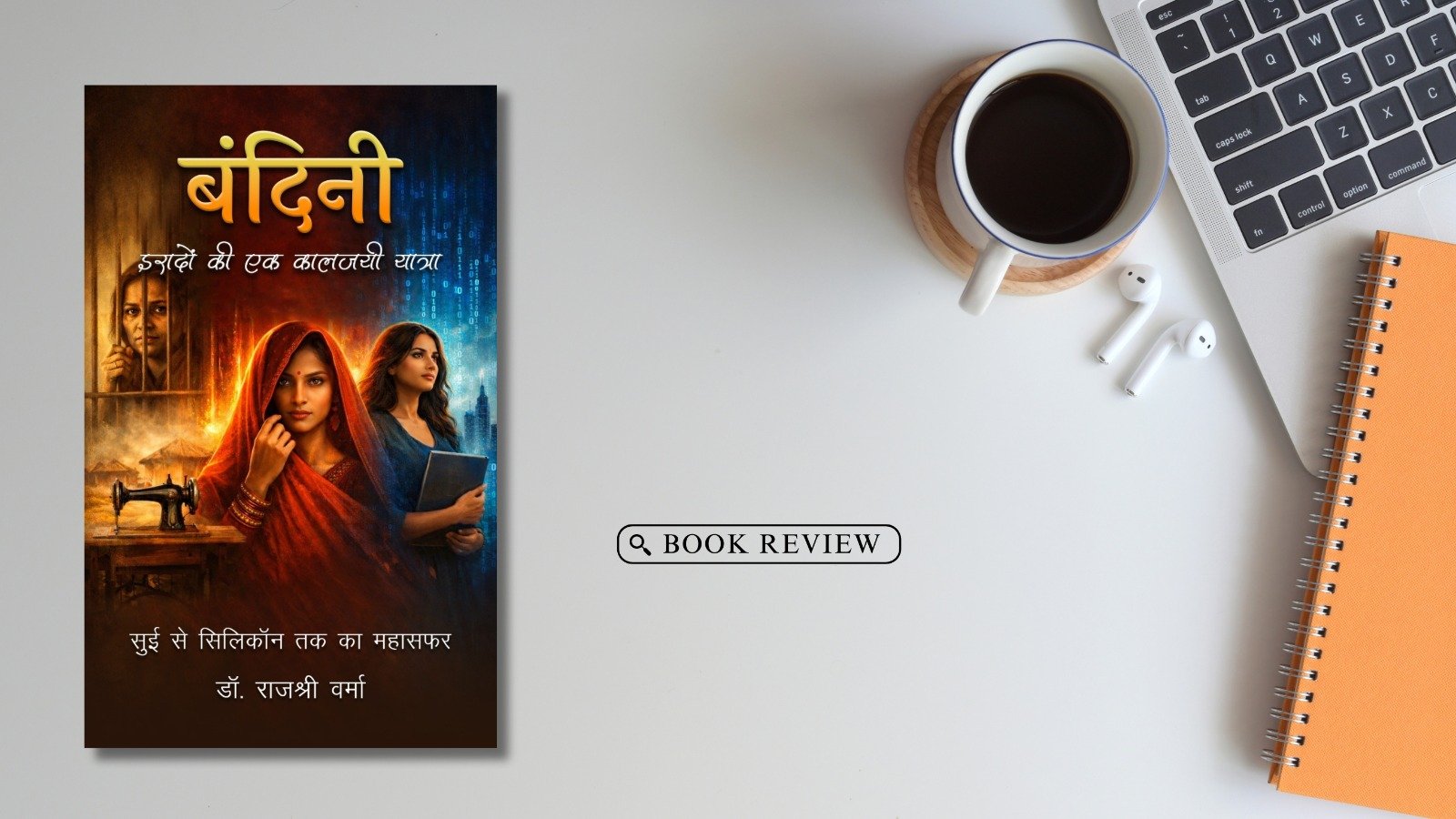
Dr. Rajshree Verma’s Bandini: Iraadon Kee Ek Kalajayee Yatra is not merely a generational family saga; it is a deeply emotional and socially reflective narrative that explores the silent endurance, suppressed aspirations, and gradual awakening of Indian womanhood across changing times. Rooted in the cultural soil of Bihar and expanding into the contemporary digital era, the novel becomes both a social document and an emotional testimony of women who struggle not only against external oppression but also against inherited silence.
The novel’s greatest strength lies in its thematic depth. Through the lives of Sarla, Vidya, and Aradhana, the author constructs three distinct eras of feminine consciousness. Sarla represents the traditional Indian woman—conditioned by sacrifice, duty, and societal restrictions. Her life reflects the generation that normalized suffering as virtue and silence as dignity. Vidya emerges as the transitional bridge, carrying the emotional wounds of the previous generation while attempting to negotiate education, self-respect, and identity within rigid social frameworks. Aradhana, the youngest voice, symbolizes a modern woman who seeks autonomy, expression, and intellectual freedom in a rapidly changing world. Together, these three women create a layered narrative that illustrates how social change is neither sudden nor easy, but evolves painfully through generations.
What makes Bandini emotionally compelling is the author’s sensitivity toward the psychology of women. Dr. Rajshree Verma’s medical background, particularly her experience as a homeopathic physician, becomes evident in the way she understands emotional trauma and internal conflict. The characters are not presented as symbolic figures alone; they breathe, suffer, hesitate, and evolve like real individuals. The author understands that many wounds remain invisible and that emotional neglect can imprison a person more deeply than physical confinement. This psychological realism adds maturity and authenticity to the storytelling.
The narrative style is descriptive, reflective, and emotionally charged. The language carries a literary softness while maintaining social sharpness. The author often uses emotional introspection and situational symbolism to depict the condition of women trapped between tradition and aspiration. The transition from the narrow lanes of Muzaffarpur to the limitless possibilities of the digital world symbolizes not just geographical movement but the expansion of female consciousness itself. The story consistently asks whether society truly allows women freedom, or merely changes the shape of their confinement.
One of the most admirable aspects of the book is its refusal to portray women as either helpless victims or unrealistically invincible heroes. Instead, the women in Bandini are resilient human beings who survive through emotional intelligence, patience, sacrifice, and gradual assertion of selfhood. Their strength is quiet yet transformative. The title Bandini—meaning “imprisoned woman”—therefore becomes deeply symbolic. The imprisonment here is not only domestic or social; it is emotional, cultural, and psychological. Yet within that imprisonment exists an unbroken journey of determination and identity.
The social commentary embedded within the novel is powerful and relevant. Dr. Verma addresses patriarchy not through loud ideological confrontation but through lived experiences and emotional truths. She examines how customs, morality, family honor, and societal expectations often become instruments of suppression for women. At the same time, the novel also celebrates education, awareness, and self-expression as pathways toward liberation. The narrative subtly encourages society to reconsider its definitions of dignity, duty, and gender roles.
The cultural texture of Bihar enriches the novel considerably. Rather than merely functioning as a backdrop, the regional setting shapes the emotional and social realities of the characters. The author’s familiarity with the environment lends credibility and intimacy to the narrative. Readers can feel the weight of conservative traditions, family structures, and societal expectations that define the lives of the women portrayed.
Another notable strength is the intergenerational structure of the story. By spanning three generations, the novel captures the evolution of women’s struggles across time. It effectively shows that while external circumstances may change, many emotional battles continue in different forms. This continuity gives the book universality and relevance for readers across generations.
However, at certain points, the narrative becomes heavily reflective, which may feel slow for readers seeking fast-paced storytelling. Some passages prioritize emotional analysis over dramatic movement. Yet for readers who appreciate literary fiction rooted in social realism and emotional depth, this introspective style becomes one of the novel’s defining qualities rather than a weakness.
Bandini: Iraadon Kee Ek Kalajayee Yatra ultimately succeeds as a meaningful exploration of womanhood, silence, resilience, and identity. It is a novel that speaks softly but leaves a lasting emotional impact. Dr. Rajshree Verma writes with empathy, ideological clarity, and psychological insight, making the book not just a story but a mirror to the lived realities of countless women across generations.
This is a thoughtful and emotionally resonant work that will particularly appeal to readers interested in women-centric literature, social realism, generational narratives, and psychologically nuanced storytelling. The novel stands as a tribute to every woman whose silence concealed strength and whose struggle became the foundation for future freedom.