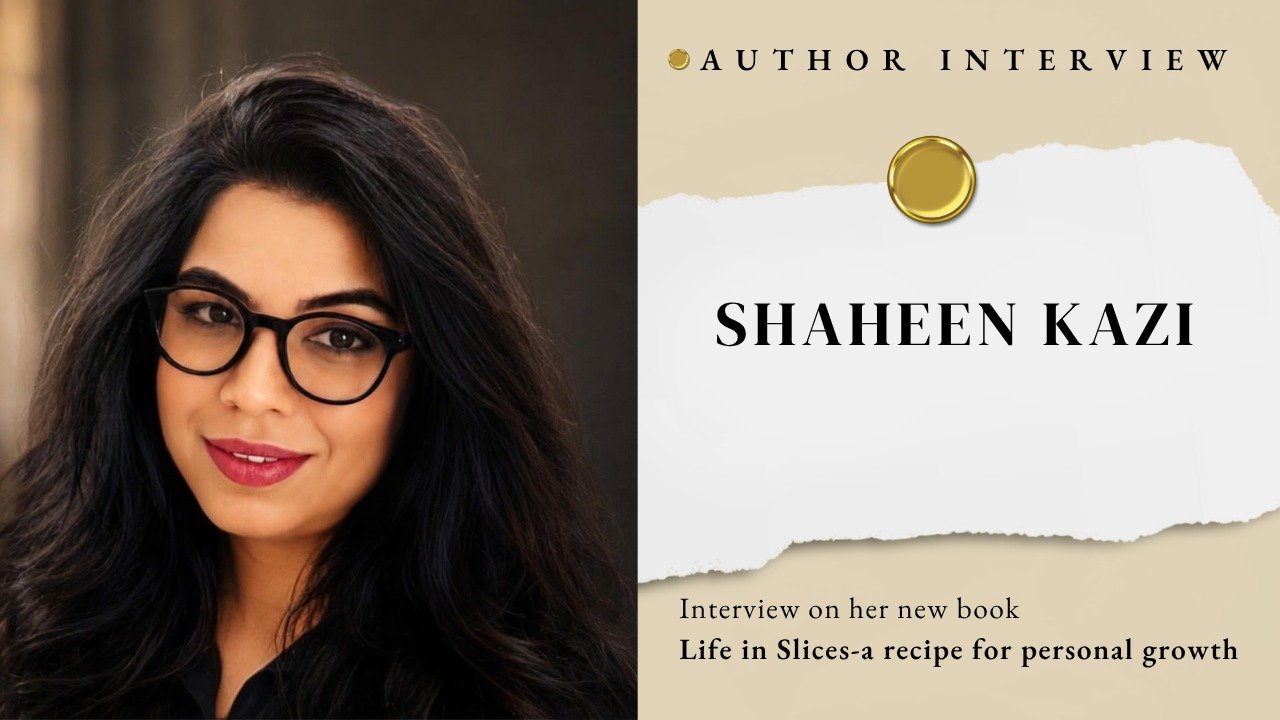
Book: Life in Slices: A Recipe for Personal Growth
Author: Shaheen Kazi
About the Author
Shaheen Kazi is an Indian author who believes that every ordinary moment carries an extraordinary lesson. Writing across genres—including fiction, poetry, horror, children’s literature, and personal development—she enjoys exploring the many shades of human emotions and relationships. Her stories are inspired by real-life experiences, everyday observations, and the belief that growth begins with self-awareness and gratitude. Through her books, she hopes to inspire readers to reflect, heal, and embrace life’s journey with courage and compassion. When she isn’t writing, she finds inspiration in books, travel, nature, and the simple moments that often become life’s greatest stories.
Interviewer: Life in Slices turns ordinary experiences into lessons about personal growth. What first inspired you to transform your observations and life experiences into a book?
Author: I have always believed that life teaches us through ordinary moments. We don’t necessarily need extraordinary events to learn something meaningful. Sometimes it is a conversation, a disappointment, a mistake, a relationship, or even a quiet moment alone that changes the way we see ourselves.
I had gone through many such moments and often found myself reflecting on what they had taught me. Slowly, I began writing those thoughts down. Initially, I wasn’t thinking about writing a book. I was simply trying to make sense of life. Eventually, I realised that if these experiences had taught me something, perhaps they could help someone else too. That thought became the beginning of Life in Slices.
Interviewer: The title Life in Slices is both simple and meaningful. What does the phrase “Life in Slices” personally represent to you?
Author: To me, life is never one complete story that we understand all at once. It comes to us in slices—one experience, one relationship, one loss, one achievement, one mistake, one moment at a time.
Some slices are sweet, some are bitter, some are difficult to swallow, and some remain with us forever. But together, they make up who we become.
That is what Life in Slices represents to me: accepting every part of life instead of choosing only the beautiful pieces and pretending the difficult ones never existed.
Interviewer: In your preface, you mention that you once had no clear career plan and never imagined becoming an author. How did your journey toward writing eventually begin?
Author: My writing journey was never a carefully designed career plan. In fact, there was a time when I had no idea that writing would become such an important part of my life.
I began writing because I had stories inside me that wanted to be told. At first, it was simply an outlet—a place where I could put my thoughts, emotions and observations into words. Gradually, I became more serious about it and discovered that writing gave me a voice I hadn’t realised I possessed.
Looking back, I think some journeys are not meant to be planned. They are meant to be discovered. Writing was one such discovery for me. ‘Writing’ had choosed me to be the part of words.
Interviewer: The book contains 50 individual chapters, each exploring a different aspect of life. How did you decide which experiences and subjects deserved a place in the book?
Author: I didn’t want the book to feel like a collection of lectures. I wanted it to feel like a collection of conversations about things we all experience but don’t always discuss.
I chose subjects that had made me stop and think—failure, relationships, loneliness, gratitude, ageing, forgiveness, self-love, courage, disappointment, kindness and even death. Some were inspired by personal experiences, while others came from simply observing people and life around me.
The common thread was simple: if a subject had the power to make me reflect, I believed it might make a reader reflect too.
Interviewer: Your writing often feels like a conversation with the reader rather than traditional self-help advice. Was creating this personal and approachable voice a conscious decision?
Author: Very much so. I have never wanted to tell readers how they should live their lives. Who am I to do that?
I prefer to share what I have learned, what I have struggled with, and the questions I have asked myself. I wanted the reader to feel that we were sitting together and talking rather than that I was standing in front of them giving advice.
I believe people don’t always need someone to give them answers. Sometimes they simply need someone to say, “I understand. I’ve been there too.”
Interviewer: One of the recurring ideas in the book is that failure can become an important part of growth. How have your own failures influenced the person and writer you are today?
Author: Failure has probably taught me more than success ever could.
Success gives you confidence, but failure makes you look inward. It forces you to question your choices, your expectations and sometimes even your definition of success. I have made mistakes, trusted the wrong people, taken wrong turns and experienced disappointments. None of those experiences was pleasant while I was living through them, but each one left me with something valuable.
As a writer, those experiences have made me more empathetic. I don’t look at people simply as successful or unsuccessful anymore. I wonder what they have survived to become who they are.
Interviewer: In chapters such as “The Beauty of Trying,” you emphasize the importance of continuing even when the outcome is uncertain. Why do you believe trying itself deserves to be celebrated?
Author: Because the outcome is never entirely in our hands, but the courage to try is.
We often measure ourselves by results. If we succeed, we call ourselves capable; if we fail, we assume we weren’t good enough. But there is tremendous courage in trying when you don’t know what the result will be.
Trying means you allowed yourself to hope. You stepped outside your comfort zone. You gave yourself a chance.
Sometimes the greatest victory isn’t reaching the destination. It is having the courage to take the first step.
Interviewer: Gratitude appears as an important philosophy throughout the book. How has practicing gratitude changed the way you respond to difficult situations in your own life?
Author: Gratitude doesn’t make difficult situations disappear. What it changes is the way we look at them.
There have been moments in my life when I could focus only on what was missing. Slowly, I learned to notice what was still present—the people I love, the small moments of happiness, a kind word, a beautiful morning, a book, a conversation, or simply another opportunity to begin again.
Gratitude doesn’t mean pretending everything is perfect. It means recognising that even when something is broken, not everything is broken.
Interviewer: The book discusses emotionally sensitive subjects such as loneliness, disappointment, ageing, forgiveness, and death. Which of these subjects was the most difficult for you to write about?
Author: Loneliness was particularly difficult because it is such a quiet emotion. You can be surrounded by people and still feel completely alone. Writing about it meant acknowledging emotions that many of us try to hide.
Death was also difficult because it forces us to confront the truth that life is temporary. We spend so much time planning tomorrow that we sometimes forget to appreciate today.
But perhaps the most difficult subjects are the ones that make us look honestly at ourselves. Writing can be very revealing because you cannot hide from your own words.
Interviewer: You also write about self-love and self-forgiveness. Why do you think people sometimes find it easier to forgive others than to forgive themselves?
Author: Because we are often much kinder to other people than we are to ourselves.
When someone else makes a mistake, we can understand their circumstances. We can say, “They were struggling,” or “They didn’t know better.” But when we make the same mistake, we replay it repeatedly and punish ourselves for it.
Self-forgiveness doesn’t mean saying that our mistakes didn’t matter. It means accepting that we are human and allowing ourselves to grow beyond those mistakes.
We cannot change yesterday, but we can decide who we become because of it.
Interviewer: Your chapter “Autistic Child Is Not Invisible” brings attention to acceptance and empathy. What message did you particularly want readers and society to understand through this chapter?
Author: I wanted readers to understand that difference should never become a reason for invisibility.
Every child deserves to be seen, heard, respected and allowed to participate in the world around them. A child should not have to behave like everyone else to deserve acceptance.
Sometimes society is uncomfortable with what it doesn’t understand. Instead of asking, “Why is this child different?”, I think we should ask, “What can I do to make this world easier and kinder for this child?”
Empathy begins when we stop demanding that everyone experience life the way we do.
Interviewer: The book also reflects strongly on women, dignity, family, and relationships. How have your experiences as a woman, homemaker, and mother shaped your perspective as a writer?
Author: They have shaped me enormously.
Being a woman teaches you about strength in ways you don’t always recognise while you’re living through it. Being a homemaker teaches you that my family should move ahead without any worries, a homemaker is not promoted yet it still matters. And being a mother teaches you that love can exist alongside worry, frustration, sacrifice and hope.
These experiences have made me more interested in the emotions behind people’s behaviour. A person is rarely just what we see on the surface.
I think that understanding has influenced not only Life in Slices but also the way I approach all my writing.
Interviewer: Several chapters encourage readers to pause and question the way they normally look at life. Was your intention to provide answers, or rather to encourage readers to discover their own answers?
Author: Definitely the latter.
I don’t believe there is one universal formula for happiness or personal growth. What works for one person may not work for another.
My intention was to put certain thoughts on the table and invite readers to examine their own lives. If a chapter makes someone stop and ask themselves, “What do I really want?” or “Why am I holding on to this?” then I feel the chapter has done its job.
The answers should ultimately belong to the reader.
Interviewer: While writing the book, was there any chapter that unexpectedly changed your own perspective on life?
Author: Yes. Interestingly, some chapters began with me thinking I knew what I wanted to say, but by the time I finished writing them, I had learned something myself.
Writing about gratitude, forgiveness and trying again particularly made me look at my own experiences differently.
That’s one of the beautiful things about writing: sometimes you begin by thinking you are teaching someone else, only to realise that you are actually teaching yourself.
Interviewer: Many people today are constantly comparing their lives with others, especially through social media. What lesson from Life in Slices do you think is particularly important for this generation?
Author: Don’t compare your behind-the-scenes with someone else’s highlight reel.
Social media can make everyone else’s life appear perfect. We see achievements, celebrations, beautiful homes, holidays and happy photographs, but we rarely see the struggles behind them.
Every life has its own timeline. Your journey doesn’t become less valuable because someone else reached somewhere before you.
I would tell this generation: measure your progress against who you were yesterday, not against what someone else is showing you today.
Interviewer: If a reader is currently experiencing failure, loneliness, or uncertainty about their future, what would you want them to take away from this book?
Author: I would want them to remember that their current chapter is not their entire story.
Failure is a chapter. Loneliness is a chapter. Uncertainty is a chapter. None of them has to be the ending.
Sometimes life becomes confusing because we are standing in the middle of the story and cannot yet see where it is going. We don’t need to know the entire path. Sometimes we need enough courage to take the next step.
If Life in Slices gives even one person the strength to begin again, then it has achieved something meaningful.
Interviewer: You have written about happiness, relationships, mistakes, hope, kindness, courage, and gratitude. Among all these ingredients, which one would you call the most essential ingredient in the “recipe for personal growth”?
Author: I would choose self-awareness.
Without understanding ourselves—our fears, patterns, weaknesses, desires and mistakes—it is difficult to truly grow. We can keep changing our circumstances, relationships and surroundings, but eventually we have to look inward.
Self-awareness isn’t always comfortable. Sometimes what we discover about ourselves is difficult to accept. But once we become honest with ourselves, change becomes possible.
So if life is a recipe, I would say self-awareness is the ingredient that allows us to understand all the others.
Interviewer: Your book suggests that wisdom can often be found in very ordinary moments. Has becoming a writer changed the way you observe everyday life?
Author: Absolutely.
Writing has made me a much closer observer of life. I notice conversations, expressions, silences, relationships and the little things people often overlook.
A person sitting alone in a café, someone waiting for a phone call, a mother watching her child, an elderly couple walking together—ordinary moments can contain extraordinary emotions.
I think writers learn to look beyond what is happening and ask, “What is happening underneath?”
Interviewer: What response or message from a reader about Life in Slices would make you feel that the book has truly achieved its purpose?
Author: The message that would mean the most to me would be something like, “Your book made me look at my life differently.”
I don’t necessarily need a reader to agree with everything I have written. I would much rather they question something, reflect on something, forgive someone, appreciate something, or find courage to change something in their own life.
If someone closes the book and feels a little more hopeful, a little more understood, or a little kinder towards themselves, then I would consider Life in Slices successful.
Interviewer: Finally, after sharing these fifty slices of life with your readers, what is the next chapter for Shaheen Kazi as an author?
Author: The next chapter is very different from Life in Slices.
I am currently working on a psychological thriller. It is a darker and more layered story, exploring human emotions, relationships, secrets and the things people hide behind ordinary lives.
I think that is what excites me most about being a writer—the freedom to keep evolving. I don’t want to be confined to one genre or one kind of story.
Life in Slices allowed me to share the lessons I found in life. My next stories will allow me to explore the mysteries hidden within it.
And perhaps that is the most beautiful thing about being an author: there is always another chapter waiting to be written.