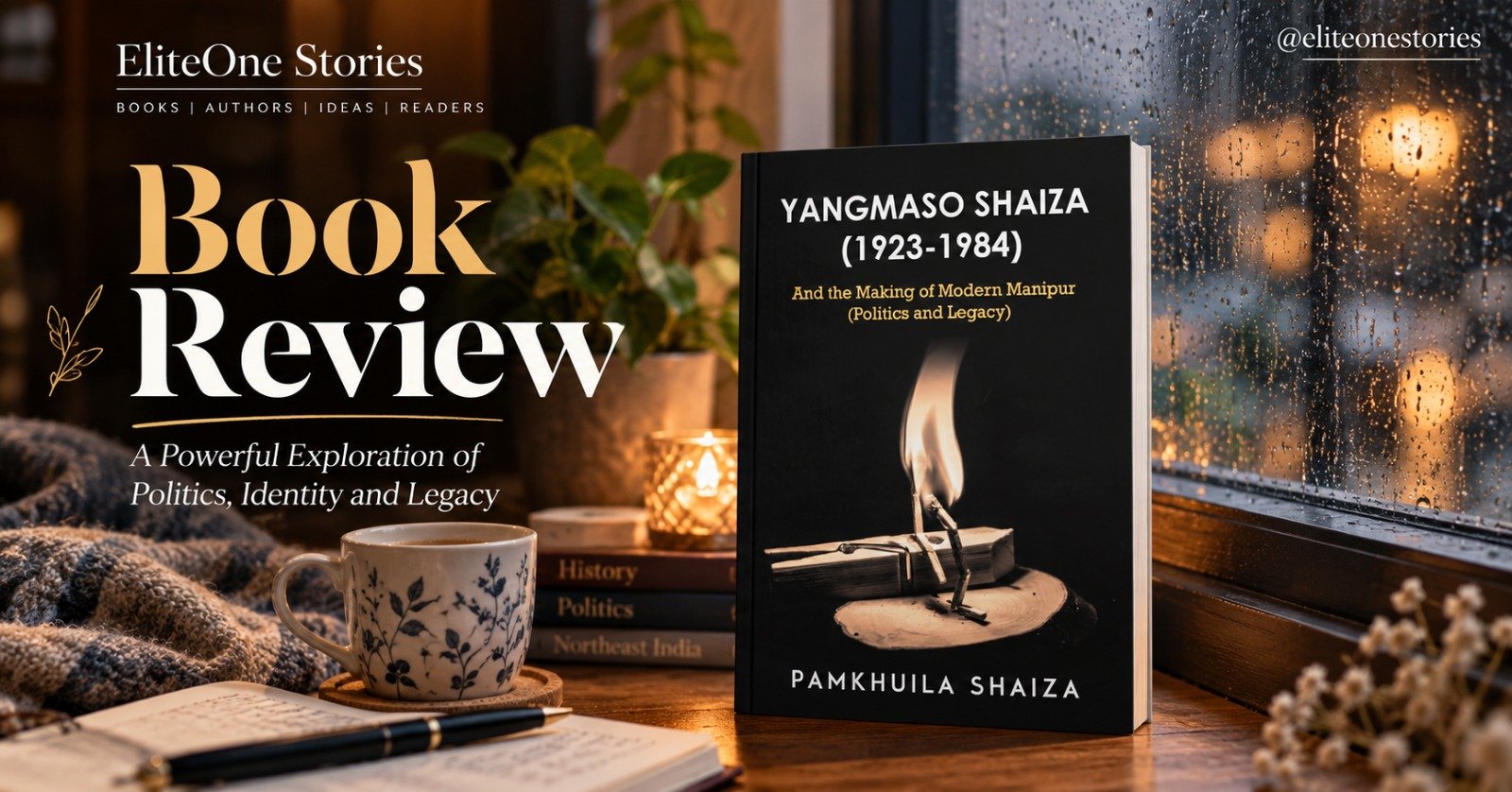
History is not merely a record of events and dates. It is also an exploration of the people, political decisions, social transformations, and struggles that shape a region’s identity. Yangmaso Shaiza (1923–1984) and the Making of Modern Manipur: Politics and Legacy by Pamkhuila Shaiza offers a historical examination of one of the significant political figures in modern Manipur and places his life within the wider story of political change in Northeast India. As a work of academic nonfiction, the book seeks to recover important historical narratives while examining the relationship between indigenous leadership, democratic governance, cultural identity, and the formation of modern political institutions.
At the centre of the book is Yangmaso Shaiza, recognised as Manipur’s first tribal Chief Minister. His political life unfolded during a period marked by the challenges of state formation, ethnic diversity, and democratic transition. Rather than presenting his life as an isolated biography, the author approaches his legacy through the broader political and social circumstances of the region. This perspective allows readers to consider how an individual leader’s career can illuminate the complex forces that influence governance and political identity. The book’s central subject therefore extends beyond one person, inviting readers to examine the historical conditions in which leadership emerged and the lasting significance of political decisions.
One of the notable aspects of this work is its emphasis on indigenous perspectives and historical interpretation. The author draws upon oral histories, family archives, political records, and indigenous historiography to reconstruct the past. These sources provide a framework for exploring experiences and narratives that may receive limited attention in broader accounts of Indian political history. By bringing such perspectives into the discussion, the book highlights the importance of examining regional histories through the voices, experiences, and cultural contexts of the communities concerned. Its approach also raises an important question about historical writing: whose experiences are preserved, and whose stories require renewed attention?
The book further broadens its scope by examining the Shaiza family and its contributions to the political and civic development of the region. It considers Shangyang Shaiza’s role in education and civic development, alongside the political careers of Yangmaso Shaiza and Hangmila Shaiza. The historical connections involving A. Z. Phizo and Rano Shaiza also form part of the narrative. This wider family perspective helps situate individual lives within an interconnected historical landscape, where political participation, community development, and personal legacies intersect. It also demonstrates how the study of a family can provide a useful lens for understanding larger developments in indigenous politics and institution-building.
Another significant dimension of the book is its engagement with major political developments that have shaped the region. These include the assassination of Yangmaso Shaiza, the 1975 Shillong Accord, Naga political movements, and the Sadar Hills controversy. Each of these subjects belongs to a wider history of political negotiations, competing identities, and the continuing challenges of democratic governance in Northeast India. By bringing these developments into the same historical discussion, the book encourages readers to look beyond isolated incidents and consider the relationships between leadership, political movements, and the broader social environment. The inclusion of these topics also gives the work relevance for readers seeking to understand the historical background of continuing debates surrounding identity, representation, and political conflict.
Pamkhuila Shaiza’s research interests in the social and cultural history of the Naga tribes of Northeast India provide a meaningful context for this study. The author’s broader scholarly focus includes cultural transformation following the introduction of colonialism and Christianity, identity formation, indigenous resilience, and the consequences of encounters between local communities and external institutions. These concerns connect the book’s regional focus with wider discussions in Indigenous Studies. The history of Manipur and the Naga people is thus approached not simply as a local subject but as part of a larger conversation about colonial legacies, cultural continuity, and the ways indigenous communities respond to changing political and social circumstances.
The book’s academic orientation makes it particularly relevant for students, researchers, historians, and readers interested in Northeast Indian history. Those studying indigenous leadership, postcolonial governance, regional political movements, and the evolution of democratic institutions may find its subject matter especially valuable. General readers who wish to understand the historical complexities of Manipur may also appreciate its focus on people and events that connect regional experiences with broader questions about power, identity, and belonging. Since the work deals with interconnected political and historical developments, it invites careful reading and reflection rather than offering a simplified account of the past.
A major strength of the book’s premise is its effort to connect biography with historical analysis. By examining Yangmaso Shaiza’s life alongside the political trajectory of his family and the wider developments of Manipur, the study presents history as a network of relationships rather than a collection of disconnected events. Its attention to indigenous historical perspectives further reinforces the importance of preserving regional narratives within the larger understanding of India’s past. Readers approaching the work for academic purposes may find this combination of political history and indigenous historiography particularly useful.
Overall, Yangmaso Shaiza (1923–1984) and the Making of Modern Manipur: Politics and Legacy is a significant contribution in subject and intention to the study of Manipur’s political history and indigenous leadership. Pamkhuila Shaiza brings attention to a political figure whose life offers a way to explore broader questions of governance, cultural identity, and historical change. The book’s value lies in its attempt to recover overlooked narratives and place them within a wider regional and postcolonial context. For readers interested in understanding the political evolution of Manipur, the Naga people, and Northeast India, this work offers an opportunity to engage with a complex and important chapter of the region’s history.