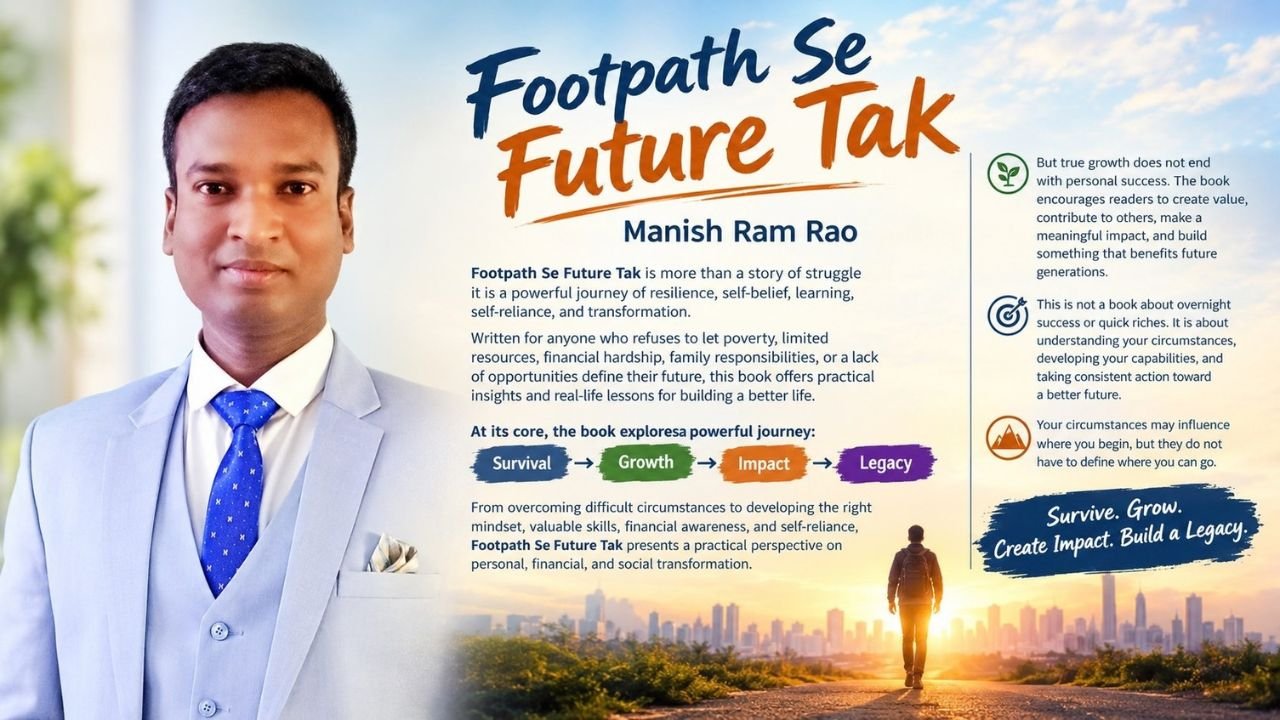
Title: Footpath Se Future Tak
Author: Manish Ram Rao
ISBN: 9789373357461
Publisher: Evincepub Publishing
Some life stories begin with comfort, support, and opportunities. Some begin with questions, responsibilities, and struggles that come much earlier than expected. The story of Manish Ram Rao belongs to the second kind. His journey, shared through his book Footpath Se Future Tak, is not simply a story about becoming financially successful. It is the story of a person who learned to move forward when resources were limited and the path was not clear. At a young age, Manish understood that life does not give everyone the same starting point. While some children grow up with books, guidance, good schools, and financial support, others grow up with responsibilities that make them think about survival much earlier. His childhood was shaped by such circumstances. There was a time when even small needs had to be considered carefully. There was a time when buying a book was difficult and family responsibilities felt bigger than personal dreams. Yet, even during those years, the desire to learn and move ahead remained alive. The turning point came when, at around 12 to 14 years of age, he started selling biscuits, chocolates, and mixture on the footpath. He had around ₹30 with him and used that small amount to begin. For others, it may have looked like a very small activity. For Manish, it became an early lesson in work, responsibility, confidence, and self-reliance. Sitting beside the road and trying to sell small packets was not easy. He felt shy and wondered what people he knew might think if they saw him. But slowly, customers started coming. The money he earned was small, but the feeling behind that first earning was much bigger. It gave him the confidence that he could do something with what he had. Looking back, that footpath was not just a place where he sold snacks. It became one of the first places where he began learning about life, effort, money, and the importance of taking action.
The struggles did not end there. Manish’s education also faced financial difficulties. At one point, his graduation studies stopped because of a shortage of only ₹2,000. For someone looking at the situation from outside, ₹2,000 may not seem like a life-changing amount. But at that stage of his life, it stood between him and his education. He remembers standing at a counter, knowing that he did not have enough money to complete what he had started. It was a difficult moment because he could see other people moving ahead while he felt stuck. Such experiences could easily have made him give up. Instead, they pushed him to ask difficult questions about his future. Could he keep blaming his circumstances, or could he learn something new and slowly change his direction? This became an important part of his thinking. He started understanding that circumstances can create limitations, but they do not have to become a person’s complete identity. His early years also included teaching tuition, working in private schools, doing part-time jobs, and taking up different kinds of work, including sales and documentation. Each experience gave him a different lesson. He saw that many people worked hard, but hard work alone did not always take them forward. People also needed skills, communication, knowledge, confidence, exposure, and the right direction. These lessons became important building blocks for the ideas that later shaped Footpath Se Future Tak. The book does not present struggle as something that should be romanticised. Instead, it looks at struggle as something that can teach a person to understand life better and make more informed choices. Manish’s own journey shows how learning can continue even when formal opportunities are limited. Every small job, every setback, every rejection, and every new experience added something to his understanding of people and life.
As his journey moved forward, Manish entered new working environments and got an opportunity to see life from a wider perspective. He worked in the corporate and EdTech space, including companies such as Byju’s and Testbook. He also counselled more than 10,000 students. These experiences allowed him to interact with people from different backgrounds and understand their hopes, fears, problems, and ambitions. He also worked with more than 100 small business owners and noticed something important. Hard work was present almost everywhere, but the right direction was not. This observation became one of the central ideas behind his book. According to his experience, poverty is not always only about having less money. It can also be connected with a lack of information, exposure, guidance, confidence, skills, networks, and opportunities. When a person spends most of life thinking only about daily survival, it can become difficult to think about the future. This is why Manish gives importance to changing the way a person looks at his or her situation. For him, a change in life often begins with a change in thinking. This does not mean simply reading positive quotes or watching motivational videos. It means taking responsibility for the next step, learning from mistakes, developing useful skills, meeting new people, and looking for possibilities. His book talks about the difference between a mindset that only sees limitations and one that is willing to learn and grow. It also explains why skills can become an important form of personal strength. A person may not have money at the beginning, but learning a useful skill can create new possibilities. This idea is also reflected in the wider message of the book: knowledge becomes more useful when it is applied in real life.
Another important part of Manish’s journey is his understanding of money and financial awareness. Coming from a background where even small amounts mattered, he gradually understood that earning money and building financial stability are two different things. Footpath Se Future Tak therefore moves beyond the idea of simply earning more. It discusses saving, financial awareness, multiple income sources, investment, wealth building, entrepreneurship, networking, and systems. The book also makes it clear that there is no overnight formula for success. Manish does not present wealth as something that can be achieved through a shortcut. Instead, he focuses on gradual improvement and practical action. The journey begins with survival, but it should not end there. A person can learn, improve skills, increase value, create better income opportunities, and slowly build stability. The book also talks about the importance of having a structure for money. It encourages readers to think about essential expenses, learning and self-development, saving, investment, and future security according to their own situation. This is important because financial growth is not only about how much a person earns. It is also about how that money is understood and used. Manish’s own experiences give these ideas a personal connection. He has seen what it feels like when a small amount of money can stop an important dream. He has also seen how increased skills and experience can create choices. For him, financial strength is not simply about having more money. It is also about having more control, more awareness, and more choices in life. This practical approach makes the book relevant to students, working people, small business owners, young professionals, and families who want to understand how they can improve their financial direction step by step.
What makes Manish’s story meaningful is that he does not stop the journey at personal success. After experiencing hardship, learning new skills, building his career, and understanding financial growth, he began looking at a larger question: what can one person’s struggle mean for others? This question forms an important part of Footpath Se Future Tak. The book moves from survival to growth, then from growth to impact, and finally towards legacy. Manish believes that personal progress becomes more meaningful when it creates value for others as well. His experiences with students, small business owners, working professionals, and people struggling to find direction helped shape this thought. He understands that sometimes one correct piece of guidance can save years of confusion. A useful skill can open a new opportunity. Better financial awareness can help a family make stronger decisions. A change in mindset can help a young person stop seeing his or her current situation as the final truth. The book therefore encourages readers to think not only about what they can achieve for themselves but also about what they can create for the people who come after them. Legacy, in this sense, is not limited to money or property. It can include education, values, discipline, knowledge, skills, financial awareness, systems, and the willingness to help others grow. Manish’s message is that building a better future for the next generation begins with the choices made today. His own life gives a personal background to this idea. The child who once worried about small amounts of money and sold snacks on a footpath eventually began thinking about how his experiences could help others find direction. That change from personal struggle to a desire to create wider value is one of the strongest parts of his story.
Footpath Se Future Tak is ultimately a story about movement. It is about moving from survival towards growth, from confusion towards direction, from dependence towards self-reliance, and from personal progress towards meaningful impact. Manish Ram Rao does not claim that every person will become rich by following the ideas in his book. Instead, the book asks readers to understand their circumstances, identify what is missing, develop their capabilities, and take consistent steps towards a better future. His own journey gives weight to this message because he has experienced several stages of that journey himself. He has known the pressure of financial shortage, the hesitation of doing small work, the pain of interrupted education, the uncertainty of different jobs, the pressure of targets, the value of skills, and the importance of learning from people and situations. He has also seen how exposure can change a person’s understanding of what is possible. The central message is simple: your beginning does not have to become your final destination. A difficult childhood does not have to decide the whole story. Limited money does not mean limited potential. A small beginning does not mean a small future. At the same time, the book reminds readers that change needs action. Reading alone is not enough. Learning has to be used. Skills have to be developed. Money has to be understood. Relationships have to be built. Systems have to be created. Progress has to continue even when it is slow. The journey described by Manish can therefore be summed up in four simple stages: Survive. Grow. Create Impact. Build a Legacy. His story began on a footpath, but the lessons learned there became the foundation for a much bigger vision. Footpath Se Future Tak is an invitation to look at one’s present situation honestly, without allowing it to become the final definition of one’s life. It is a reminder that every journey has a beginning, and sometimes the smallest beginning can become the first step towards a very different future.