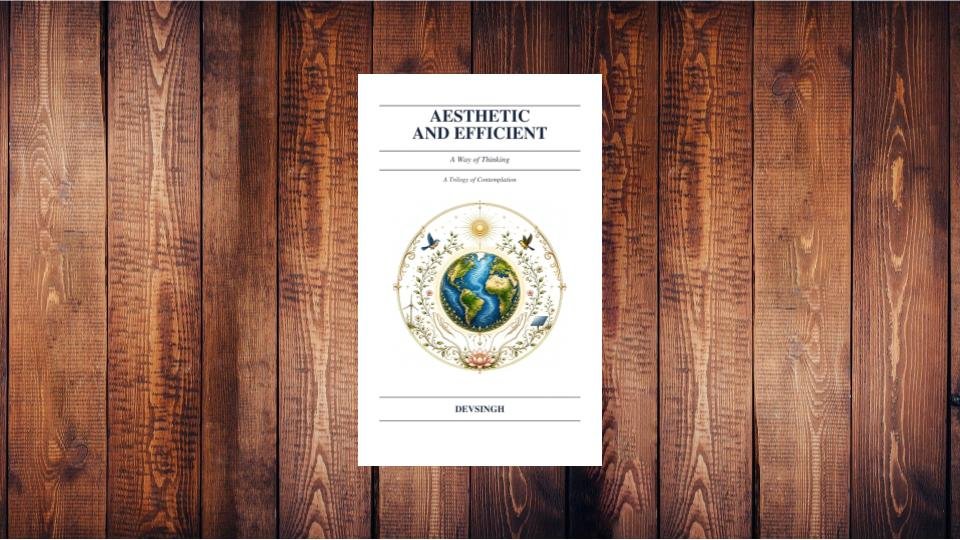
In Aesthetic and Efficient: A Way of Thinking, Devsingh Balan delivers an expansive and deeply resonant finale to his Trilogy of Contemplation. Building on the foundation laid by Journey to Infinity Within (which explored inner consciousness) and The Inward Quest (which examined leadership and professional integrity), this concluding volume completes an ambitious arc, moving from the inner mind to action, and finally to the physical objects and environments we inhabit. Balan sets his sights on a pervasive and damaging modern myth: the idea that beauty and utility are competing forces that must be balanced against one another. With a serene blend of natural observation, design history, and practical wisdom, he persuasively argues that this divide was never real in the natural world, nor should it be in ours. True durability, whether in a tool, an architectural layout, or a daily habit, exists only when form and function are treated as one and the same.
What makes Balan’s voice uniquely compelling is his rare synthesis of perspectives. Grounded in both contemplative philosophy and high-rigor engineering, he approaches efficiency with technical precision while honoring aesthetic beauty with an artist’s nuance. At the core of his argument is nature as the ultimate master designer. He draws captivating connections between human ingenuity and the biological world, citing examples like the passive cooling of traditional wind-cooled stone screens (jalis) alongside the breath-like ventilation of termite mounds and the hydrodynamics of a humpback whale’s tubercled flipper. Even Leonardo da Vinci’s visionary notebooks make an appearance, reinforcing the idea that humanity’s greatest breakthroughs occur when we pay close attention to how the Earth builds. Through these vivid vignettes, Balan demonstrates that when an object or system is aligned with natural principles, it naturally inherits both striking elegance and peak functionality.
Yet, the book does not remain safely in the realm of admiring nature; it turns an uncompromisingly clear eye toward the systemic waste of contemporary society. Balan diagnoses our current throwaway culture not merely as an environmental failure, but as a failure of philosophy and imagination. He illustrates how separating aesthetic appeal from practical utility inevitably results in hyper-consumerism, producing short-lived, disposable objects that are either flashy eye candy devoid of purpose, or soul-crushing utilitarian tools designed with no regard for the human spirit. Structured thoughtfully across forty concise, meditative chapters, the prose remains fast-paced and digestible, making it as much a daily devotional as a design manifesto.
What elevates this volume into an indispensable life guide is its actionable application: Balan arms the reader with four durable questions to evaluate anything they make, buy, or build. These criteria act as a rigorous mental filter against physical clutter and superficial choices, forcing both creators and everyday consumers to take accountability for what they bring into existence. Evoking the spirit of design classics like Victor Papanek’s Design for the Real World and Christopher Alexander’s The Timeless Way of Building, the book never feels preachy or academic. Instead, it reads like an intimate, luminous conversation with a thoughtful mentor. Aesthetic and Efficient stands as a gentle yet profound framework for architects, designers, artists, and conscious consumers alike, leaving us with an enduring reminder of what it means to create the way nature always has: where nothing is wasted, and nothing is missing.