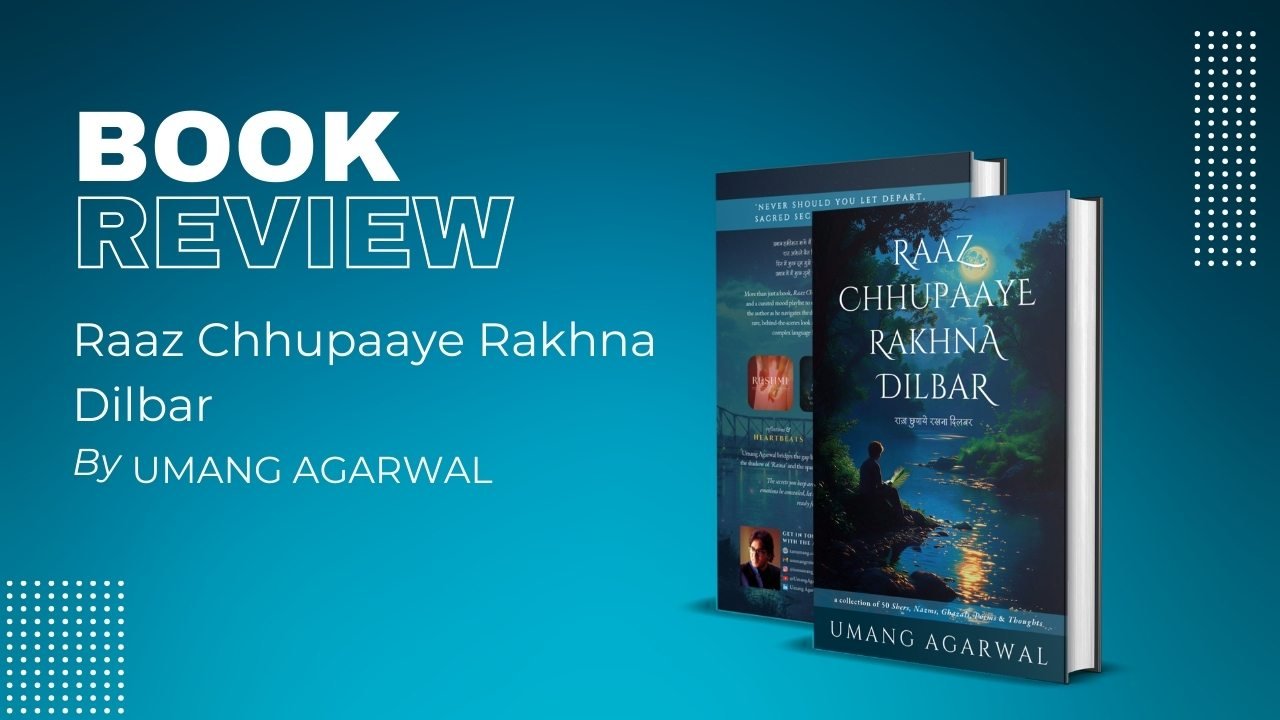
Title: Raaz Chhupaaye Rakhna Dilbar
Author: UMANG AGARWAL
ISBN: 9789373357829
Publisher: Evincepub Publishing
First Impression
When you first pick up this book, the title itself does something to you. Raaz Chhupaaye Rakhna Dilbar; keep your secrets hidden, dear heart. There is weight in those words. Not the heavy, dramatic kind; more like the weight of something unsaid for a very long time. You get the feeling before you even read the first page that this book is not going to perform emotions for you. It is going to sit beside you and quietly feel them with you. That is exactly what it does.
Umang Agarwal is a young writer from Kolkata, born in 2003, who is also a film director, music composer, and lyricist. But in this book, he is none of those things. He is just a person who spent five years writing down what he felt, late at night, when nobody was watching. That honesty is what makes this collection special.
About the Book; A Peaceful Sanctuary for Restless Dreamers
The book describes itself as “a peaceful sanctuary for restless dreamers,” and that description is quite accurate. It contains 50 poetic pieces divided into four chapters; Raina, Dashamlav, Jheeni, and Aagaaz. The pieces are a mix of Shers, Nazms, Ghazals, Poems, and short Rubaaiyaan. Most of the writing is in Hindi and Urdu, but the author has been kind enough to provide transliterations in English alongside every piece. He has also explained difficult Urdu words in footnotes, which makes the book very accessible even to readers who are not fluent in Urdu. What he has intentionally not given is an English translation; and that is a deliberate choice. He wants you to interpret the poetry your own way. That is a brave decision, and it mostly works.
Foreword and Preface; A Warm Beginning
The foreword is written by Naman Chandak, a stand-up comedian and poet, who has known the author for a few years. He writes with genuine warmth. He says that the book will make you cry in the first few pages and leave you smiling by the end. He calls it a “roller coaster of emotions,” and anyone who reads the book from start to finish will agree with him completely.
The preface, written by the author himself, is one of the most honest introductions you will read in any debut collection. He explains that this book started as something called Izhaar, but then one restless night he wrote a sher about the importance of keeping certain secrets hidden from the world, and the book got its final title. He speaks about how all these pieces came from those ten minutes every night when he would sit alone with his thoughts and write in the most poetic way he could manage. He also makes clear from the beginning that this book is not about becoming a famous author. It is about ringing a bell of hope in the hearts of readers and telling them they are not alone. That kind of purpose; simple, honest, and human; you do not forget easily.
There is also a very charming personal account at the beginning of the book, titled An August Occasion, where Umang describes how he managed to meet the legendary Javed Akhtar Sahib, gifted him the draft manuscript, and sat in the green room for twenty minutes listening to him narrate stories and play music. He even asked Javed Saab about the difference between a Ghazal and a Sher from the audience during the Q&A. This little story alone tells you a lot about the kind of person the author is; curious, respectful, and genuinely in love with words.
Chapter I; Raina (Shers, Nazms, Ghazalein)
Raina means night. This chapter is dedicated to those nights of overthinking, of lying awake with feelings you cannot name. The author opens it with a quote from Gulzar Sahab, describing a sleepless night from the film Parichay (1972). That sets the mood perfectly.
There are thirty pieces in this chapter, and most of them deal with love; not the happy kind, but the kind where you are left waiting, wondering, missing. The very first piece, Aaraam (Rest), asks a simple but sharp question; people will ask about your house, your number, your work, but will anyone ever ask if your heart is at peace? It is the kind of question that hits you right in the chest because we have all felt that nobody really asks.
Asmanjas (Confusion) is a longer Nazm that deals with the helplessness of love; the feeling that even God would be powerless if love were to be separated. It has beautiful imagery and is one of the stronger pieces in this chapter.
Bahaane (Excuses) is another standout; a deeply personal Ghazal about how when a relationship fades, everything dries up: no tears come, no songs come, no poetry comes, no taunts come. All that remains are a thousand excuses for separation. The use of Quranic imagery and the act of bowing in worship adds an unexpected spiritual depth to what is essentially a poem about heartbreak.
The chapter also has lighter, more conversational pieces like Jaao, Humne Maan Liya! (Fine, We Accept!) and Kyun Sapnon Mein Aate Ho (Why Do You Come in Dreams?). These bring a more playful energy and are easy to connect with for younger readers. By the time you reach Zaruri Nahi Hai (It Is Not Necessary), which is a proper Ghazal exploring all the things love does not demand from you, the chapter feels complete; like a long, quiet night that finally turned into morning.
Chapter II; Dashamlav (Kavitayein)
Dashamlav means decimal; the point between two numbers, the pause between two ideas. The author uses this chapter to pay homage to poets who conveyed more than their words actually said, and to explore the larger issues of society, the mind, and memory. The shift in tone from Chapter I is very noticeable. These poems are less about personal heartbreak and more about the world around us.
Calculator is a brilliant piece. It imagines God arriving with a calculator on Judgment Day to settle the accounts of a person’s sins and virtues. The math is very much not in the person’s favour. It is sharp, a little funny, and deeply thought-provoking all at once.
Hypocrisy is a short but memorable poem that uses nature; the sea complaining of dryness, the sky asking to be made bluer; to comment on the hypocrisy that surrounds us in the age of Kalyug. It is compact and punchy.
Ishwar Jaane Kiske Hisse (God Alone Knows Whose Share Is What) is one of the most moving pieces in the entire book. It questions the unequal distribution of joy and sorrow in the world and compares all of humanity to puppets on a string, dancing to whoever’s tune pays the most. The line about everyone being either a athanni (eight annas) or a chavanni (four annas); essentially saying that every person is valued and reduced to a price in this world; is unforgettable.
Maajhi (The Boatman) is written in a folk dialect that feels very authentic and rooted. It questions why someone keeps pretending to love you when they have no time for you, no truth in them. It has a rustic, folk-song quality that is quite different from the rest of the book.
Sunn Re Bachpan (Listen, O Childhood) is the emotional high point of this chapter. It is written in the same folk style and speaks directly to one’s lost childhood, asking it to come back, even for a little while. It acknowledges that adults break and fall apart, and then humbly asks childhood to wait; promising to return to it one day. It is the kind of poem that stays with you for days.
Syaahi (Ink) closes the chapter beautifully; a meditation on ink itself, on writing, on the priceless and timeless nature of words. The final comparison of ink to a mother; irreplaceable, invaluable; is a genuinely lovely image to end on.
Chapter III; Jheeni (Khayaal aur Rubaaiyaan)
Jheeni means fine, subtle, or delicate. And that is exactly what this chapter is; very short, very quiet, and very true. These are small thoughts, Rubaaiyaan (four-line verses), that do not try to explain too much. They leave space for you to fill in the rest.
The chapter introduction says: “Thoughts cannot be expressed. Words can never replace feelings, for something or the other will always get lost in translation.” That is the spirit of this chapter.
Dil is just two lines: the heart weighs every relationship in emotions, beats plenty, but says nothing. Two lines. That is all. And yet it captures something that takes most people a lifetime to understand.
Kaash (If Only) is four lines that imagine a love without identity, without recognition; where even though the heart breaks, neither person exists in the equation. It is abstract and a little aching at the same time.
Shor (Noise) is the last piece of this chapter and perhaps the most quietly devastating one in the whole book. It asks the heart to not fall in love, so that the world does not mistake its very heartbeat; the sound of its love; for mere noise. In four lines, the author captures what it feels like to love someone in a world that does not understand the language of your feelings.
This chapter is the shortest in the book, but it leaves the deepest marks. Less is more, and the author clearly knows this.
Chapter IV; Aagaaz (My Humble Beginnings as a Lyricist)
Aagaaz means beginning. This is the most unique chapter in the book; it is not poetry, but it is absolutely poetic. The author takes you inside the process of writing his first released song, Reshmi (2025), for which he was the music director, composer, and lyricist.
He explains the thinking behind each stanza of the song; why the girl starts softly, almost breathlessly, like someone speaking through silk threads. Why the hook line, “Ya ke tum mere ho, ya hun main tumhaari” (Either you are mine, or I am yours), is the soul of the song; because true one-sided love does not seek acceptance, it only seeks to surrender. He talks about how simplicity in lyrics is harder to achieve than complexity, how the best lyrics are the ones where the message is light even if the feeling is heavy.
He references Gulzar Sahab, Javed Akhtar Sahab, Jaideep Sahni, and a beautiful scene from Dil Dhadakne Do to explain his lyrical thinking. None of this feels like name-dropping. It feels like a young writer speaking about his teachers with deep respect and love.
The chapter also includes unreleased lyrics from the second verse of Reshmi; lines that were too heavy for the song but too beautiful to throw away. Reading them, one can understand why he kept them. They are genuinely lovely.
My Thoughts
Raaz Chhupaaye Rakhna Dilbar is not a perfect book, and it does not try to be. Some pieces are stronger than others. Some Ghazals are more polished, some Rubaaiyaan feel more raw. But that rawness is also its charm. This is a debut collection written across five years of real nights and real feelings by a twenty-two-year-old who genuinely believes in the power of words.
What makes this book worth reading is not just the quality of any single poem. It is the consistency of feeling throughout. Page after page, you get the sense that someone sat alone with their pain, their questions, their love, and their longing; and instead of looking away, they wrote it down. The book has a Mood Playlist curated by the author, and that detail alone tells you how much care went into creating this experience.
The author has the blessings of Padma Bhushan Javed Akhtar Sahib on the cover. He has a foreword from a comedian who made you feel before he made you laugh. He has a preface that is more honest than most full-length memoirs. And he has fifty pieces of poetry that sit beside you quietly, like a good friend who does not need to speak to make you feel less alone.
For those who grew up on film songs, late-night thoughts, and the particular sadness of loving someone without saying so; this book will feel like home.
A sincere, heartfelt debut that deserves to be read slowly, preferably at night, with the Mood Playlist running softly in the background.
Buy on Amazon: https://www.amazon.in/dp/937335782
Review by Neel Preet
For Eliteonestories.com