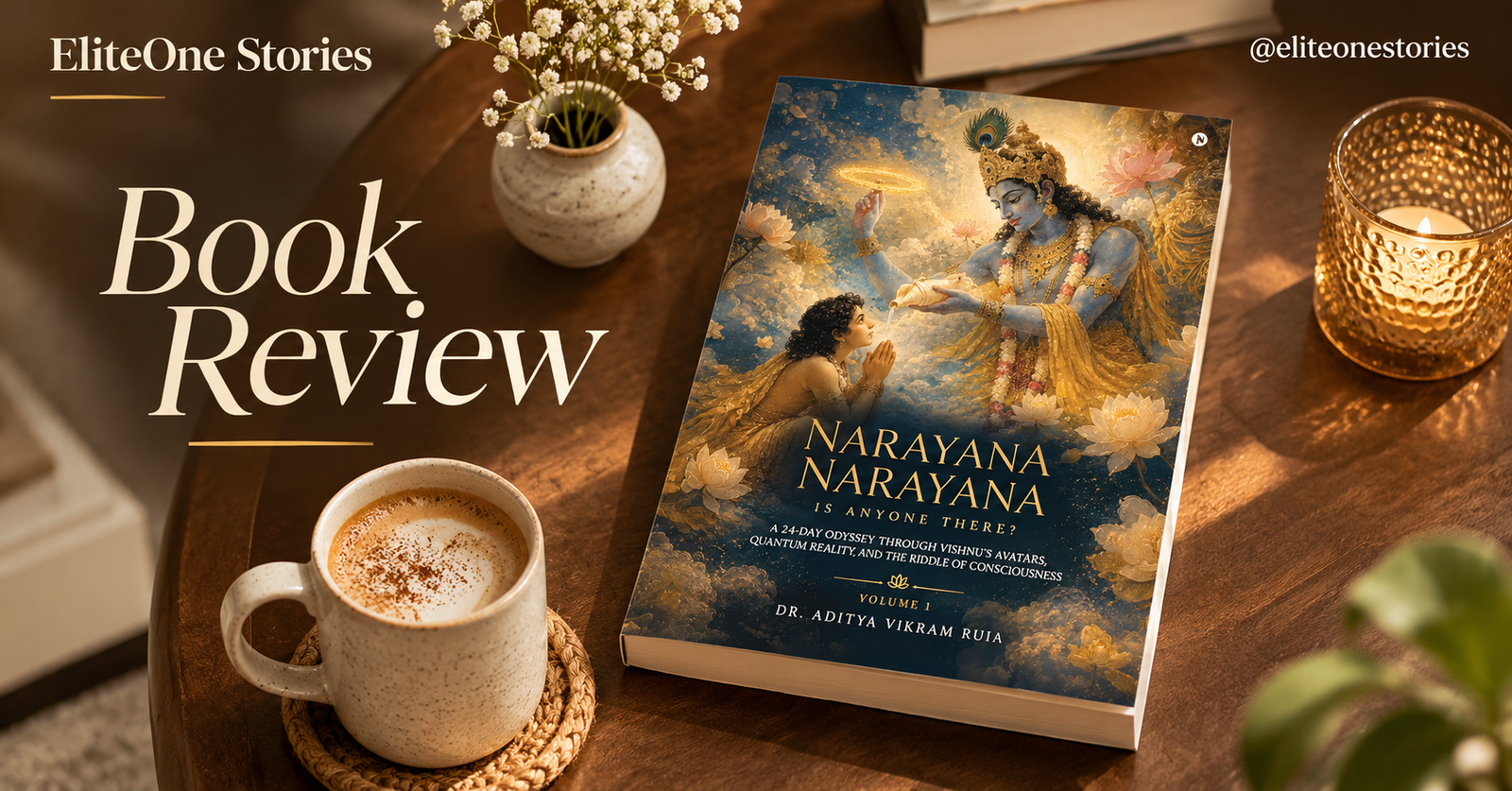
What happens when the mysteries of modern science meet the timeless questions of ancient Indian philosophy? Can the universe be understood entirely through scientific principles, or is there a deeper intelligence underlying the existence of everything? These questions form the intellectual and philosophical foundation of Narayana Narayana Is Anyone There: A 24-Day Odyssey Through Vishnu’s Avatārs, Quantum Reality, and the Riddle of Consciousness by Dr. Aditya Vikram Ruia. Bringing together scientific curiosity, spiritual reflection and the philosophical traditions of Hinduism, the book invites readers to reconsider their understanding of existence, consciousness and the possibility of a divine presence within the universe.
One of the most compelling aspects of the book is its central question: is the universe merely the outcome of blind chance, or does its extraordinary order point towards something beyond our current understanding? The author approaches this question through observations about the cosmos, the delicate conditions that support life on Earth and the fundamental forces governing the universe. From Earth’s remarkably balanced orbit and its protective magnetic field to Jupiter’s role in the wider planetary environment, these examples encourage readers to reflect on the complexity of the natural world. Rather than treating these observations as simple scientific facts, the book uses them as starting points for a much broader philosophical inquiry into purpose, design and the possibility of divine intelligence.
The relationship between science and spirituality is particularly significant to the book’s overall approach. Discussions surrounding quantum reality, the physical universe and consciousness create an opportunity to examine how scientific explanations and philosophical questions can exist alongside one another. The author raises an important distinction between understanding the physical processes of the universe and understanding the awareness through which those processes are experienced. Physics may help explain matter, energy and the behaviour of fields, but the question of who or what experiences reality remains considerably more complicated. By bringing this distinction into focus, the book encourages readers to move beyond the assumption that scientific knowledge has necessarily answered every fundamental question about existence.
Consciousness is perhaps the most intriguing subject explored through this intersection of disciplines. Human beings continuously observe, interpret and experience the world, yet the nature of awareness itself remains a profound subject of philosophical and scientific investigation. The book draws attention to this mystery by asking readers to consider whether consciousness is simply a product of physical processes or whether it points towards a deeper dimension of reality. This line of inquiry connects naturally with the philosophical foundations of Advaita Vedānta, which examines the relationship between the individual self, ultimate reality and the nature of existence. Such ideas offer readers an opportunity to approach familiar spiritual concepts through a more questioning and reflective perspective.
The inclusion of Vishnu’s Avatārs adds another important dimension to this exploration. Rather than presenting spirituality solely as a collection of religious beliefs, the book places the Avatār tradition within a broader journey of contemplation. Its 24-day Avatār meditation protocol gives the reader a structured way to engage with the spiritual themes introduced throughout the experience. The devotional dimension is further strengthened by the book’s association with the Bhakti tradition, where faith, surrender and a personal connection with the divine occupy a central place. This creates an interesting contrast between intellectual investigation and devotional practice. While scientific inquiry encourages observation and questioning, Bhakti offers a more personal and experiential approach to understanding the divine. The book’s attempt to bring these perspectives together gives its central theme considerable depth.
Another distinctive feature is the inclusion of QR-linked videos and psychological self-assessment tools. The use of GAD-7, WHO-5 and an original Consciousness Reflection Index introduces an interactive element that extends beyond conventional philosophical reading. These tools are intended to encourage readers to reflect on their psychological well-being and personal experiences during the 24-day journey. Their inclusion suggests that the author wants readers to engage actively with the material rather than simply absorb ideas passively. It also introduces a measurable and reflective dimension to what might otherwise remain an entirely subjective spiritual exercise. However, it is important to distinguish between psychological self-assessment and scientific measurement of consciousness itself. These instruments can support personal reflection and well-being awareness, but they do not establish the existence of a divine reality or provide a scientific measurement of consciousness.
The author’s professional background makes the book’s interdisciplinary perspective particularly interesting. Dr. Aditya Vikram Ruia is a Consultant Interventional Cardiologist with qualifications including MBBS, MD, DM, FSCAI and ECFMG certification. His training at Mount Sinai Hospital in New York and his experience in cardiovascular medicine provide a professional foundation rooted in scientific observation and medical practice. Alongside his career, his lifelong engagement with Advaita Vedānta and the Bhakti tradition reflects a sustained interest in spiritual and philosophical questions. His identity as a painter and poet adds another creative dimension to this combination of disciplines. The contrast between examining the physical human heart through medicine and contemplating the deeper questions of existence through ancient wisdom becomes a defining element of the book’s intellectual identity.
The dedication to his son, Om, pictured dressed as Kṛṣṇa, also introduces a personal and devotional dimension to the work. It connects the book’s larger philosophical questions with the everyday experience of love, parenthood and the presence of the sacred in ordinary life. This personal detail reinforces one of the book’s underlying ideas: that spirituality need not always be associated with distant or extraordinary experiences. Sometimes, the search for meaning begins with the relationships and moments closest to us.
In terms of its writing approach and reader engagement, Narayana Narayana Is Anyone There is likely to appeal to those who enjoy books that raise questions rather than provide convenient conclusions. Its subject matter brings together several intellectually demanding areas, including cosmology, quantum physics, Hindu philosophy, meditation and psychological reflection. This broad scope gives the book an ambitious character, although it also means that readers may need patience when moving between scientific concepts and spiritual interpretations. Those approaching the subject with a purely scientific background may find the philosophical discussions especially thought-provoking, while readers familiar with Hindu spiritual traditions may appreciate the attempt to examine ancient ideas through contemporary questions.
The book’s greatest strength lies in its willingness to create a dialogue between different ways of understanding reality. It does not simply position science and religion as opposing forces. Instead, it encourages readers to recognise that certain questions may require intellectual curiosity, philosophical examination and personal reflection together. Its interactive 24-day format also gives the reading experience a practical dimension, making it more than a conventional discussion of spirituality. At the same time, the distinction between scientific evidence, philosophical interpretation and personal belief remains essential when engaging with subjects such as quantum physics and consciousness. Approaching these areas with an open but critical mind allows readers to appreciate the book’s questions without treating philosophical possibilities as established scientific conclusions.
Overall, Narayana Narayana Is Anyone There is an ambitious exploration of the relationship between the universe, human awareness and the search for the divine. It offers an interesting reading experience for spiritual seekers, science enthusiasts, philosophy readers and anyone curious about the deeper questions surrounding human existence. Rather than demanding unquestioning belief, Dr. Aditya Vikram Ruia encourages readers to observe, contemplate and reflect on what lies beyond the immediately visible world. The book ultimately leaves readers with a question that is both ancient and deeply personal: if the universe is full of mysteries waiting to be understood, could the greatest mystery be the consciousness through which we experience it?
Rating: 4.8/5