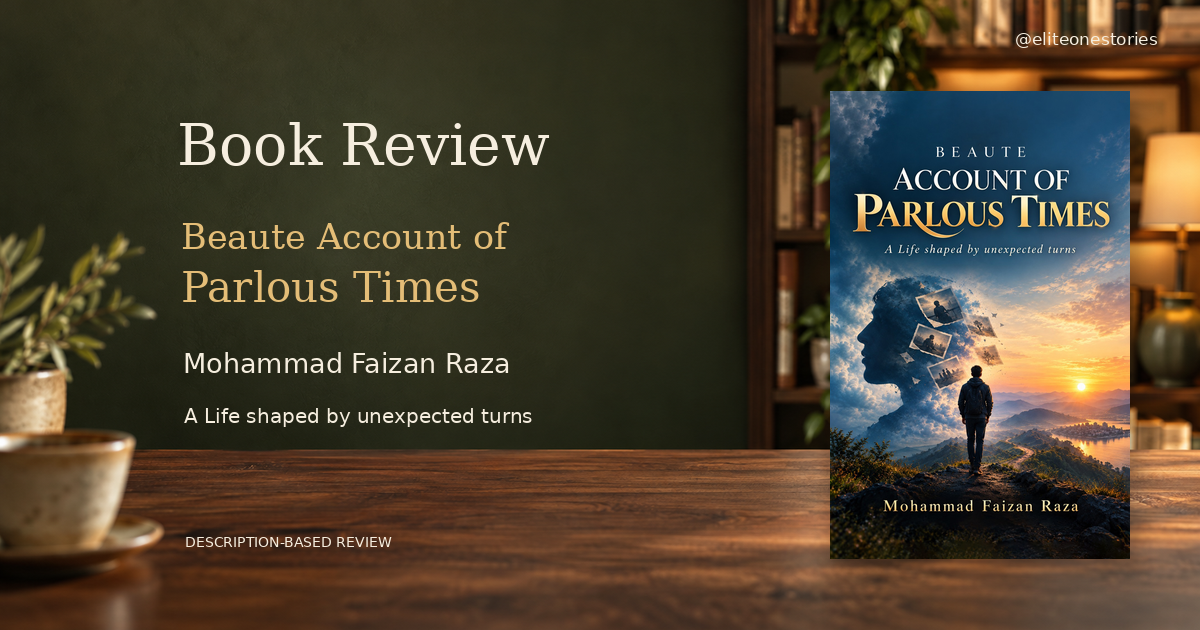
A Life shaped by unexpected turns
Book by Mohammad Faizan Raza
A future can look straightforward before it has to be lived. That distance between expectation and experience is the most compelling idea in the description of Beaute Account of Parlous Times by Mohammad Faizan Raza. The book follows Ahsan from small-town classrooms into an unfamiliar city, on a journey involving failure, self-doubt and relationships. Its subtitle, A Life shaped by unexpected turns, places unexpected change at the centre of Ahsan’s development. This is a description-based review, drawing on the supplied synopsis and author biography rather than a reading of the manuscript. It evaluates the book’s stated premise and possible appeal, not its literary execution.
The premise asks a useful question about the measures by which a young life is judged. Ahsan begins with dreams and expectations, but the description gradually shifts attention towards his ability to continue as circumstances become more demanding. A destination remains part of the language of the story, yet reaching it is no longer the only way to understand growth. This is a promising basis for fiction because it opens up the space between setting an aim and knowing how to live when that aim becomes uncertain. It makes room for a character whose development may be difficult to measure from the outside.
Ahsan is introduced as one of many young people looking towards a future that seems ready to be discovered. The familiarity of that starting point is a strength of the book’s presentation. It offers readers an immediate way to understand his expectations before asking them to consider the disappointments that follow. The emotional interest lies in how a person responds when experience no longer confirms an early picture of life. The description does not disclose Ahsan’s particular dreams, leaving their details to the book. Its emphasis is on the vulnerability of having expectations at all, a concern that can carry beyond one character’s circumstances.
The change of setting sharpens this concern. A small-town classroom and the streets of an unfamiliar city represent different stages in Ahsan’s journey, giving the account of growing up a concrete movement through places. Leaving familiarity can make uncertainty more immediate: the questions of what to do next and how to understand oneself arise in surroundings that must also be learned. This is an interpretation of the transition described, rather than evidence of a particular scene. Without named locations or further context, the strongest reading of the setting is as part of Ahsan’s adjustment, not a claim about any specific town or city.
The pairing of failure with self-doubt is especially significant to the book’s introduction. It points towards the consequences that a setback can have after the immediate event has passed. An unsuccessful effort can become a question about personal ability, or about whether an earlier hope still deserves to be pursued. The description does not say which decisions Ahsan makes in response. It does, however, establish a protagonist for whom difficulty has an emotional dimension. Readers looking for fiction concerned with uncertainty and confidence may find that emphasis more inviting than a premise built only around an outward sequence of obstacles.
Friendship and family prevent that emotional emphasis from becoming detached from the people in Ahsan’s life. Both are included among the experiences through which he grows, although the synopsis gives no details about individual relationships. Their inclusion creates the possibility of a fuller account of endurance, one attentive to the people with whom uncertainty is shared. It would be unjustified to assign any character a supportive or antagonistic role on this evidence. What can be valued at the level of the premise is the recognition that a young person’s attempts to continue take place among relationships, not in an empty social world.
The description’s closing idea, of a boy remaining on his feet as life becomes heavier, is the clearest statement of the book’s appeal. It gives attention to persistence while difficulty is still present. That emphasis may interest readers who want a story to acknowledge the effort of carrying on before it offers the satisfaction of resolution. It also sets a demanding standard for the full narrative: endurance is most persuasive when a character’s pressures and responses feel particular. The synopsis establishes the intended concern, but only the text can show how convincingly that concern is developed into a lived fictional experience.
Raza’s work as both a poet and a prose writer offers a relevant context for this subject. His biography identifies life, emotions, relationships and human experiences as recurring interests, with inspiration coming from personal experience and the wider world. Beaute Account of Parlous Times fits that account at the level of its subject. His first book, a Shayari collection, is being revised for publication, while this fiction is described as his second book. These details introduce a writer working across forms; they do not establish the language, rhythm or narrative method of this particular work. Those remain questions for a full-text review.
As presented, the book is most likely to interest readers of reflective coming-of-age fiction and stories about adapting to an unfamiliar stage of life. Its potential value lies in the attention it gives to adjustment itself. Readers may recognise the distance between what they once expected and what later became necessary, without needing Ahsan’s circumstances to match their own. This is a basis for possible connection, not a guarantee of a particular emotional response. The book’s description offers an invitation to follow a developing life whose significance rests partly in the willingness to keep moving when certainty is unavailable.
Beaute Account of Parlous Times therefore begins with a clear thematic proposition: growing up includes learning how to continue through changes one could not fully anticipate. Its description brings that proposition into focus through Ahsan’s changing surroundings, shaken confidence and relationships. The premise is accessible, and its emphasis on endurance gives prospective readers a useful sense of what to look for. A judgement of its success as fiction must await the manuscript. On the material available, its strongest promise is an attentive account of the interval between the future a young person imagines and the life he must learn to inhabit.