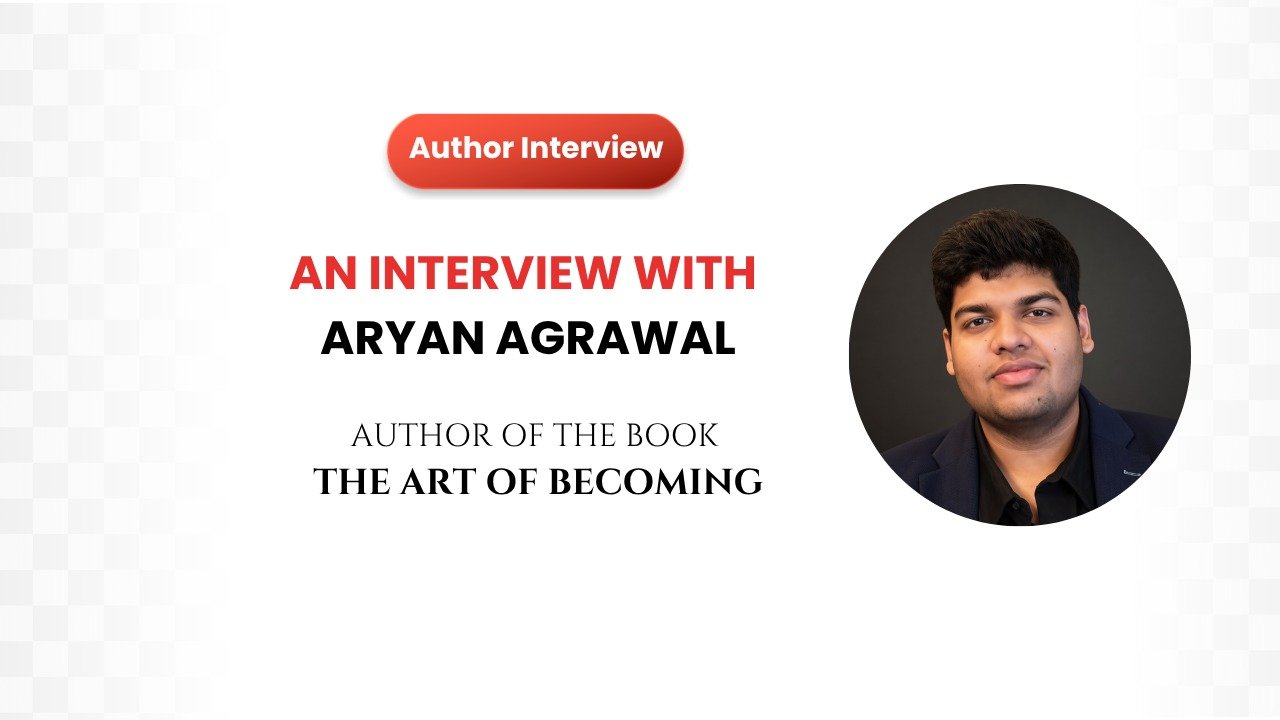
Title: The Art of Becoming
Author: Aryan Agrawal
Publisher: Evincepub Publishing
About the Author
Aryan Agrawal, author of The Art of Becoming: The Illusion That Builds You, brings a fresh perspective to confidence, identity, and adaptability. Founder of Sunrise Exports Pvt. Ltd. and Director of Aryan Public School, Aryan developed his philosophy through personal experience – first as a quiet observer, then as someone learning to adapt across schools, cities, business spaces, and relationships. His book explores how people naturally wear different “masks” in different situations and how those identities can be used consciously without losing authenticity. Through 42 practical chapters, Aryan encourages readers to build confidence, read situations better, and grow with purpose.
Neel Preet: The Art of Becoming grew from your own experience of being a quiet student who began observing how people communicate, influence others, and adapt to different social environments. At what point did you realise that these personal experiments could become a complete philosophy – and eventually a book?
Aryan Agrawal: It wasn’t one single moment – it was a pattern that kept repeating. As a quiet observer, I noticed I behaved differently in a classroom, on a business call, or with strangers, and each version worked better in its own context. Once I saw that this shifting wasn’t fake but functional, I started documenting it. Somewhere around the 15th or 20th “situation” I’d broken down this way, I realized I wasn’t just coping – I had a repeatable system. That’s when it stopped being self-help notes and became a book.
Neel Preet: One of the book’s central ideas is that we do not need to become completely different people; rather, we need to become “fluent” in who we already are and learn which version of ourselves a particular situation requires. How would you explain this idea to someone who worries that adaptation means losing authenticity?
Aryan Agrawal: Adaptation isn’t about becoming someone else – it’s about knowing your own range and choosing the right note for the room. A musician doesn’t lose their identity by playing different pieces; they express more of who they are by having more range. The person underneath stays constant; only the version you lead with changes.
Neel Preet: You draw a strong distinction between pretending and becoming. In your view, what is the clearest sign that a person has genuinely developed a new quality rather than simply performing it for others?
Aryan Agrawal: The clearest sign is consistency without an audience. Pretending needs a witness – it collapses the moment no one’s watching. Becoming shows up even when it’s inconvenient, unrewarded, or unobserved. If the quality still holds up alone, in private, under pressure – it’s real.
Neel Preet: The word “mask” appears throughout the book, but you do not necessarily treat masks as dishonest. Why did you choose this metaphor, and when does a useful social mask cross the line into unhealthy performance?
Aryan Agrawal: I chose “mask” because masks aren’t inherently dishonest – actors, professionals, even parents wear them functionally. It crosses into unhealthy performance when the mask exists to hide rather than to adapt: when it’s maintained out of fear of being seen, not out of fit for the situation, and when removing it starts to feel unsafe rather than just unfamiliar.
Neel Preet: You argue that confidence is not necessarily something people are born with, but something that can be built through action, repetition, preparation, and experience. Which personal experience convinced you most strongly that confidence can be learned?
Aryan Agrawal: It was almost always the moments I had zero natural confidence for – walking into a room as the “quiet one” and having to act decisive anyway – where the confidence built afterward, not before. Doing it once, badly, and surviving, taught me more than any pep talk could. Repetition, not personality, built the confidence.
Neel Preet: The book describes different “shades of confidence” – fake confidence, over-confidence, under-confidence, and generated confidence. Why do you consider generated confidence the most sustainable form, and how can a young person practically begin building it?
Aryan Agrawal: Fake confidence has no substance behind it; over-confidence ignores feedback; under-confidence refuses to act. Generated confidence is earned through actual reps – preparation, small wins, direct experience – so it doesn’t collapse under pressure. A young person can start small: pick one low-stakes situation a week, prepare slightly more than feels necessary, and let the result, not the mood beforehand, be the evidence they collect.
Neel Preet: You write extensively about fear and suggest that the real problem is not fear itself, but allowing fear to stop action. Do you think fear should be conquered, managed, or simply carried with us while we move forward?
Aryan Agrawal: Carry it forward. Trying to “conquer” fear treats it as an enemy to defeat once and for all, which sets people up for disappointment when it returns. The real skill is acting with fear present – not waiting for it to disappear before moving.
Neel Preet: Your framework often asks readers to imagine the person they want to become before taking action. How do you prevent this future-self exercise from becoming fantasy or wishful thinking instead of genuine transformation?
The difference between fantasy and transformation is whether the exercise is followed by action within 24–48 hours. Imagining the future self is only useful as a rehearsal for a specific next step – not as an end in itself. If there’s no immediate, concrete action attached, it’s just wishful thinking.
Neel Preet: An interesting idea in the book is that a temporary persona can act as a kind of “experiential catalyst” – helping someone enter a situation they are afraid of until the experience eventually becomes natural. Can you share a real example from your own life where you first “borrowed” confidence and later genuinely developed it?
Aryan Agrawal: This is actually one of the clearest examples from my own life. Before I started the export business, I applied for a job at an export firm – and I genuinely didn’t know how any of it worked. I didn’t know where to apply, what the process looked like, or honestly, whether anyone would even take a chance on me. So I stepped back and asked a different question: what kind of person would they actually hire? I broke it down – what qualities that person would need to have, and which of those I already possessed versus which I didn’t yet have. Once I could see the gap clearly, I didn’t wait to “become” that person over years. I built a mask of exactly that person – the one who was going to get the job – and I stepped into it deliberately. I told myself, with full conviction, “I am that person, and I am getting this job.” That wasn’t fake confidence – I wasn’t pretending the gap didn’t exist. It was generated confidence: I’d done the work of identifying exactly what was needed, and the mask gave me a way to act like that person before I fully felt like him. I walked in, carried that persona through the interview, and got the job. And over time, actually doing the work, the mask stopped being something I was wearing – it became who I actually was. That’s the whole idea of the book in miniature: the mask gets you through the door, but the experience behind it is what makes it real.
Neel Preet: Many people are already different versions of themselves with parents, friends, teachers, colleagues, clients, and strangers. What separates healthy adaptability from manipulation?
Aryan Agrawal: Intent and outcome. Adaptability serves the relationship – it makes communication clearer and more comfortable for both people. Manipulation serves only the adapter, often at the other person’s expense. If you’d be comfortable with the other person knowing exactly how and why you adjusted, it’s adaptability.
Neel Preet: You discuss “reading the room” as an important social skill. What do you think people most commonly fail to notice when entering a new social or professional environment?
Aryan Agrawal: Most people read content – what’s being said – and miss structure: who’s actually driving the conversation, what unstated rule is operating, and what mood is underneath the words. The biggest miss is walking in with a fixed plan for how you want to come across, instead of first observing what the room needs.
Neel Preet: The book also explores the online mask and the group chat self. Do you think social media has made young people more adaptable – or has it made them more uncertain about which version of themselves is real?
Aryan Agrawal: More uncertain, more often. The online mask and the group chat self create so many parallel versions of a person that many young people lose track of which version is the “home base.” Adaptability is healthy when there’s a stable core to return to – social media multiplies the versions faster than most people build that core.