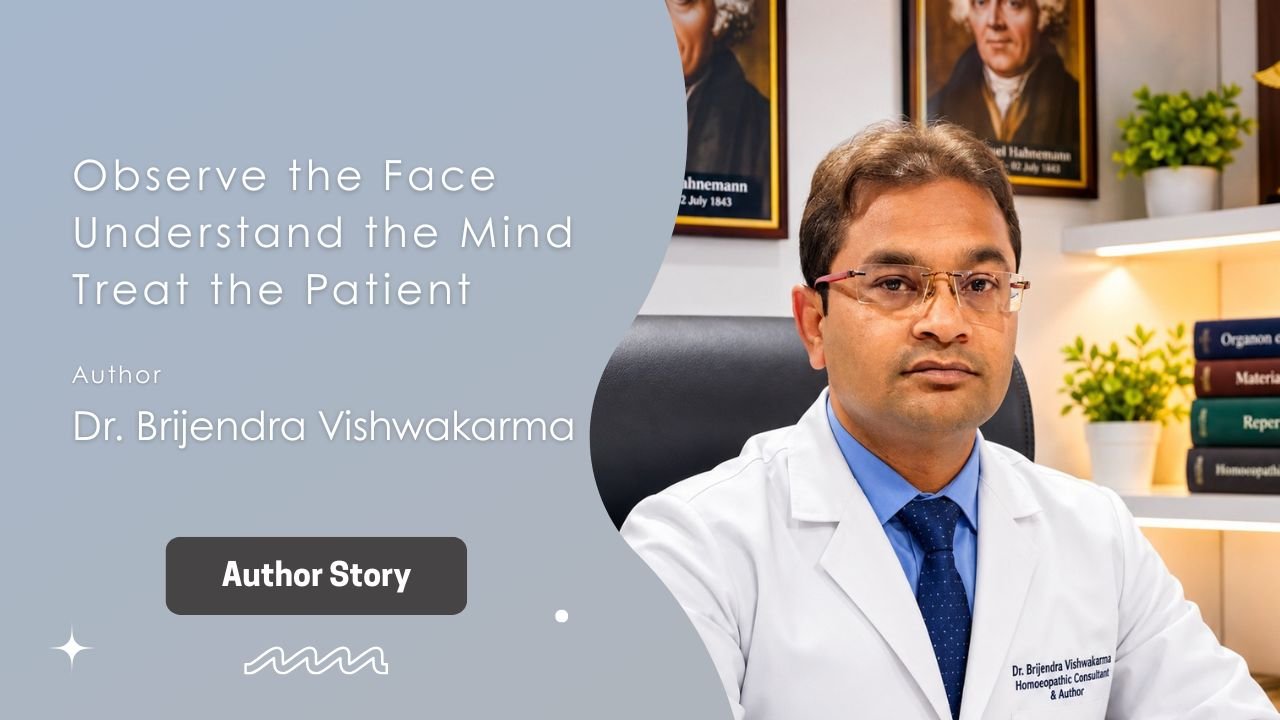
Title: Observe the Face. Understand the Mind. Treat the Patient
Author: Dr. Brijendra Vishwakarma
ISBN: 9789373355207
Publisher: Evincepub Publishing
In every medical system, there are doctors who treat diseases and there are doctors who try to understand the person behind the disease. Dr. Brijendra Vishwakarma belongs to the second group. His book Observe the Face. Understand the Mind. Treat the Patient: A Homoeopathic Physician’s Guide to Facial Expressions, Personality and Clinical Observation is not only a guide for Homoeopathic practitioners but also a reflection of his deep belief that healing begins with careful observation. As a reviewer, what stands out most is that this book does not make unrealistic claims about face reading or personality judging. Instead, it encourages doctors and students to become better observers, better listeners, and more thoughtful physicians. The title itself carries a complete philosophy. Before selecting a medicine, before looking at reports, and before reaching a conclusion, the doctor must first observe the patient. This simple but powerful idea becomes the foundation of the entire book and also of Dr. Vishwakarma’s journey as a Homoeopathic physician and author.
Dr. Brijendra Vishwakarma has more than fourteen years of clinical experience in Homoeopathy and holistic healthcare. He completed his BHMS from Barkatullah University, Bhopal, and later founded Vital Touch Homoeopathic Clinic, Centre for Holistic Cure, in Bhopal. His work has always focused on understanding patients at the physical, mental, and emotional levels. One of the most inspiring parts of his story is that his faith in Homoeopathy became stronger through his own experience with illness. After suffering from Gastroesophageal Reflux Disease and finding limited relief through conventional treatment, he underwent Homoeopathic treatment under Dr. Amol Kirar and experienced significant improvement. This personal experience became a turning point in his life and encouraged him to dedicate himself completely to the study and practice of Classical Homoeopathy. His background also includes experience in ICU and ICCU settings in allopathic hospitals, which gives him a wider understanding of patient care. This combination of personal healing, clinical practice, and continuous learning has shaped the thoughtful and balanced approach seen throughout the book.
What makes Observe the Face. Understand the Mind. Treat the Patient different from many clinical books is its respect for both tradition and modern understanding. Dr. Vishwakarma draws inspiration from great Homoeopathic teachers such as Dr. Samuel Hahnemann, Dr. James Tyler Kent, and other masters of Classical Homoeopathy, while also bringing in ideas from psychology, behavioural science, and non verbal communication. The book is organised into ten practical chapters that explore the face, eyes, forehead, eyebrows, smile, lips, jaw, chin, movement, posture, voice, and constitutional tendencies. Every chapter reminds the reader that observation should never become assumption. A patient who avoids eye contact is not automatically insecure. A serious face does not always mean sadness. A smile may hide emotional pain. This careful distinction between observation and judgment gives the book credibility and maturity. Dr. Vishwakarma repeatedly reminds readers that the face offers clues, the patient tells the story, and the totality of symptoms guides the prescription. This is one of the strongest messages in the book and one that every medical student and practitioner can learn from.
Another important strength of the book is its practical value. It is written in a clear and organised manner that makes it useful for undergraduate students, postgraduate scholars, teachers, and experienced Homoeopathic physicians. The discussions are connected with remedy pictures and case taking, making the book relevant to daily clinical practice. Dr. Vishwakarma does not ask readers to memorise facial expressions or classify people into fixed personality types. Instead, he trains the reader to observe carefully, listen patiently, correlate intelligently, and prescribe cautiously. This practical approach reflects years of experience in consultation rooms where every gesture, pause, tone of voice, and emotional reaction may help the physician understand the patient more deeply. His writing shows respect for scientific observation and clinical responsibility. He also gives due importance to compassion, patience, and humility, qualities that are often discussed less in medical education but remain essential in patient care. Through examples, structured observations, and thoughtful explanations, the book helps readers improve one of the most important skills in medicine, the ability to truly observe.
Dr. Vishwakarma’s dedication to Homoeopathy goes far beyond this single book. He has authored several books and academic works on Homoeopathy, holistic healing, Materia Medica, mental state interpretation, case taking, miasms, potency selection, emergency care, and wellness. He has also studied under respected Homoeopathic teachers and researchers from India and abroad and has actively participated in national and international educational programmes. This continuous effort to learn and contribute to the field is visible throughout his writing. He acknowledges the guidance of teachers, colleagues, family members, and patients with sincerity and gratitude. The book is dedicated to his parents, wife, teachers, and the Homoeopathic community, showing that he sees medicine not only as a profession but also as a service built on relationships and learning. Such humility gives the work an honest and human quality. Rather than presenting himself as someone who has all the answers, Dr. Vishwakarma presents himself as a physician who continues to observe, learn, and grow with every patient encounter.
In the end, Observe the Face. Understand the Mind. Treat the Patient is much more than a book on facial expressions. It is a reminder that medicine begins with attention. It asks physicians to slow down, to watch carefully, to listen fully, and to respect the individuality of every patient. Dr. Brijendra Vishwakarma has successfully transformed years of clinical experience into a practical guide that is both educational and inspiring. The language is clear, the structure is systematic, and the message is deeply relevant for today’s healthcare environment, where technology often receives more attention than human observation. Whether one agrees with every Homoeopathic concept or not, the central lesson of the book is universal. A good doctor must first understand the person who is suffering. This makes the book valuable not only for Homoeopathic practitioners but also for anyone interested in patient centred care and clinical observation. Dr. Vishwakarma’s journey from a dedicated student to an experienced physician and thoughtful author deserves appreciation, and this book stands as a meaningful contribution to the literature of Homoeopathy and compassionate medical practice.