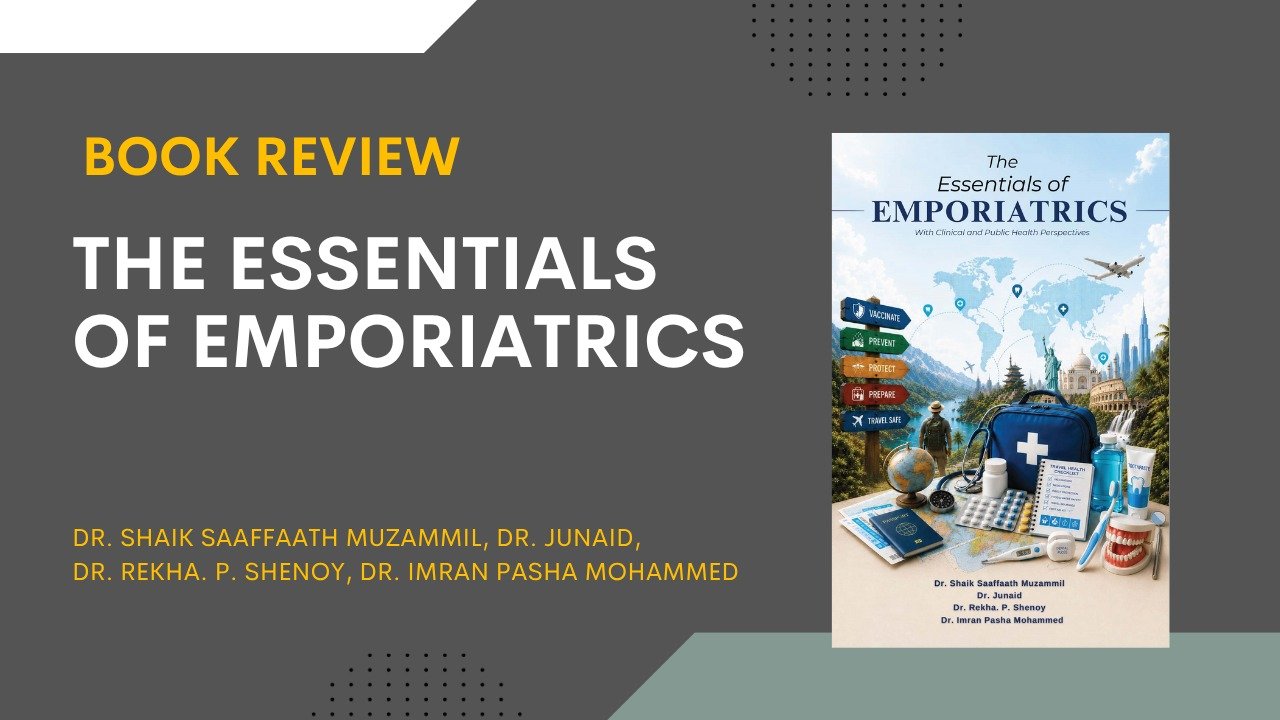
Title: The Essentials Of Emporiatrics
Author: Dr. Shaik Saaffaath Muzammil, Dr. Junaid, Dr. Rekha. P. Shenoy, Dr. Imran Pasha Mohammed
ISBN: 9789373351063
Publisher: Evincepub Publishing
There are books that arrive at the right moment, and then there are books that seem almost necessary for the times we live in. The Essentials of Emporiatrics belongs firmly in the latter category. In a world where international movement has become both routine and risky, this book offers a compelling exploration of travel medicine – not merely as a clinical discipline, but as a vital framework for understanding health in an increasingly mobile civilization.
At its core, this book is about preparedness. But it goes much further than simply listing vaccines or travel advisories. It asks a larger question: what does it mean to travel safely in a world where diseases, climates, cultures, and risks are constantly shifting?
That question forms the intellectual backbone of this ambitious work.
The term “Emporiatrics” itself may be unfamiliar to many readers, but the book does an admirable job of demystifying it. Travel medicine is introduced not as an isolated branch of healthcare but as an evolving intersection of epidemiology, tropical medicine, environmental science, and public policy. This layered understanding is one of the book’s greatest strengths. It recognizes that health no longer exists within borders; it moves with us.
What makes the book especially engaging is its historical consciousness. Rather than beginning with modern air travel, it traces the roots of travel-related illness back to ancient civilizations, religious pilgrimages, and the Silk Road. These chapters are particularly fascinating because they remind us that human movement has always carried both opportunity and vulnerability. Disease, as history repeatedly shows, has often travelled faster than knowledge.
The historical sections are not merely decorative; they deepen the reader’s understanding of why travel medicine became necessary in the first place. From the Black Death to colonial expeditions, from maritime scurvy to cholera outbreaks during pilgrimages, the book presents travel as one of history’s most powerful engines of both discovery and contagion.
Yet it is in its contemporary relevance that the book truly shines.
The post-COVID world has made everyone more aware of how interconnected health systems have become. A virus emerging in one region can disrupt lives across continents within weeks. The author uses this reality effectively to underline why emporiatrics matters – not just for doctors, but for policymakers, travellers, and society itself.
One of the most valuable contributions of the book is its insistence on prevention as philosophy. This is not reactive medicine. It is medicine that anticipates. Whether discussing yellow fever vaccinations, malaria prophylaxis, or traveller’s diarrhoea, the text consistently emphasizes that informed preparation can prevent unnecessary suffering.
This approach feels refreshingly practical.
The sections on vector-borne diseases are particularly detailed and useful. Malaria, dengue, Zika, chikungunya, and yellow fever are discussed not only in medical terms but in relation to geography, seasonality, and traveller behavior. This contextualization makes the information easier to absorb and more meaningful.
Equally noteworthy is the attention given to non-infectious dangers.
Too often, travel health literature focuses exclusively on pathogens. This book wisely expands the conversation to include road accidents, altitude sickness, environmental hazards, dehydration, and even mental health challenges. This broader lens reflects real-world travel far more honestly. Sometimes the greatest risk on a journey is not an exotic virus but fatigue, carelessness, or poor planning.
The inclusion of psychological well-being deserves special praise. Culture shock, loneliness, sleep disruption, and emotional strain are rarely treated seriously in travel medicine texts. Here, they are given space, and rightly so. Travel changes the mind as much as it challenges the body.
Stylistically, the book is methodical and information-rich. It leans heavily into academic precision, which works well for medical students, clinicians, and researchers. The prose is clear, though occasionally dense, and the abundance of scientific references reinforces its credibility. This is not casual reading, but it is deeply rewarding for those willing to engage with it.
Perhaps what lingers most after reading The Essentials of Emporiatrics is the realization that travel has never been as simple as movement from one place to another. It is an encounter – with new landscapes, new pathogens, new vulnerabilities, and new responsibilities.
This book captures that complexity with intelligence and urgency.
It reminds us that in a globalized world, health is shared. The traveller is not separate from the world they enter; they become part of its biological and social systems. That insight alone makes this book important.
For medical professionals, it is an excellent educational resource. For students, it is a comprehensive introduction to an expanding field. And for the thoughtful traveller, it offers something equally valuable: awareness.
Because the truth is simple – every journey carries risks. The wisdom lies in understanding them before the journey begins.
And that is precisely what this book teaches so well.
Buy on Amazon: https://www.amazon.in/Essentials-Emporiatrics-Shaik-Saaffaath-Muzammil/dp/9373351060
Review by Neel Preet
For Eliteonestories.com