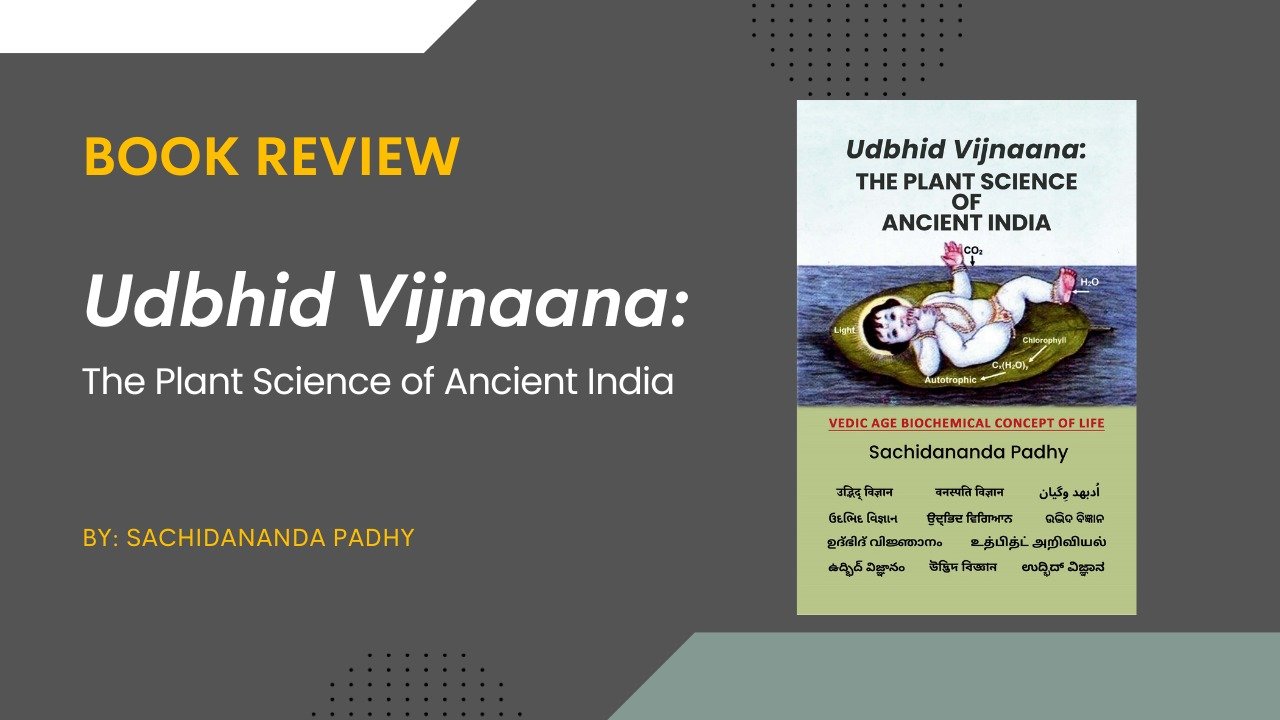
Title: Udbhid Vijnaana: The Plant Science of Ancient India
Author: Sachidananda Padhy
ISBN: 9789373356150
Publisher: Evincepub Publishing
Modern science often looks toward the future, but some of its most fascinating discoveries begin with a thoughtful examination of the past. Udbhid Vijnaana: The Plant Science of Ancient India (Aspects of Ethnobotanical Investigation) by Sachidananda Padhy is one such work. Rather than presenting ancient Indian knowledge as mythology or folklore alone, the author attempts to examine centuries-old botanical understanding through a scholarly and research-oriented lens. The result is a book that bridges history, culture, Sanskrit literature, and plant science in a way that is both ambitious and intellectually stimulating.
At first glance, the title may suggest that this is simply another academic work on ethnobotany. However, the book goes far beyond documenting plants or cataloguing traditional practices. It explores how ancient Indian civilization perceived the plant world-not merely as a biological resource but as an integral part of philosophy, medicine, agriculture, spirituality, architecture, ecology, and everyday life. This multidisciplinary approach makes the work stand out from conventional botanical literature.
One of the book’s greatest strengths is its extensive exploration of Sanskrit texts, epics, and ancient manuscripts. Rather than treating these literary sources as symbolic narratives, the author studies them as repositories of scientific observation. Throughout the chapters, readers encounter discussions on plant classification, botanical terminology, medicinal significance, environmental ethics, and ecological awareness that existed long before modern scientific terminology became widespread.
The structure of the book reflects years of careful research. Beginning with an introduction to ancient plant science, the narrative gradually expands into discussions on traditional writing systems, concepts of life, legendary sages, biodiversity, microbiology, nomenclature, and environmental conservation. Each chapter builds upon the previous one, creating a comprehensive picture of how plants occupied a central position in India’s intellectual and cultural heritage.
Perhaps the most fascinating aspect of the book is its emphasis on Sage Paraasara, whom the author presents as one of the earliest pioneers of botanical science. While many readers are familiar with figures associated with Ayurveda or philosophy, few may know about the botanical observations attributed to Paraasara. The author’s effort to highlight these contributions encourages readers to reconsider the historical timeline of botanical knowledge.
Equally engaging is the discussion surrounding Saint Kannva and early concepts resembling microbiology. Although modern readers may approach some historical interpretations cautiously, the author’s intention is not to diminish contemporary science but to encourage a broader appreciation of indigenous intellectual traditions. This balanced curiosity makes the book thought-provoking rather than dogmatic.
Environmental consciousness emerges as another central theme. Long before sustainability became an international concern, ancient Indian traditions emphasized harmony between humans and nature. The chapters discussing phytodiversity, ecological restoration, and plant consciousness remind readers that conservation is not merely a modern scientific agenda but has deep cultural and philosophical roots. In an age of climate change and biodiversity loss, these reflections feel remarkably relevant.
The book also demonstrates the richness of ethnobotanical knowledge embedded within folklore, dreams, architecture, rituals, and traditional lifestyles. Subjects such as insect-repellent plants, Vaastu-related vegetation, sacred species, and plant symbolism illustrate how scientific observations often coexisted with cultural practices. Whether every interpretation convinces the reader is less important than the broader realization that traditional societies observed nature with extraordinary attentiveness.
From a literary perspective, the work maintains an academic tone throughout. This is not a popular science book designed for casual reading over a weekend. Instead, it resembles a reference volume intended for serious readers, researchers, university students, historians, botanists, Sanskrit scholars, and anyone interested in India’s knowledge systems. Readers seeking simplified explanations may occasionally find the density of information challenging, but those willing to invest time will discover a wealth of material rarely brought together in a single volume.
One particularly admirable quality is the author’s evident respect for both tradition and investigation. Rather than asking readers to accept historical claims unquestioningly, the book repeatedly encourages observation, documentation, and scholarly inquiry. This spirit of exploration aligns well with scientific thinking itself.
The production of the book further reflects its research-oriented nature. Extensive chapter organization, historical references, thematic continuity, and interdisciplinary discussions make it suitable for academic libraries and research institutions. It also serves as an important reminder that the history of science is far more diverse than commonly represented in mainstream narratives.
Ultimately, Udbhid Vijnaana succeeds because it invites readers to look beyond the conventional boundaries separating science, culture, and history. It demonstrates that ancient literature can serve as an important source for understanding humanity’s long relationship with the natural world. Whether one agrees with every historical interpretation or not, the book unquestionably stimulates curiosity and encourages further exploration.
For readers interested in ethnobotany, Indian scientific heritage, biodiversity, or environmental philosophy, this is an engaging and valuable contribution. It enriches discussions on indigenous knowledge while reminding us that many ideas considered modern today have roots extending deep into human civilization.
Rating: ★★★★☆ (4.8/5)
Udbhid Vijnaana is a meticulously researched work that successfully reconnects readers with the botanical wisdom preserved in India’s ancient intellectual traditions. It is an important addition to the growing literature on indigenous science and ethnobotanical history.
Buy on Amazon: https://www.amazon.in/Udbhid-Vijnaana-Plant-Science-Ancient/dp/9373356151
Review by Neel Preet
For Eliteonestories.com