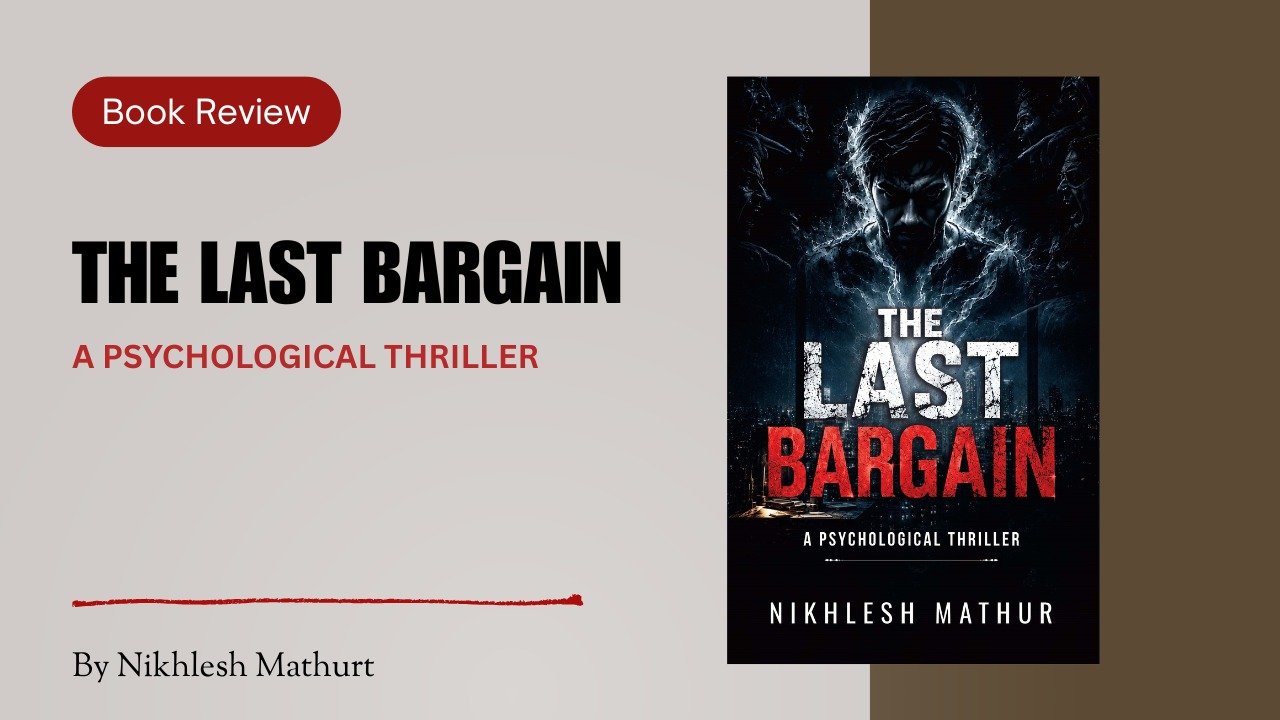
Title: The Last Bargain
Author: Nikhlesh Mathur
Publisher: Evincepub Publishing
At 2:15 in the morning, a man who has spent years avoiding confrontation drives through an empty city at more than 120 kilometres per hour.
That alone tells us that something is wrong.
VK, the central character of Nikhlesh Mathur’s The Last Bargain, is not the sort of man one expects to find deliberately waiting on a deserted road for someone he hates. He is usually hesitant, physically unimposing and accustomed to swallowing humiliation rather than answering it. Yet on this particular night, he confronts Mahendra, the muscular bully who has tormented him for years, and defeats him with almost unbelievable strength.
Then morning arrives.
VK is back in bed.
His wife Sareeta remembers him being there during the night.
And VK himself is not completely sure whether the assault actually happened.
Mahendra, unfortunately, is very sure.
This contradiction gives The Last Bargain its most effective early mystery and immediately turns an ordinary revenge fantasy into something much stranger.
Mathur’s novel works best when it makes both VK and the reader doubt what they know. Another nighttime incident produces information VK should never have possessed. People claim to have seen him in places he could not logically have visited. His memories resemble dreams, yet evidence from the waking world keeps suggesting that those dreams occurred.
The result is a thriller driven not simply by the question “Who did it?” but by the far more unnerving question: “Where was VK when it happened?”
That question becomes darker because VK has reasons to resent almost everyone who enters his life.
Mahendra humiliates him publicly. Rana, his office superior, abuses and insults him. Sahani enjoys mocking him and benefits professionally at his expense. At home, Sareeta’s frustration repeatedly strikes at his deepest insecurity. Even when VK receives praise, it often arrives with suspicion attached.
He is a man starved of respect.
And that makes his transformation dangerous.
One of the clever things about The Last Bargain is that it allows readers to experience a certain satisfaction when VK first fights back. After watching him endure humiliation, seeing him overpower Mahendra initially feels almost cathartic. But Mathur gradually removes that comfort. Revenge stops looking like justice once mysterious deaths begin accumulating.
By the time the police are examining multiple deaths connected to people who had antagonised VK, the emotional equation has completely changed. Investigators recognise that VK has motive, yet his physical whereabouts make the cases almost impossible to explain.
Then the book changes gears.
Enter Rajshekaran.
The scientist introduces one of the novel’s most unusual elements: an illegal experimental programme involving a virus or compound capable of affecting the nervous system and human consciousness. VK becomes trapped in the experiments after allowing himself to be injected. Once the process begins, Rajshekaran warns him that stopping before the concluding dose could be fatal.
This is where the book moves beyond a conventional psychological thriller.
What appeared to be some unexplained second personality begins to acquire a disturbing scientific framework. Later, VK learns that he is Subject 009. Earlier subjects have died or been eliminated after becoming unstable, while something unusual in VK’s biology appears to have allowed him to survive longer than expected. Ruhani’s investigation suggests that the compound may enable part of a person’s consciousness to function independently of the physical body.
Whether one chooses to interpret this as science fiction, supernatural fiction or a meeting point between the two is part of the pleasure of the novel.
Ruhani is also one of the characters who grows considerably in importance. She begins within VK’s personal world as a woman he desires and idealises, particularly because his marriage leaves him emotionally insecure. But she eventually becomes connected to the larger conspiracy. Her attempt to investigate suspicious pharmaceutical activity and Rajshekaran’s work changes her from a romantic distraction into someone carrying vital information.
Sareeta, however, may be the more interesting relationship in the book.
The marriage is messy. Sareeta can be cruel with words, while VK is emotionally withdrawn, resentful and increasingly attracted to Ruhani. Yet as the danger grows, their relationship stops functioning merely as domestic conflict and becomes part of the novel’s emotional core. Sareeta sees things in VK that neither the police nor VK himself can properly understand. When medical equipment suggests that VK’s heart had shown no electrical activity for an extraordinary period even though his body remained alive, her immediate fear is not simply that he is dying. She wonders whether his soul has wandered again.
Those are the moments when the title begins to acquire its real force.
VK wanted strength. He wanted courage. He wanted revenge. He wanted people to stop laughing at him.
But every wish has a price.
The novel repeatedly asks whether gaining the ability to fulfil one’s darkest desires is actually a gift. VK’s hidden self appears capable of doing what his ordinary self cannot—but it also acts with a violence and freedom that frighten him. Power has arrived without wisdom.
The wider conspiracy adds another layer. Rajshekaran’s work is not taking place in isolation. Political connections, illegal funding and powerful interests make it increasingly difficult to separate scientific wrongdoing from institutional corruption. Even when truth emerges, the people controlling the system remain capable of deciding which version of that truth reaches the public. The later investigation is deliberately left with unresolved shadows rather than a perfectly neat cleansing of every wrongdoing.
That choice suits the atmosphere of the novel.
The Last Bargain is not a quiet book. It moves through violence, desire, jealousy, scientific experimentation, police investigation and conspiracy with considerable energy. Readers looking for strict realism may find its central idea unusual, but those comfortable with genre-crossing fiction are likely to enjoy the unpredictability.
What remains most memorable is VK himself.
He begins as a man desperate to become stronger.
By the end, the more important question is whether strength was ever what he truly needed.
And that is the bargain at the heart of the story.
Buy on Amazon: https://www.amazon.in/Last-Bargain-Nikhlesh-Mathur/dp/9373354108