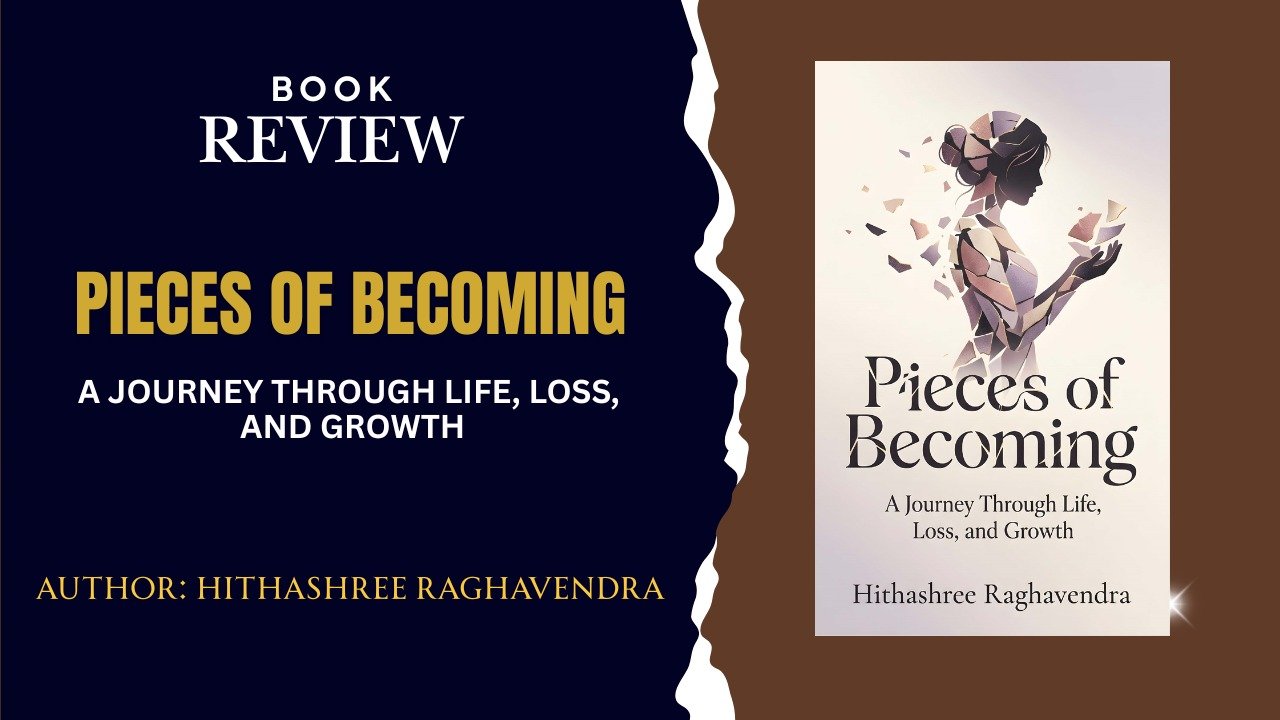
Title: Pieces Of Becoming
Author: Hithashree Raghavendra
Publisher: Evincepub Publishing
Hithashree Raghavendra’s Pieces of Becoming is not a conventional self-help book, nor does it pretend to be one. It is closer to a reflective companion—an intimate collection of thoughts on growing up, relationships, fear, expectations, regret, acceptance, and the difficult but necessary act of moving forward. From the beginning, the author makes her intention clear: she does not want to give readers fixed answers. Instead, she invites them to pause, question, remember, and perhaps recognize pieces of their own lives in her reflections.
The book begins with a deceptively simple question: what is the purpose of life? Rather than reducing the answer to success, love, happiness, or achievement, Raghavendra suggests that purpose changes as we change. Childhood, adolescence, adulthood, family, career, failure, and relationships all produce different versions of the self. This idea becomes the thread connecting the entire book. “Becoming” is presented not as a dramatic transformation but as a gradual accumulation of experiences—some joyful, some painful, and some understood only much later.
One of the strongest aspects of the book is its accessibility. Raghavendra does not rely on complex philosophical language. Her observations are grounded in familiar situations: failing an exam, missing childhood, losing a friendship, being misunderstood, comparing oneself with others, regretting a decision, or wondering whether a close bond is friendship, love, admiration, or attachment. These examples make the book especially relatable to young adults and readers who are in a period of transition.
The chapters on relationships are particularly engaging. “Chemistry of Connections” uses scientific imagery to describe different kinds of friendships. Casual and deeper bonds are compared with different chemical structures, while certain people are described as catalysts—individuals who may not stay forever but still alter the course of our lives. It is a playful metaphor, but it also expresses one of the book’s recurring truths: permanence is not the only measure of a meaningful relationship. Some people leave, yet what they taught us remains.
This idea flows naturally into chapters such as “Was It Love?”, “Misunderstanding,” and “The Unsaid Things.” Here, the author explores the uncertainty that often surrounds modern relationships. She writes about labels, assumptions, delayed messages, unspoken gratitude, silent affection, and friendships that fade not because people stopped caring but because neither person spoke clearly. The discussion is less about assigning blame and more about showing how easily silence becomes a story we tell ourselves. In a time when communication is constant but understanding is often fragile, these chapters feel particularly current.
The book also turns inward. “Judgment” and “Expectations” examine the pressure created by other people’s opinions as well as the harsher standards we place on ourselves. Raghavendra is most convincing when she reminds readers that comparison can distort our sense of worth. The discussion of social media is brief but relevant: we compare our ordinary days with carefully selected highlights from other people’s lives and then wonder why our own progress seems insufficient. Her answer is not to abandon ambition, but to replace impossible standards with realistic growth.
The emotional arc becomes more mature in the later chapters. Regret leads into acceptance; acceptance leads into letting go; letting go becomes moving on; and moving on finally opens into hope. This progression gives the book a satisfying structure. Acceptance is presented not as approval of what happened, but as the decision to stop fighting an unchangeable reality. Letting go, similarly, does not mean erasing a person, dream, or memory. It means refusing to live permanently inside the past. Moving on is then shown as a repeated process rather than a single brave decision.
The chapter on hope is an effective conclusion to this journey. Hope, in Raghavendra’s view, is not certainty that life will follow the plan we once imagined. It is the willingness to believe that something meaningful can still emerge when that plan changes. The image of an artist adapting a painting after an unexpected mistake captures this beautifully: a changed picture is not necessarily a ruined one.
Stylistically, Pieces of Becoming is direct, conversational, and sometimes deliberately unfinished in rhythm. Readers looking for dense philosophy or formal psychological analysis may find the treatment of certain topics simple. Yet simplicity is also the book’s strength. Its purpose is not to prove theories but to create recognition. The author writes as someone thinking alongside the reader rather than lecturing from a distance.
The final reflective section strengthens that sense of participation. Instead of ending with a neat conclusion, the book asks readers to examine their own beliefs, expectations, connections, mistakes, and unspoken truths. That choice feels appropriate because the book’s central argument is that becoming is never finished.
Pieces of Becoming is best read slowly rather than in a single rush. Some chapters may feel more personal than others, depending on where the reader is in life. It is a thoughtful, sincere book for anyone who has outgrown an old version of themselves, lost a connection, questioned a choice, or needed permission to begin again. Its message is gentle but persistent: life changes us in fragments, and perhaps understanding those fragments is how we begin to understand ourselves.
Buy on Amazon: https://www.amazon.in/Pieces-Becoming-Hithashree-Raghavendra/dp/9373357115
Review by Neel Preet
For Eliteonestories.com