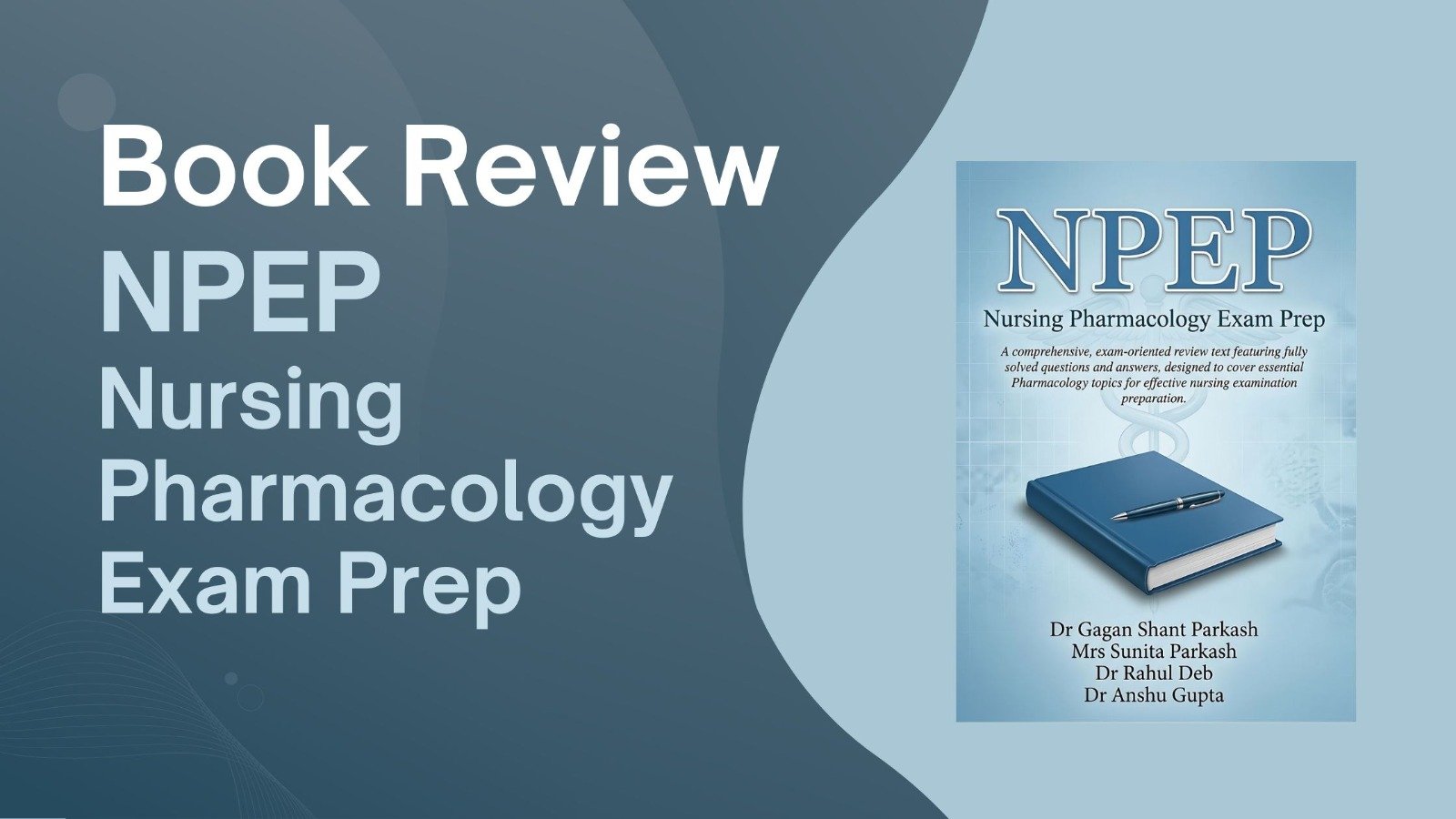
Title: NPEP Nursing Pharmacology Exam Prep
Author: Dr. Gagan S Parkash, Mrs. Sunita Parkash, Dr. Rahul Deb, Dr. Anshu Gupta
ISBN: 9789373354200
Publisher: Evincepub Publishing
Pharmacology is often considered one of the most challenging subjects in nursing education. With countless drug names, classifications, mechanisms of action, side effects, and clinical applications to remember, many students feel overwhelmed while preparing for exams. This is where NPEP – Nursing Pharmacology Exam Prep stands out as a practical, well-structured, and student-friendly guide. Written by Dr. Gagan S. Parkash, Mrs. Sunita Parkash, Dr. Rahul Deb, and Dr. Anshu Gupta, this book is designed specifically to simplify pharmacology and make exam preparation easier and more effective for BSc Nursing students.
From the very first few pages, the purpose of the book is clear – it is not just another textbook but an exam-oriented review guide created to help students revise quickly, understand concepts clearly, and perform confidently in university examinations. The authors acknowledge that pharmacology can be vast and heavily medical in orientation, which often makes it difficult for nursing students to grasp. To address this challenge, the content has been organized in a concise and systematic way, focusing on clarity, clinical relevance, and applied understanding rather than unnecessary complexity.
One of the strongest aspects of this book is its well-structured format. Each chapter is designed with a logical flow, making it easy for readers to follow and retain information. Important concepts are explained in a simplified language without compromising academic accuracy. The use of flowcharts, tables, abbreviations, and structured explanations helps students memorize key points quickly and revise effectively before exams. This format is particularly useful for last-minute preparation when students need to review important topics in a short amount of time.
The book covers a wide range of essential pharmacology topics required in the nursing curriculum. For example, in General Pharmacology, the explanations of concepts like bioavailability, polypharmacy, tachyphylaxis, and the essential drug concept are concise yet informative. These topics are not only important from an exam perspective but also highly relevant in clinical practice. The section on polypharmacy is particularly useful because it explains the causes, risks, and management strategies in a practical manner that nursing students can easily understand and apply.
Another standout feature is the emphasis on practical and clinical knowledge. The chapter on prescription writing, medical abbreviations, and principles of drug calculation is highly beneficial. Drug calculation is one of the most critical skills in nursing, and the book explains formulas such as dose calculation, weight-based dosing, and infusion rates in a clear and easy-to-follow manner. These sections not only help students score better in exams but also prepare them for real-life clinical responsibilities.
The inclusion of legal and ethical aspects of pharmacology further strengthens the book’s usefulness. Topics such as Indian Pharmacopoeia, drug schedules, informed consent, documentation, and adverse drug reaction reporting are discussed with clarity. This helps students understand the legal responsibilities associated with drug administration and patient safety – an area that is often overlooked in many exam preparation books.
Another impressive section is the discussion on pharmacovigilance and drug safety. In modern healthcare, monitoring adverse drug reactions and ensuring safe medication practices are crucial. The book explains pharmacovigilance in a structured and practical way, covering definitions, objectives, components, and the role of healthcare professionals – especially nurses – in ensuring drug safety. This not only enhances theoretical knowledge but also builds professional awareness among nursing students.
The chapter-wise abbreviation lists are another practical addition. Pharmacology is full of abbreviations that can confuse students, but this book simplifies learning by providing quick-reference abbreviation tables. Whether it is terms related to blood disorders, GI system drugs, chemotherapy, or antimicrobials, these lists save time and improve understanding.
What makes NPEP especially effective is its exam-oriented approach. The content appears to be aligned with common university exam patterns, including long answers, short answers, and important conceptual questions. This makes it highly suitable for students who want focused preparation rather than reading lengthy and overly detailed textbooks. The solved-answer style also gives students a better idea of how to frame answers in examinations.
In terms of language and presentation, the book is simple, direct, and easy to understand. Medical jargon is explained well, making it accessible even for students who struggle with technical terminology. The academic tone remains professional while still being approachable.
If there is one limitation, it is that students seeking extremely in-depth pharmacological explanations or advanced medical details may still need to refer to standard textbooks. However, that does not reduce the value of this book. In fact, the authors themselves clearly state that this book is meant as a companion for revision and reinforcement, not a replacement for comprehensive textbooks.
Overall, NPEP – Nursing Pharmacology Exam Prep is an excellent resource for nursing students who want a concise, exam-focused, and practical pharmacology guide. It successfully bridges the gap between theoretical pharmacology and nursing practice while keeping exam preparation at the center. With its simplified explanations, practical examples, structured presentation, and clinical relevance, this book can significantly reduce the fear associated with pharmacology.
For BSc Nursing students preparing for university exams, quick revisions, or clinical understanding, NPEP is a highly recommended and dependable study companion. It is not just a book for passing exams – it is a guide that helps build confidence and strengthens the foundation of safe and effective nursing practice.
Amazon: https://www.amazon.in/dp/9373354205
Review by Neel Preet
For Eliteonestories.com