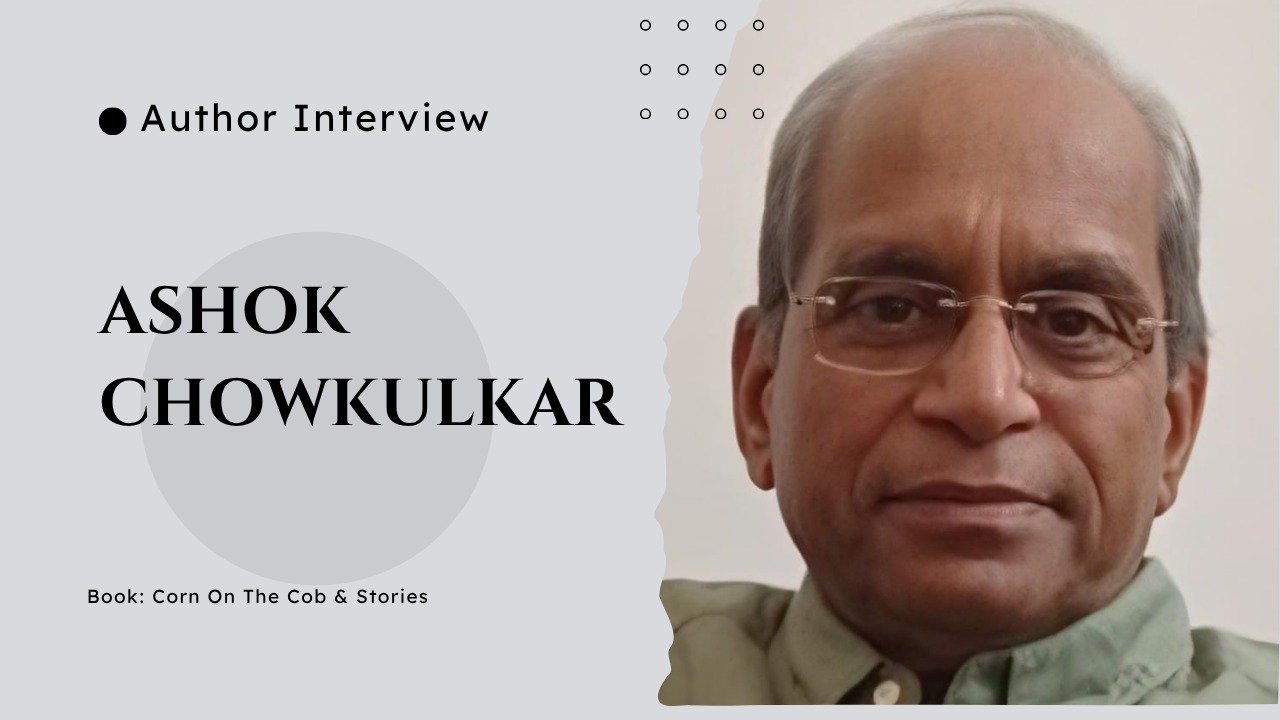
Title: Corn On The Cob & Stories
Author: Ashok Chowkulkar
ISBN: 9789373354255
Publisher: Evincepub Publishing
About the Author
Ashok Chowkulkar has donned many hats. From a veteran of the Central Reserve Police Force [CRPF] to the corporate legal world, leading to private legal practice. Throughout his life’s trajectory, he lived with, learned from, and was mentored by people from different walks of life, including top business leaders, decorated Police Officers, and Retired Army Officers. This is reflected in his stories and talks at seminars and training workshops, where he has been heralding the true spirit of Pay it Forward.
His extensive reading of fiction, non-fiction, biographies, and history, drawing lessons from business management principles, has helped him articulate his thoughts, expressions, and stories to motivate and mentor those who continue to seek his advice. Ashok is also a prolific writer and storyteller on Substack Page [ashnomics.substack.com], speaking on his YouTube Channel – Ashnomics and other podcasts. Apart from this, he regales in wit, humour and satire and has contributed his stories to publications. This book is his first for general readers, and the stories should resonate with them and their lives.
About the Book
What shapes a life? Not moments, but people.
This book brings together portraits of individuals whose courage, discipline, empathy, and quiet strength left an enduring imprint.
From the rigour of uniformed service to the mentorship of corporate leaders and the grace of everyday lives, each story reveals the unseen forces that guide us.
Like a cornfield that survives weather, labour, and time, these lives were shaped through struggle.
And in turn, they shaped the lives of others without seeking credit. Because, in the end, no life grows alone.
The Creative Process
Neel Preet: The Metaphor of the Cob: You use the different varieties of corn – ruby red, white, and coarse – to describe the diverse people who have shaped your life. What was the exact moment or memory that sparked this specific metaphor for your book’s title?
Ashok Chowkulkar: Once, while I was reflecting on my life and experiences, and on the people who had shaped my work and personal life, I came across an article about how corn comes in different colours, tastes and textures, and how those delicate orange, silky threads protect the corn from heat and insects. I felt this was no different from all those men and women who protected and nourished me, shaping who I am today in my life and career.
Neel Preet: Transitioning Roles: Your career in the CRPF was defined by discipline and “forged steel,” while creative writing requires a high level of vulnerability. How difficult was it to lower your “velvet armor” to share such personal regrets, like the passing of your mother, Vimal?
Ashok Chowkulkar: During my career in the CRPF, I met thousands of jawans and officers who were serving far from their families, each with their own share of grief, regrets and triumphs, and who were willing to share them and felt lighter when listened to. I have seen many jawans succumb to illness, epidemics and skirmishes. Growing up, we are at times oblivious to the sacrifices, hardships and stress our parents endure. Perhaps I did not make many opportunities to express those regrets to my mother, Vimal. While writing about her in the book, it was a difficult phase; all those walls collapsed, and life required closure.
Family and Legacy
Neel Preet: The Silent Influence: In your chapter “The Gentle Presence,” you mention your mother enforced a “Magna Carta” of equal chores for her sons. How did this early lesson in domestic equality influence your later perspective as a leader in the armed forces?
Ashok Chowkulkar: I suppose my mother was a feminist pioneer. Her Magna Carta helped my brothers and me enormously throughout our lives. We could cook a full meal and do laundry and other chores effortlessly, which helped us whenever we were away from home. As for me, in the battalion kitchen, I could at times help the cook make rotis, listen to their stories, and even carry and read mail aloud to them. After marriage, I could handle a child, cook, do laundry and shop. Sharing work is a joy!
Neel Preet: The Hidden Archive: You describe discovering your brother Satish ji’s prolific manuscripts only after his passing. Did the discovery of his “joyful rebellion” through writing serve as a primary catalyst for you to finally publish your own reflections?
Ashok Chowkulkar: We grew up together, studied and fought like foes, but were never shy about sharing books. I could see him as a schoolkid and later as someone doing something, either writing or painting, but I had no idea about his treasure. Along with my elder brother, we published his first book. After his passing, I discovered a treasure trove of his poems in English, Marathi and Hindi. It was then, yes, that he served as a primary catalyst for me to publish my own reflections on life and career.
Leadership and Mentorship
Neel Preet: Structured Empathy: You credit Commandant D. K. Suri with modelling “structured empathy” through his monthly darbars. In today’s corporate and social world, how do you think leaders can better implement this balance of authority and genuine listening?
Ashok Chowkulkar: Having seen many organisations and firms from the inside, I reminisce about Army and Police Commanders who empathise with the men under their command, enquire into and listen to their issues, treating this as a basic principle of man-management. Leaders in the corporate and social worlds need to imbibe this basic principle of genuine listening to boost their employees’ morale and steer growth.
Neel Preet: The Lesson of Loss: You wrote movingly about your father, Sham Rao (Anna), and the dignity with which he bore financial betrayal. What is the most important piece of advice you think he would give to a young professional facing a similar setback today?
Ashok Chowkulkar: He would have advised that, no matter how close your friendship or family relationship may be, when it comes to business or financial matters and to trusting your money, keep a safe distance between the two rather than risk a dagger in your back.
Social Reflections
Neel Preet: The Spirit of Volunteering: Through PKK Nair, you learned that true volunteering doesn’t require “marketing” or applause. Having served in conflict zones like Agartala, how do you feel the definition of “service” has changed in the age of social media?
Ashok Chowkulkar: Of late, ‘service’ has become a business in the modern age. The pain, suffering and deprivation are best experienced in close quarters. There is joy and satisfaction in offering a glass of water or milk, or even in cradling a wailing child to sleep.
Neel Preet: A Secular Bond: You highlighted Commandant B. K. Karkera’s commitment to a secular spirit within the battalion. How has your time in the CRPF shaped your views on the cultural and religious tapestry of India as described in your stories?
Ashok Chowkulkar: The Indian Armed Forces and Central Armed Police Forces have an impregnable secular fabric, unlike what we see outside the Forces. Commandant B.K.Karkera was committed to this spirit. We were all from different faiths, built the prayer hall/temple, and worshipped all the gods together. It is such a beautiful thing to participate and feel the bonhomie. The rest of the nation should learn from this.
The Author’s Philosophy
Neel Preet: The Albom Influence: You frequently reference Mitch Albom and the theme of having “one more day” to say the things left unsaid. If you could have one more meal at that “table set for memory,” who would be the one person you’d most want to talk to, and what is the one question you’d ask them?
Ashok Chowkulkar: My father, Anna. I would ask him if heaven is serving him the finest whisky and cheese. Yes, also, a few bytes from there.
Neel Preet: The Next Harvest: “Corn on the Cob & Stories” is your debut “harvest” of memories. Now that you have established your voice with Evincepub Publishing, are there specific “seeds” of other stories – perhaps more focused on your direct tactical experiences or spiritual journey – that you plan to grow next?
Ashok Chowkulkar: Yes. There is a story of romance and separation. But quickly, in a fiction novel. My spiritual journey is limited to ‘Spirits’. Hahaha.