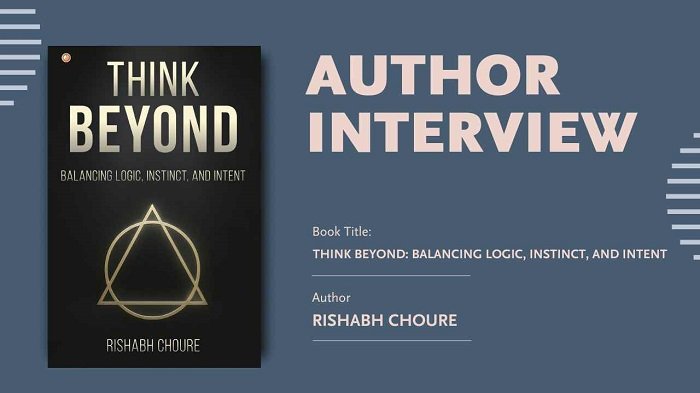
Rishabh Choure, a writer and deep thinker, explores the intersection of logic, instinct, and intent in his debut book Think Beyond. With a passion for purposeful living and mindful decision-making, he encourages readers to move past overthinking and discover balance — where clarity, emotion, and awareness coexist in harmony.
EliteOne Stories: What personal experience inspired you to explore the balance between logic, instinct, and intent?
Rishabh Choure: It wasn’t one grand moment of realization — it was the small, quiet conflicts that shaped me. The times when my mind said one thing, but my heart whispered another. I spent years caught between overthinking and impulsiveness, trying to find a space where both could coexist. The turning point came when I realized that clarity doesn’t come from choosing one side — it comes from listening to both, consciously. Think Beyond was born out of that inner dialogue — an attempt to understand how logic and instinct can work together when guided by intent.
EliteOne Stories: You describe intuition as an ally of logic — how can readers practically cultivate that relationship?
Rishabh Choure: We often treat intuition like a feeling that can’t be trusted — but intuition is simply experience disguised as emotion. To cultivate it, one must slow down and listen. Logic gives structure, but intuition gives subtlety. The practical way to balance them is through awareness. Before making a choice, pause — ask yourself not only what makes sense, but also what feels aligned. The goal isn’t to silence logic or emotion, but to create a space where both have a voice. That’s where wisdom begins.
EliteOne Stories: How does Think Beyond challenge the modern obsession with perfection and control?
Rishabh Choure: Perfection, in many ways, is our most sophisticated illusion. We’ve been conditioned to equate control with success — to believe that unpredictability means failure. But the truth is, life was never meant to be symmetrical. Think Beyond challenges that mindset by showing that balance is not control; it’s awareness. When we stop trying to perfect every outcome, we begin to participate in life rather than manage it. Real strength is not in controlling everything — it’s in trusting yourself enough to not have to.
EliteOne Stories: In moments of conflict between the mind and the heart, what does “thinking beyond” actually look like?
Rishabh Choure: “Thinking beyond” doesn’t mean choosing between them — it means rising above the conflict itself. The mind sees through logic, the heart through emotion, but both are partial truths. When you “think beyond,” you step into a third space — intent. Intent unites the clarity of logic and the honesty of emotion. It asks, “What truly matters here?” That question dissolves confusion. In that space, your decisions stop being reactions and start becoming reflections of who you are.
EliteOne Stories: How has writing this book changed your own decision-making or thought process?
Rishabh Choure: Writing Think Beyond taught me patience — not with the world, but with myself. Earlier, I often rushed to conclusions, wanting clarity before the process was ready to give it. I still struggle with overthinking; it’s something I haven’t completely overcome. But I’ve come to see it differently now — it’s both my strength and my weakness. Overthinking allows me to see multiple perspectives deeply, but it also tests my ability to let go. The key, I’ve learned, isn’t to fight it, but to navigate it consciously. I don’t seek instant answers anymore. I observe my thoughts, trace their roots, and let time refine them. The book didn’t just change how I think — it changed how I wait.
EliteOne Stories: You often speak about awareness — how does self-awareness influence our sense of purpose?
Rishabh Choure: Awareness is the bridge between who we are and who we think we are. Most people live in reaction — chasing what they believe they should want. But self-awareness helps us peel back the layers of conditioning. It shows us what’s real, what’s borrowed, and what’s truly ours. Purpose isn’t something you find outside — it’s what remains when all the noise fades. Awareness doesn’t create purpose; it reveals it.
EliteOne Stories: Many readers struggle with overthinking. What’s one mindset shift that can help them break free?
Rishabh Choure: I relate deeply to that struggle because I still live with it too. Overthinking, for me, is like a double-edged sword — it sharpens my understanding but can dull my peace. The real shift is in perception. Overthinking isn’t the enemy; attachment to every thought is. The mind’s nature is to think; you can’t silence it, but you can choose what to engage with. Instead of asking “How do I stop thinking?”, ask “Which thoughts deserve my attention?” Once you stop identifying with every passing idea, you start living with intention rather than reaction. That’s when thinking becomes a tool — not a trap.
EliteOne Stories: How do you define “intentional living” in a world that rewards speed over stillness?
Rishabh Choure: Intentional living is about direction, not pace. It’s asking “why” before saying “yes.” We live in a world obsessed with motion — but not meaning. To live intentionally means to pause and make decisions from alignment rather than impulse. Sometimes the most productive thing you can do is stop and ask yourself whether your actions reflect your values or your fears. Stillness is not the absence of progress — it’s the birthplace of clarity.
EliteOne Stories: What advice would you give to someone trying to align logic and emotion in their daily choices?
Rishabh Choure: Don’t force alignment — nurture it. Logic and emotion are like two eyes: they see differently, but only together do they give you depth. Begin by acknowledging both without judgment. When logic feels cold, invite empathy. When emotion feels overwhelming, invite reason. Over time, they stop competing and start complementing each other. That’s what it means to live from balance — not choosing one over the other, but learning to see through both.
EliteOne Stories: If readers could take away just one truth from Think Beyond, what would you want it to be?
Rishabh Choure: That balance is not a destination — it’s a dialogue. You don’t “achieve” it once and for all; you practice it every day. To think beyond is to accept that clarity and chaos, logic and emotion, stillness and movement — all coexist. The goal isn’t to escape contradiction, but to understand it. Because when you stop running from life’s dualities, you finally start living its truth.