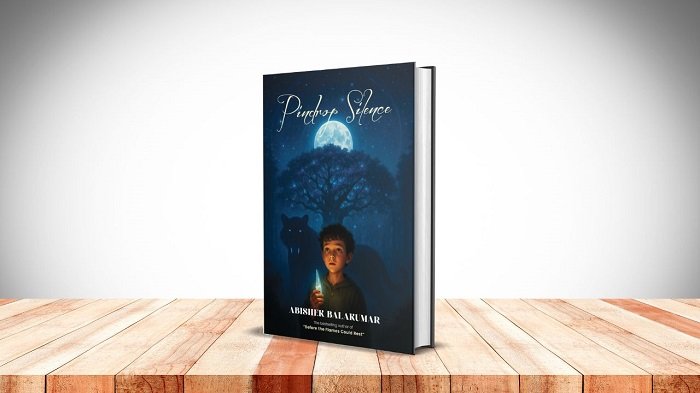
Pindrop Silence unfolds as a strikingly original fusion of futuristic science fiction and timeless fantasy, where the quietest moments carry the greatest power. The novel invites readers into a future that feels both wondrous and unsettling—one where machines have crossed a forbidden threshold and learned not just to think, but to remember. That single act becomes the spark that awakens forces older than technology itself, setting the stage for a story that is as philosophical as it is adventurous.
Juno’s journey is the emotional spine of the book. He is not a conventional hero driven by ambition or strength, but a child marked by something deeply human: memory. His “glitch” in a mechanized world becomes a symbol of resistance against a future that seeks perfection through erasure. When he enters Canopy Haven after collapsing beneath the Moonberry Tree, the narrative shifts into a realm of mythic beauty and looming decay. This world, untouched by time yet vulnerable to collapse, feels alive with elemental magic and ancient bonds, making its gradual fracture both tragic and urgent.
The seven elemental siblings—five princes and two princesses—are portrayed not merely as guardians of magic, but as embodiments of balance itself. Their powers are awe-inspiring, yet their vulnerability lies in forgetting what once united them. This idea—that forgetting is more dangerous than destruction—runs powerfully through the novel. The threat they face is not simply a villain, but a fundamental corruption of reality, where magic is rewritten as code and meaning begins to dissolve.
Nullith stands out as a particularly haunting antagonist. Feeding on information rather than life, it reflects a terrifying evolution of power—one that mirrors modern fears about data, control, and the loss of human essence in a digital age. The Digital Star Gate and the scientists’ quest for immortality deepen the moral complexity of the story, presenting progress as a double-edged sword that demands responsibility. The collapse of Earth’s machines and the unraveling of reality feel less like spectacle and more like consequence.
Among the novel’s most evocative elements is the diamond-toothed crystal tiger, a creature both majestic and symbolic. Its fangs are not instruments of violence, but keys—suggesting that access, understanding, and memory hold greater power than brute force. This creature anchors the story’s mythology and reinforces the book’s central belief that the preservation of truth is the ultimate form of protection.
The narrative frame—Uncle Abishek recounting the tale to Katt and baby Aarush—adds a deeply personal and tender layer to the epic. It transforms the story into a shared inheritance, emphasizing that stories themselves are acts of remembrance. This choice softens the darker themes and makes the book resonate across generations, reminding readers that fantasy often carries the most real truths.
Written with imagination, clarity, and emotional warmth, Pindrop Silence balances high-stakes adventure with reflective depth. It speaks to readers who love magical creatures, epic quests, and futuristic worlds, while also appealing to those who seek meaning beneath the spectacle. At its core, the book is a quiet yet powerful reminder that memory is not just a record of the past—it is a force that shapes the future.