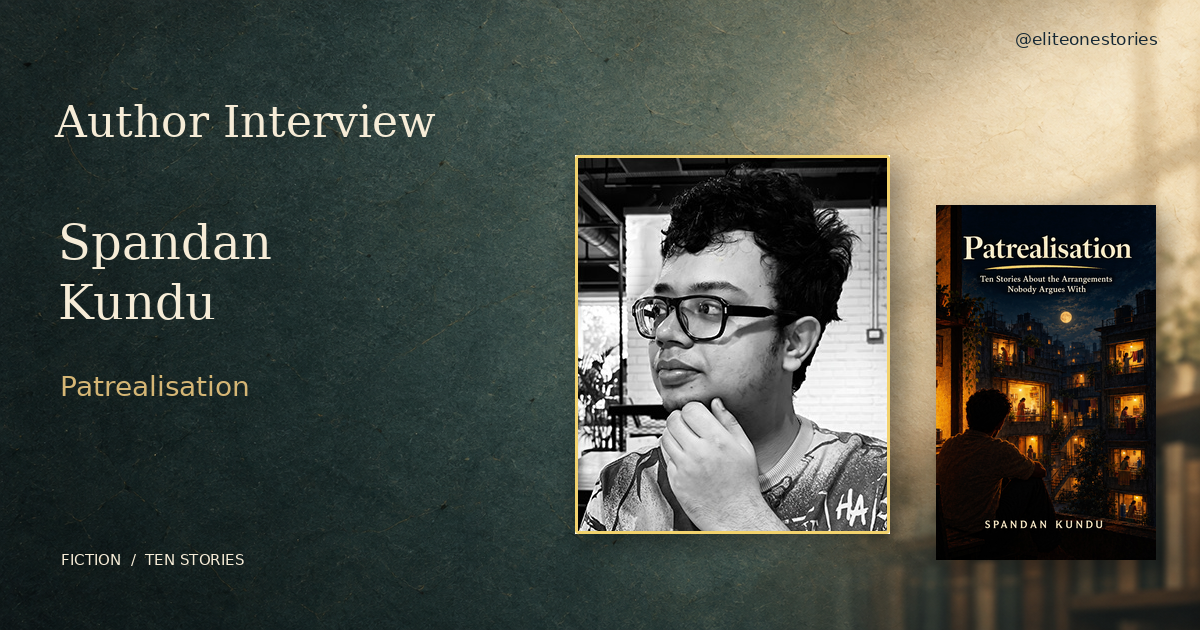
Spandan Kundu is a computer science graduate of IIT (ISM) Dhanbad who works on artificial intelligence systems. He grew up in Dhanbad, with family roots in Kolkata and a village house in Bengal. Patrealisation, his first book, brings together ten stories concerned with everyday expectations and the people who sustain them. His reading is largely in sociology, including work by Naila Kabeer, Uma Chakravarti, Bina Agarwal, Leela Dube and Sudhir Kakar. He coined the book’s title to describe recognising an arrangement he had previously accepted without question. His fiction draws on familiar domestic and public settings, and his author biography identifies men who notice late as his chosen narrative vantage. The questions below explore that perspective and the craft of the collection.
The Literature Times : How did the word become the organising idea for ten stories?
The word came first, in the first story. I was writing about Maashi, and the moment I kept returning to was the one where I realised I had never known her name. I needed a word for that moment, and Patrealisation was the closest I could get. Once I had it, I started seeing the same moment in other memories. A chocolate wrapper, a neighbour’s wedding, a train journey. Each was a different situation, but the feeling of noticing late was the same. So the word stopped being the title of one story and became the thread through all ten.
The Literature Times : How do you decide which ordinary object can bear narrative weight?
Most of the objects were really there. The stories come from things I saw, and when I went back to those memories, an object was usually what I remembered most clearly. The packet, the glasses, the coin. I kept the ones a character uses without thinking about them. An object that nobody notices in the scene can carry a lot, because the reader is the one who finally notices it. If I had to explain an object, I cut it.
The Literature Times : How did you keep the narrators’ admissions from becoming self-forgiveness?
By making sure admitting it never fixes anything. In Little Dollops of Joy, he understands everything and the packet still stays unopened. In Vahini and Dhaakini, he never asks the housing society about her payment. In Two Boxes, he is one of the people at the window. The last story ends with him unable to remember the names of dolls he played with as a child. A confession is easy. I wanted the reader to see that the narrator knows, and to see that knowing has changed very little.
The Literature Times : Why does the epilogue come after the stories, and how much explanation did you want readers to receive?
I wanted readers to feel each situation before anyone named it. If the concepts came first, the stories would read like examples. So the stories come first, and the epilogue is there for readers who want to go further, into the work of Naila Kabeer, Uma Chakravarti, Bina Agarwal and others. A reader can skip it and lose nothing from the fiction. Some readers have told me it helped them put words to what they felt, and that is all I wanted it to do.
The Literature Times : How did you balance Hindi and Bengali dialogue with accessibility?
I set myself one rule. I never translate a line inside the dialogue. The words stay as they were spoken, and the sentence after them carries the meaning in plain English. My test was to cover every Hindi and Bengali line and read only the English. If the reader lost anything, I rewrote the narration. I also kept the other languages lightest at the emotional peak of each story, so nothing stands between the reader and that moment. In one story, the Hindi line stays in Devanagari, because it is printed on a scrap of newspaper. For a Bengali proverb that might have sounded foreign, a cue was added at the bottom of the page.
The Literature Times : How did you preserve Vahini and the Dhaak player’s individuality through the narrator’s limited view?
I let them be practical. The narrator wants them to be inspiring, and they are busy doing their jobs. The bus driver chose work that pays on time. The Dhaak player wants to know what she will be paid. Those details unsettle him, and that is the point. They are whole people, and his admiration is too small for them. The clearest sign of his limits is that he gives her a name in his head and never asks for her real one.
The Literature Times : Which part required the most revision?
The endings. I had a habit of writing one paragraph too many, where the narrator explains what the image before it had already shown. Late in the process I made a rule that if the last paragraph explains the one before it, the last paragraph goes. That changed almost every story. The other big change was Vahini and Dhaakini, where the second half needed a full second movement. I learnt to trust the reader more as I went.
The Literature Times : Are there other perspectives or forms you would like to explore?
There is a story I left out of this collection, about how films and social media shape these same arrangements. It did not fit the quiet register of this book, but I would like to come back to it. I am also curious about writing from inside a situation, from someone who is living it, and not from the person who notices it late. Whether that becomes a second collection or something longer, I do not know yet.