EliteOne Stories: Geetanjali Gusain, Your writing focuses on finding the extraordinary in ordinary life. What inspired this unique approach to storytelling?
Geetanjali Gusain: You can blame my background in project management! There is a problem-solving framework called the Five Whys, which drills down past surface symptoms to find a root cause. When you apply that same curiosity to human nature, something remarkable happens. If you keep gently asking why, you peel back the ordinary layers of everyday life. Beneath the simplest gesture, moment, or relationship lies a rich, unexpected story waiting to be noticed.
EliteOne Stories: You describe yourself as a collector of discarded moments. How do you transform small observations into compelling stories?
Geetanjali Gusain: Honestly, it came from realizing how limited my own view used to be. There was a time I would laugh prematurely or dismiss a moment simply because I didn’t understand it. Traveling expanded my lens. It taught me that no gesture or interaction has just one interpretation. When I pick up a discarded moment, I turn it over in my hands like a stone, looking for the light I missed the first time. The stories comes from asking what that moment meant to the person living it, rather than just the person passing by.
EliteOne Stories: How have encounters with nature, animals, and overlooked details influenced your writing?
Geetanjali Gusain: Growing up with nature and animals as your closest companions installs a different kind of compass inside you. Truthfully, I was only able to write because I had a window framing the natural beauty outside, that view is my catalyst. Humans are deeply tethered to nature, making its protection feel less like a duty and more like self-preservation. For me, that view of the jacaranda, gulmohar, pink blossom, amaltas kept taking me back to primal, joyful details like the freedom of climbing a tree, hair blowing with the breeze, the simple companionship with a playful dog, or waking up to birds chirping in the morning. My creative cells gets recharged every time I am out in nature.
EliteOne Stories: What inspired you to create the Landscapes of Hope: Indian Short Stories series?
Geetanjali Gusain: It’s less a what and more a who. The series was born from the extraordinary people I’ve had the honor of meeting, living alongside, working with, and learning from over the years. Naming my characters after them became my way of honoring their impact. Watching them rise above life’s obstacles with such profound grace showed me what true hope looks like, and those were the stories I simply had to tell.
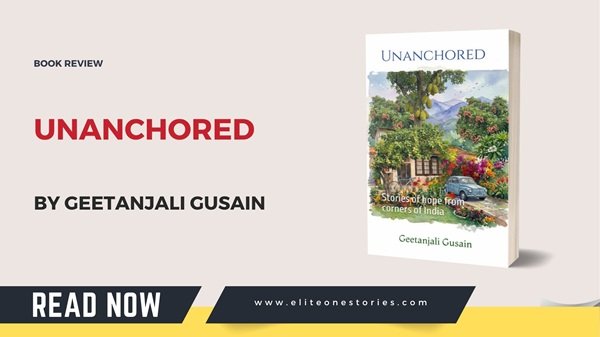
EliteOne Stories: How do you choose the diverse locations across India that shape the stories in Unanchored and Reanchored?
Geetanjali Gusain: The geography of my stories stems from a lesson I learned during my first job at The Oberoi Udaivilas. Leaving the hills for Udaipur, I was a young person away from home for the very first time. I had been raised in a protected bubble to keep strangers at arm’s length, but the people there completely redefined warmth for me. Drivers patiently taught me to ride a golf cart, a local boatman packed extra rotis from home for me, my roommate left hot Maggi after late shifts, and the corner shopkeeper would hand me aamras just seeing me walk past. That was when I realized that the energy you give is what you get back. Travel for work has since allowed me to explore every corner of India, and the deep bonds I build with both people and places make them flow naturally onto the page. The subtle nostalgia for those places stays in my subconscious, guiding where each story needs to unfold.
EliteOne Stories: Your work explores the quiet resilience of the human spirit. How do you bring hope into stories that reflect life’s struggles?
Geetanjali Gusain: Being raised in the hills, I’ve always appreciated winding roads and meandering rivers far more than straight shortcuts. But I must ask, what is hope without struggle? I suspect we’ve been conditioned to dramatize life’s hardships far more than necessary. Sometimes an experience feels overwhelming in the moment, making us react intensely, when in truth the wound isn’t as catastrophic as it seems. More often than not, it’s only in hindsight that we look back and realize we made it through, that the worst is already behind us. Hope is just our quiet way of leaning into resilience, long before we even recognize its presence.
EliteOne Stories: What role do empathy and observation play in creating characters who feel so real and relatable?
Geetanjali Gusain: Observation provides raw material, and imagination brings it to life while empathy requires strict discipline. Writing a character is not unlike architecture. While you can envision countless blueprints for a story, clarity comes from committing to one design rather than scattering your focus. Unchecked empathy can trap an author into protecting their characters from the very flaws and friction that make them human. Ultimately, you need the discipline to build with precision and let your stories and characters live authentically within their blueprint.
EliteOne Stories: What can readers look forward to in Reanchored, and how does it continue the journey begun in Unanchored?
Geetanjali Gusain: Reanchored is a natural extension of Unanchored, carrying forward the same heart while taking readers into new emotional and geographical territories. In one story, a young woman retreats to her hometown in Ambala to heal from a heartache, finding an unexpected bond with an elderly resident. In another, two siblings trek through the breathtaking landscapes of Mizoram, slowly learning to see the world through each other’s eyes. A piece particularly close to my heart follows a hotel management graduate sent to Matheran to transform a heritage property into a luxury stay, discovering far more than a work project along the way. From Kakinada to Kashmir, this collection expands the canvas with new places, richer local flavors, and subtle cultural nuances. I hope readers feel as welcomed by these stories as I felt while writing them.