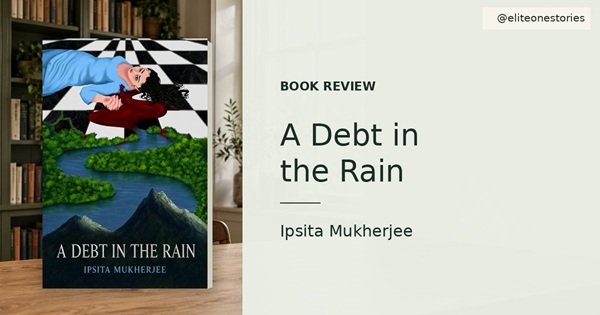
Who is allowed to decide what a family owes? The description of A Debt in the Rain, Ipsita Mukherjee’s debut novel, places that question inside a story of survival concealed for twenty-five years. Chirag believes the woman his father shot during his childhood died in the family courtyard. A photograph and an old man’s message overturn that belief. His journey from a riverside haveli towards the northern hills begins with a discovery, but the larger promise of the premise lies in what he cannot yet know about the people waiting beyond the boundaries of his familiar world.
A Debt in the Rain is presented as literary fiction set in Bengal, concerned with family, atonement and the lasting effects of violence. Its outline suggests an emphasis on moral uncertainty rather than on an uncomplicated recovery narrative.
The title’s idea of debt is particularly useful for thinking about the premise. A debt can imply a clear account: something was given, something is owed, and repayment might settle the matter. Human relationships rarely conform to that arrangement. The supplied description locates an important debt between two women expected to be enemies, a wife and a mistress sustained by each other’s compassion. Their relationship gives the title a more difficult meaning. What one person makes possible for another may be impossible to repay in any equivalent form. Gratitude, responsibility and hurt can continue to exist together without producing a settled balance.
This is also where the premise resists a familiar division of women into opposing roles. The description does not erase the distinction between wife and mistress, but it places survival and compassion beside it. That decision opens space for questions about who benefits when people are expected to remain rivals, and what becomes visible when they do not. It would be premature to credit the novel with a fully realised treatment of those questions without reading it. Even so, their presence in the stated design gives the book a point of difference from a family drama organised only around exposure and blame.
Chirag’s arrival introduces another complication: his need for answers may not coincide with everyone else’s need for safety, privacy or peace. The description refers to a house containing silences he was never meant to break. That does not tell us whether each silence is protective, coercive or something in between. It does establish a tension worth following. For someone outside a concealed history, disclosure can look like an obvious good. For those who have lived through its consequences, the question may be more demanding. A discovery narrative becomes richer when knowing the truth does not automatically confer the right to direct other people’s lives.
The long interval between the childhood shooting and the adult journey gives this tension weight. Twenty-five years is not merely a delay before a revelation; it is time in which relationships can form, obligations can accumulate and losses can become ordinary features of daily life. Chirag is not approaching an untouched scene waiting for his explanation. The outline describes a web of people already connected in ways he never imagined. This suggests a story in which the searcher’s perspective must contend with other lives rather than simply absorb them into his own understanding of the past.
Those other lives include an old servant who gave much to the family house and lost his own family in the process. His place in the description is a reminder that devotion does not have the same consequences for everyone. A household can depend on someone while leaving that person’s needs outside its account of loyalty. Alongside him are a brother and sister linked by their father but otherwise separated. Together, these stated relationships make belonging a question rather than a secure condition. Kinship may exist without intimacy, while care may emerge between people whom social convention has placed on opposite sides.
The novel’s described interest in ordinary people standing between a perpetrator and a victim also moves attention away from the central act of violence alone. It asks readers to notice the responsibilities of those around harm. Yet this is not a premise that should be simplified into an uplifting lesson about forgiveness. The summary explicitly includes vengeance, silence and kindness that may remain insufficient. That qualification matters. It allows the prospective reader to approach the story without expecting suffering to become meaningful merely because someone responds generously. Compassion can matter even where it cannot restore what was lost or supply a satisfactory ending.
For readers, the likely point of entry is the combination of family mystery and reflective literary concerns. The book is described as slow-burning, so its positioning favours attention to relationships and their histories over expectations of uninterrupted suspense. The Bengal setting and movement towards the hills give the outline a distinct location, although the supplied material cannot establish how fully those places are rendered. Readers sensitive to stories involving domestic violence and its aftermath should note the shooting at the centre of the premise. No claim about the degree of graphic detail can be made from the description alone.
Mukherjee comes to her debut after studying English literature, reporting features for an English newspaper in Kolkata, and working for more than twenty-five years in content and communications. Her biography describes a long period of writing for other people before making space for a story of her own. That background creates a meaningful context for the debut without authorising assumptions about its sources. A Debt in the Rain’s stated appeal rests on the fiction itself: an inquiry into obligations that survive secrecy, and relationships that exceed the names assigned to them. A reading of the complete novel would be needed to judge the achievement. Its premise, however, gives readers a substantial and specific reason to be curious.
Book Review of A Debt in the Rain by Ipsita Mukherjee