Title: Uttaraardh
Author Name: Vikram Kumar Soni
ISBN: 9789373356808
Publisher: Evincepub Publishing
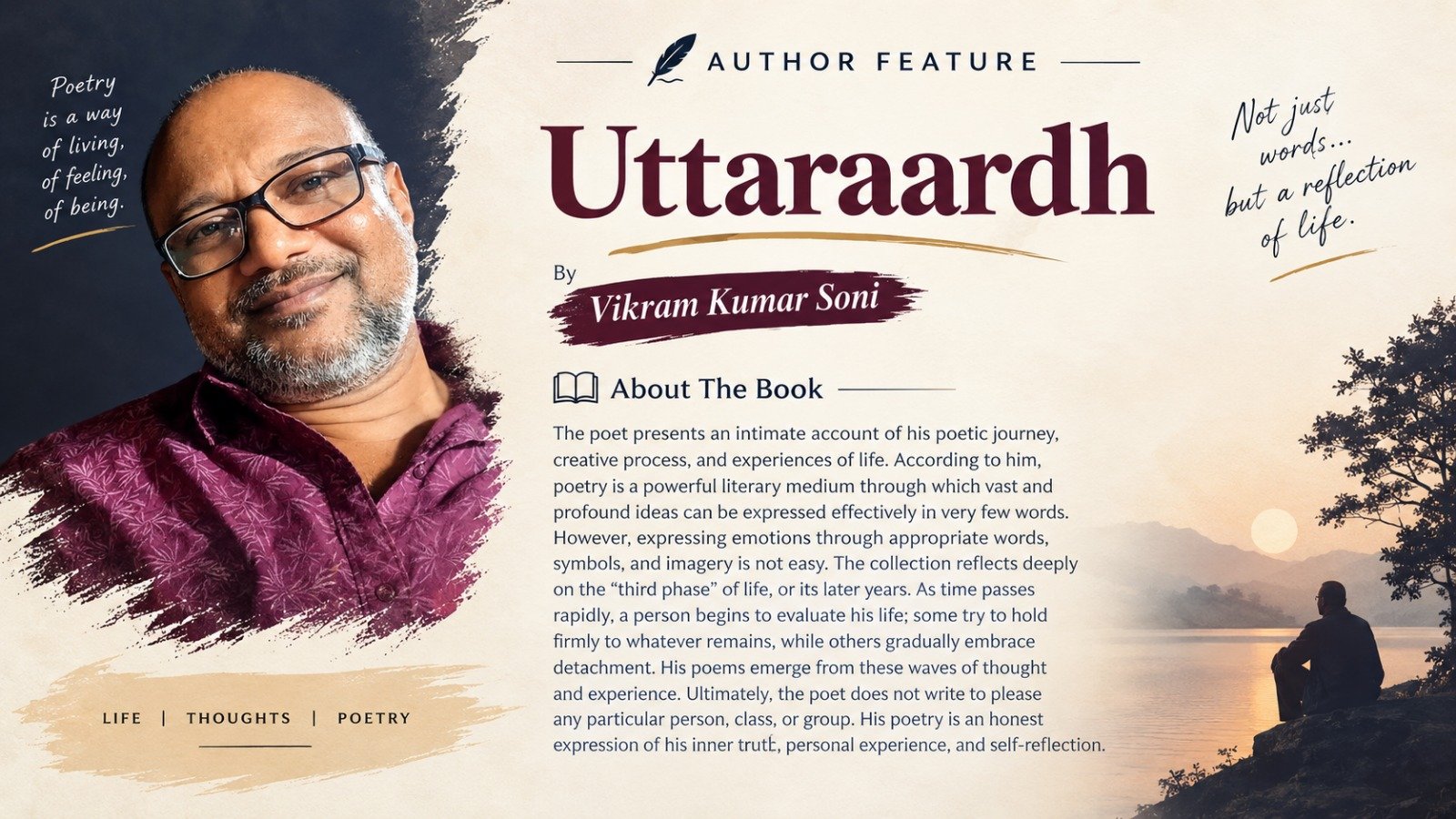
There are some books that speak loudly, while there are some books that speak quietly and still leave a deep impression on the reader. Uttaraardh by Vikram Kumar Soni belongs to the second kind. It is a Hindi poetry collection that takes the reader into the inner world of a poet who has spent years observing life, people, relationships, society, nature and his own thoughts. The title Uttaraardh, meaning the later part or second half of life, gives the collection its central feeling. It is not simply a book about growing older. It is about looking back, understanding what has been lived, asking what remains, and trying to understand oneself with honesty. In his own words, Soni explains that there is much to say through poetry, but saying something deep in very few words is not as simple as it appears. A poet has to find the right words, symbols and images to express feelings that are often difficult to explain. This thought can be felt throughout Uttaraardh. The poems do not try to impress the reader with complicated language. Instead, they come from everyday experiences and deep thoughts. The poet writes because something inside him asks to be expressed. His poems become a way of looking at life more closely, especially when a person reaches a stage where time seems to move faster and questions about life become more important. The book therefore feels personal, but at the same time, many of its emotions are familiar to ordinary readers. We all have moments when we look back at old relationships, remember people who are no longer with us, think about choices we made, or wonder what is still left to be done. Uttaraardh brings these simple but important feelings into poetry.
One of the strongest qualities of Uttaraardh is its connection with the real experiences of life. The poet does not remain limited to one subject or one kind of emotion. His poems move from loneliness to relationships, from memories to freedom, from society to nature, and from personal questions to larger questions about human life. The opening poem, “Ekaki Shaam”, presents the feeling of being alone even when one is not completely alone. The image of a person walking near the sea in the evening, watching the sun disappear and seeing a kite almost standing still in the sky, creates a quiet picture of loneliness and thought. The poem “Samudra Ke Liye… Prithvi Ke Liye…” uses the sea and earth to speak about companionship, distance and the need for connection. The poet sees the sea as lonely in the middle while it remains connected with the earth at the shore. This simple image becomes a reflection of human life. A person may be surrounded by people and still feel alone inside. The poem “Deewarein” looks at another change in human relationships. It remembers a time when neighbours could speak across their courtyard walls, share things and remain connected. Today, even when physical walls may have changed, invisible walls have become stronger between people. This is a feeling many readers can easily understand because modern life has changed the way people live and communicate. Through such poems, Soni does not simply describe what he sees. He asks the reader to stop and think about what has changed around us. The collection shows that ordinary scenes can carry deep meaning when we look at them carefully. A wall, a sea, a road, a meeting, a memory or even a silent moment can become the starting point of a poem.
The book also carries a strong concern for society, human behaviour and the world around us. Soni’s poem “Manushya Aur Jungle” looks at the long relationship between human beings and forests. It speaks about how humans moved from living in forests to building villages and cities, developing agriculture, roads and industries. But the poem takes the thought further. The real conflict today is no longer simply between humans and the forest. It has reached a point where human beings are fighting with other human beings. This makes the poem especially meaningful because it asks us to think about the direction in which society is moving. The poet’s connection with Bastar and its natural and cultural surroundings gives such thoughts a strong background. Another important poem, “Pakshadharta”, questions the idea of taking sides. People may fight for religion, power, food, rights or different beliefs, but the poet asks what an ordinary human being truly needs. He does not present himself as a great leader or someone who wants to win over others. Instead, he expresses a simple wish to live without fighting with his neighbour, without taking away anyone’s rights and without hurting others. This humane approach is one of the important strengths of the collection. The poem “Uttar-Yuddh” also moves beyond an ordinary disagreement between two people and looks at the conflict taking place inside the human mind. In this way, Soni’s poetry often starts from a visible situation and then moves towards a deeper question. His poems may talk about society, politics, religion, rights, conflict or human behaviour, but they finally return to the individual and ask what kind of person we want to be. The collection therefore does not simply tell the reader what to think. It creates questions and allows the reader to find a personal response.
At the same time, Uttaraardh is deeply personal. Some of its most touching poems deal with memories, relationships, separation and the things people are unable to say to each other. “Yaadein” reminds us that when someone’s presence ends, memories remain. Happy and painful moments, affection and even difficult experiences become part of our personal story. The poet sees memories as pictures that we create but cannot simply erase. “Mukti” takes this feeling in another direction. It speaks about the pain of letting someone go and the strange relief that can come when the emotional hold of those memories slowly becomes weaker. “Vasant Aa Gaya” brings a different mood. After a broken relationship and a long separation, an unexpected meeting brings back a feeling of hope, much like seeing the first mango blossom of spring. The meeting is simple. There is a short conversation, tea on a roadside stall and then silence, but the moment carries many unspoken emotions. “Man Ki Baat” is another poem that many readers may find close to their own lives. It speaks about the things people want to say but often cannot say because everyday demands, complaints and practical matters come in between. In “Stri Aur Purush”, the poet looks at the relationship between a man and a woman and recognises the quiet work, patience, sacrifice and care that often remain unnoticed inside a family. These poems show that the poet is not interested only in large social questions. He also pays attention to the small emotions that shape personal life. His writing becomes a reflection of relationships, misunderstandings, affection, distance and responsibility. This is where the book becomes especially relatable. The reader may not have lived the exact experience described in a poem, but the feeling behind it can still feel familiar.
Vikram Kumar Soni brings to Uttaraardh a life shaped by literature, history, language, art and culture. Born on 1 February 1968, he has an M.A. in History, Linguistics and Hindi and is presently serving as Deputy Superintendent at the District and Sessions Court in Jagdalpur, Bastar, Chhattisgarh. Along with his professional responsibilities, he has remained connected with writing and the cultural life of the region. He writes poetry, stories and articles in Hindi and Halbi and has worked in areas connected with art, culture, language, education, archaeology and nature. His creative work also extends to radio, television and theatre, and he has performed on stage in several places in Chhattisgarh and other parts of India. His contribution to language is particularly notable through his work in developing a new script and font for Halbi, the local language of Bastar. His knowledge of history and local culture, together with his interest in nature, can be felt in the subjects that appear in Uttaraardh. The poet himself says that this is his second poetry collection and that while his earlier collection covered different kinds of subjects, the poems in this book have come more directly from different corners of his own mind. He also makes it clear that he does not select subjects to please any particular person or group. His writing is an expression of his own thoughts and experiences, without worrying about how others may respond. This honesty gives Uttaraardh its identity. The collection does not try to provide easy answers to life’s difficult questions. Instead, it stays with those questions and allows them to grow in the reader’s mind. Perhaps that is also the real strength of Vikram Kumar Soni as a poet. He takes experiences that may appear ordinary and gives them space to be felt and understood. Uttaraardh is ultimately a book about the journey within, about the years that have passed, the people who have shaped us, the memories we carry, the society we live in and the person we become with time. It invites readers to pause for a while and look at their own lives. In that quiet pause, the poems may feel less like someone else’s words and more like a conversation with our own mind.