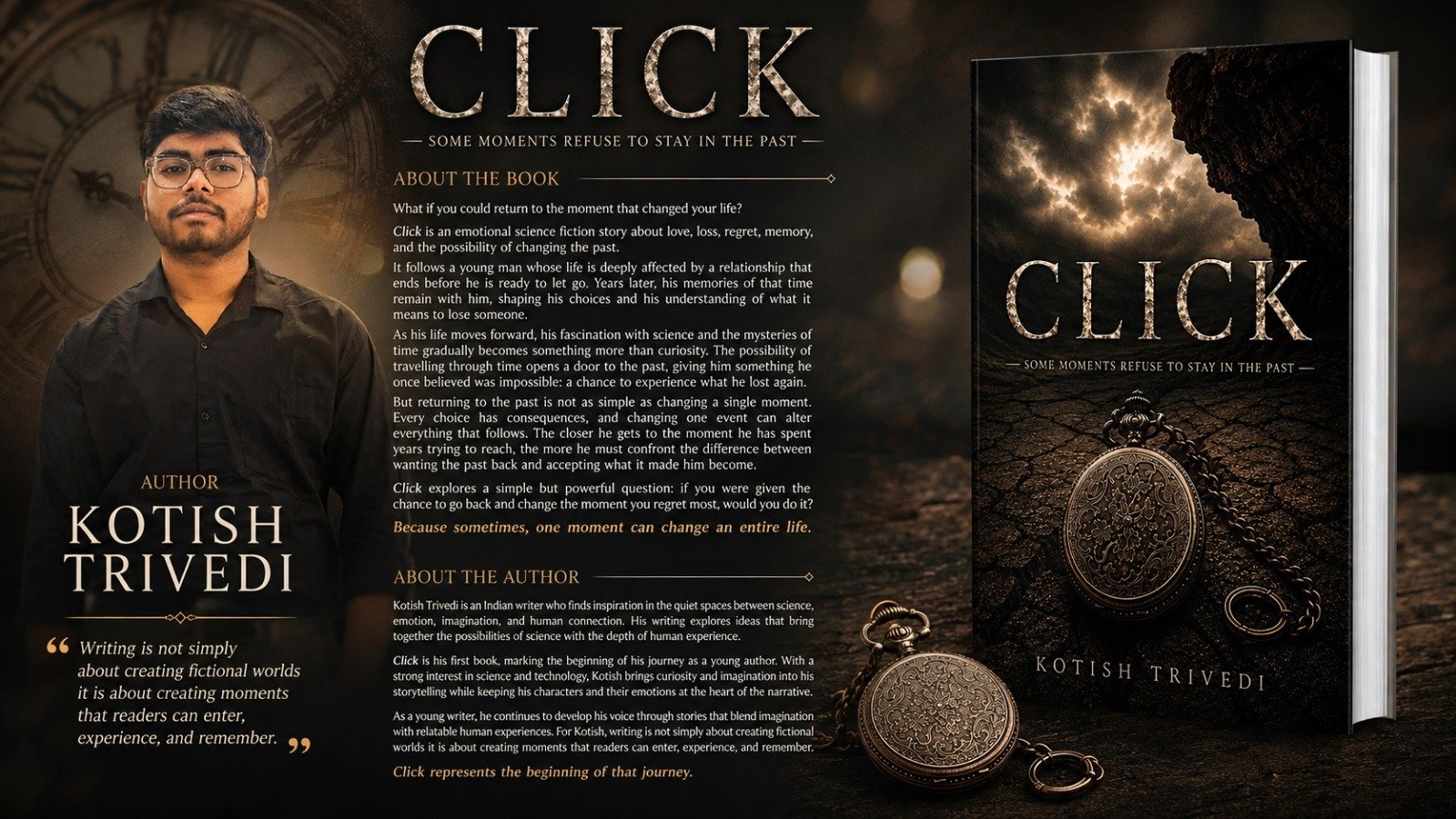
Title: Click
Author: Kotish Trivedi
ISBN: 9789373357157
Publisher: Evincepub Publishing
There are some stories that begin with a big event, a sudden discovery, or a mystery that immediately changes everything. Then there are stories that begin with something much smaller, something that feels almost too ordinary to matter. Click by Kotish Trivedi belongs to the second kind, and that is what makes its emotional journey so interesting. At its heart, the novel is about a young man who falls in love with a woman during his college years, only to lose her because life, responsibilities, and circumstances slowly pull them apart. But this is not simply a story about a relationship that ends. It is a story about what happens when a person cannot stop looking back at the moment he lost someone important. Kotish Trivedi brings together love, heartbreak, science, time, memory, and the idea of parallel realities in a way that keeps the emotional side of the story at the centre. The book opens with a powerful idea about the countless paths a human life can take, and from there it takes readers back to the beginning, to an ordinary college corridor where a simple birthday message becomes the first step toward a relationship that will eventually change the course of the protagonist’s entire life. The book itself describes this journey as being built around one promise, one pocket watch, and one mistake that fractures reality.
What makes the beginning of Click especially relatable is the way the relationship develops through small moments rather than dramatic declarations. The protagonist is an engineering student who is curious about the world and believes that every problem has a solution. Then he meets a young woman who slowly becomes an important part of his everyday life. Their relationship begins with a simple birthday wish, continues through messages and jokes, and gradually becomes something much deeper. Their first date, their conversations, their walks, their studies, and even their quiet moments together are presented as memories that gain importance only after they are gone. One of the most memorable objects in this part of the story is the pocket watch she gives him. It is not simply a romantic gift. It becomes a symbol of memory, time, and the moments people desperately wish they could hold on to. Their relationship feels believable because it is built through ordinary care. She reminds him to eat, they study together, they talk about their dreams, and they become each other’s first person to call when something good or bad happens. The book makes an important point here: love is not always expressed through grand words. Sometimes it is found in small acts of care and in simply being present for another person. The protagonist later realizes that these ordinary days were actually the happiest days of his life. This emotional foundation is important because the science fiction that comes later only works because readers first understand what he has lost.
However, life does not always allow people to keep what they love. As the two characters move closer to graduation, their relationship begins to face the pressures of careers, responsibilities, family expectations, and uncertain futures. Their love does not disappear, but their lives become more difficult to balance. This is one of the strongest emotional parts of the novel because there is no simple villain. Neither person betrays the other, and neither stops caring. Instead, they make a painful decision because they believe they are protecting each other’s future. They promise not to contact each other because they fear that returning to the relationship will prevent them from moving forward. The protagonist keeps that promise, but the silence becomes extremely difficult for him. He spends months trying to live with the absence of someone who had become part of his daily life. Yet, slowly, heartbreak changes into curiosity. Rather than allowing his loss to completely destroy him, he begins asking questions about time itself. Why does time move forward? Can its nature be understood? Could the past exist in some form that science has not yet discovered? This is where Kotish Trivedi’s central idea becomes clear. The protagonist does not enter the world of advanced science because he simply wants to become successful. His scientific journey begins because he wants to understand something deeply personal. His curiosity grows from his pain, and his pain gives direction to his curiosity. The book’s own preface makes this connection clear by presenting science and emotion as two sides of the same journey, where every equation searches for a scientific answer while every chapter searches for an emotional one.
From this point, Click changes from an emotional love story into a larger science fiction adventure. Years pass, and the protagonist becomes an aeronautical engineer whose interest in physics, space, time, and advanced technology grows stronger. Eventually, he receives an invitation to join a secret research project connected to a strange anomaly. This leads him to Project Chronos, a classified scientific project connected with an earlier experiment in which three volunteers disappeared. The story becomes more ambitious here, but the writing continues to keep the human question alive underneath the scientific mystery. The protagonist’s strength is not presented only as intelligence. It is his ability to question assumptions. During a major scientific discussion, he notices that the problem may not be a mathematical mistake but an assumption that everyone has accepted for years. Later, while studying the strange signal connected to the missing volunteers, he considers the possibility that they are not simply lost somewhere in space or time, but somewhere in another reality. He begins to think of reality itself as a map with another coordinate. The pocket watch also returns as an important part of this mystery, behaving in ways that suggest it is connected to something beyond ordinary time. These developments give the novel its science fiction identity, but they also connect naturally with the emotional idea introduced at the beginning. The protagonist has spent years trying to find a way back to something he lost, and now science appears to offer him a path.
The most exciting section of Click comes when the protagonist finally decides to enter the Chronos Machine. By this stage, his journey is no longer only about proving a scientific theory. He believes there may be people on the other side who have been waiting for answers for years, and he is willing to take the same risk that others once took. When the machine reaches full power, he enters a reality that is difficult to understand through ordinary ideas of space and time. He sees countless paths, each showing different versions of lives and different choices. This is where the novel’s central idea becomes especially powerful. The multiverse is not presented simply as a collection of different planets or worlds. It becomes a collection of decisions, possibilities, memories, and lives that could have happened differently. As he moves through these realities, he discovers something painful. Across countless versions of his life, the ending remains almost the same. He loses her in one way or another. Sometimes distance separates them, sometimes death, sometimes silence, and sometimes fate. This discovery changes the meaning of his search. Perhaps the question is not whether there is another universe where everything went perfectly. Perhaps the deeper question is whether a person can ever truly escape loss by changing the past. The journey therefore becomes much more than a scientific experiment. It becomes a test of how far a person should go for one lost relationship.
For me, this is where Kotish Trivedi’s first novel becomes most meaningful. Click is certainly interested in science fiction ideas such as time, quantum possibilities, parallel realities, and advanced technology, but its strongest quality is its emotional question. What would you do if you were given another chance to reach the person you lost? Would you change the past, even if doing so could destroy the life you have built? And if you finally reached that moment, would you discover that what you really wanted was not to change it, but simply to experience it once more? The conclusion gives this question a deeply emotional answer. After crossing what seems impossible and returning to his own world, the protagonist discovers that scientific success cannot give him the one thing he truly wanted. Fifty years have passed around him, while for him only moments have passed. The three missing volunteers return, and Project Chronos becomes a major scientific success. His own work changes physics, and the world celebrates him. Yet none of those achievements can replace the person he wanted to see. When he finally reaches her home, he learns that she passed away the previous year and had never married because she had continued to believe that he would return. He is left with the pocket watch and the painful knowledge that he found countless universes but not the one where they grew old together.
As a professional reviewer, I would describe Click as an emotional science fiction novel that uses the idea of time travel to talk about something very human: regret. Kotish Trivedi does not make science the only attraction of the story. Instead, he uses science to ask questions about love, memory, choices, and acceptance. The pocket watch becomes a simple but effective symbol of the past, while the repeated idea of the “click” reminds readers that a small moment can lead to a completely different life. The novel also benefits from its young author’s willingness to connect scientific curiosity with personal emotion. Kotish Trivedi’s own author note describes his interest in the space between science, imagination, emotion, and human connection, and Click clearly reflects that combination. As his first book, it marks an ambitious beginning to his writing journey. What stays with the reader after the final pages is not only the question of whether parallel universes are possible. It is the quieter question of whether we sometimes spend too much of our lives trying to return to moments that were beautiful because they happened only once. Click reminds us that we cannot always control where life takes us, and we cannot always bring back the people we have lost. But we can carry what they gave us. We can remember the ordinary days, the promises, the laughter, and the love that shaped who we became. That is ultimately what gives Kotish Trivedi’s story its emotional strength. It begins with a click, travels across time and reality, and finally returns to the most familiar truth of all: sometimes, the greatest journey is learning to live with the moment we cannot change.