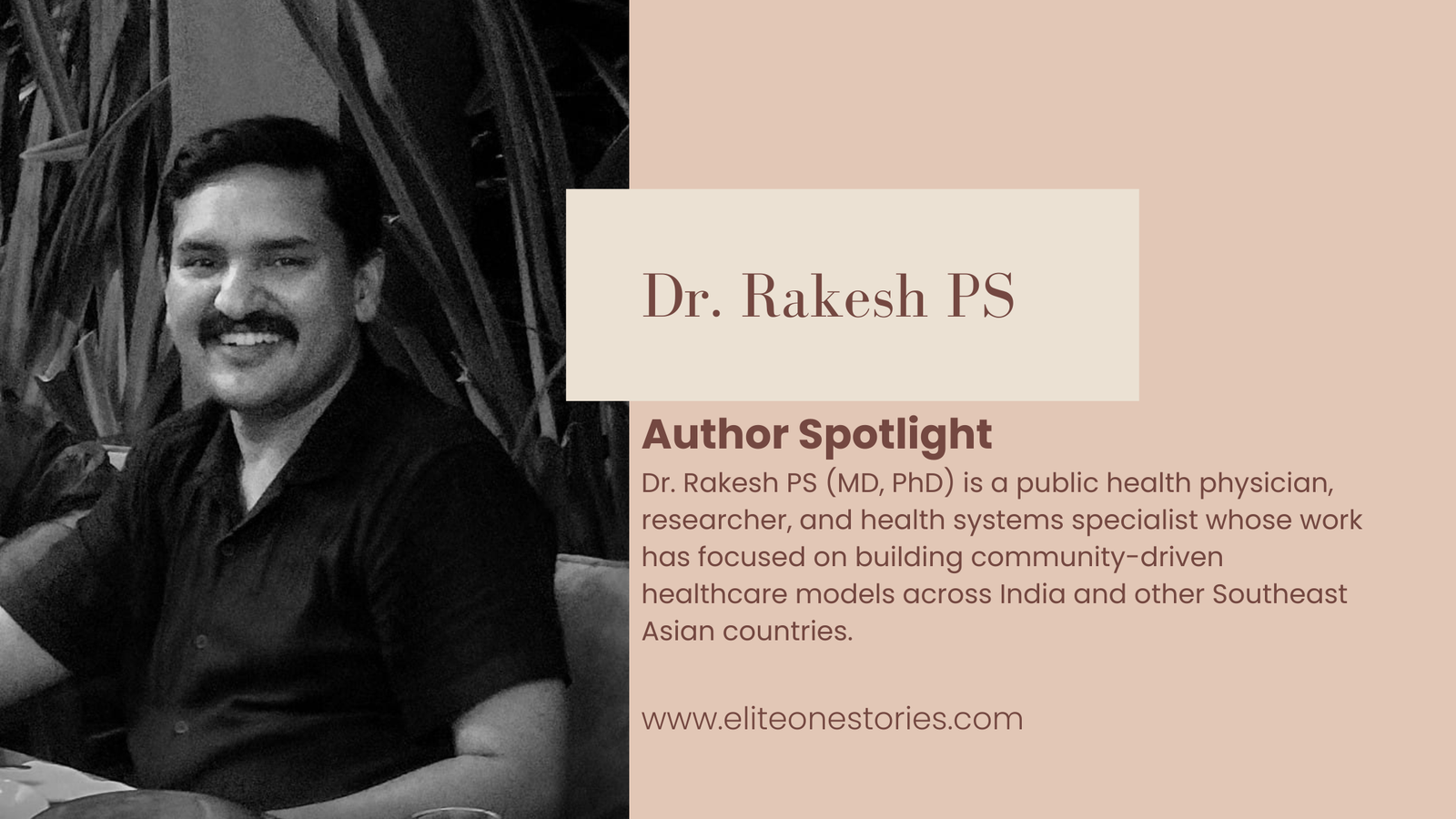
Some journeys are defined by destinations, while others are shaped by the people, communities, and experiences encountered along the way. For Dr. Rakesh PS, a public health physician, researcher, and health systems specialist, his professional journey has been deeply connected with communities and their everyday realities. His work across India and other Southeast Asian countries reflects a commitment to strengthening healthcare systems, empowering communities, and finding practical solutions to some of the most complex public health challenges. His recently authored book, Echoes from the Atoll: Inside India’s First TB-Free Islands, brings together this professional experience with a deeply personal encounter with the people and landscapes of Lakshadweep.
Dr. Rakesh’s connection with public service began remarkably early. At just fifteen years of age, he received the Rashtrapati Scout Award from the President of India, an achievement that reflected his early dedication to service, leadership, and community engagement. Over the years, these values evolved into a career in medicine and public health. Rather than viewing healthcare solely through the lens of hospitals and clinical treatment, Dr. Rakesh has focused much of his work on understanding how health systems function within communities and how public health interventions can become more effective when people themselves are placed at the centre of change.
His professional experience spans more than fifteen years and includes work with globally recognised organisations such as the World Health Organization and The International Union Against Tuberculosis and Lung Disease, commonly known as The Union. Through these roles, he has worked alongside governments, healthcare professionals, and communities to strengthen public health systems and advance disease elimination efforts. His work demonstrates an understanding that lasting health outcomes require more than medical expertise. They require trust, collaboration, local leadership, sustained engagement, and an understanding of the social realities that influence people’s lives.
One of the most significant chapters of Dr. Rakesh’s career has been his involvement in Lakshadweep’s journey towards tuberculosis elimination. His contribution to the technical roadmap played an important role in the Union Territory being declared India’s first TB-free geography. Yet, Echoes from the Atoll reveals that behind such a remarkable public health achievement lies a much more intimate story. The book emerges from fourteen journeys across the islands, where Dr. Rakesh witnessed the relationship between healthcare, community participation, geography, culture, and everyday life.
Lakshadweep is presented not simply as a location where a successful TB elimination programme was implemented, but as a living world shaped by the sea. Boats, coral reefs, monsoons, village tea shops, moonlit beaches, and quiet homes become part of the narrative. Through these settings, Dr. Rakesh explores the character of island communities and the bonds that hold them together. His observations suggest that public health initiatives can succeed most meaningfully when communities do not remain passive recipients of healthcare, but become active participants in creating healthier societies.
This perspective is central to understanding Dr. Rakesh as both a physician and a writer. His approach does not reduce people to statistics or communities to public health indicators. Instead, he pays attention to memory, relationships, resilience, and belonging. Echoes from the Atoll therefore moves beyond the boundaries of a conventional medical account. It becomes a reflection on what happens when professional responsibility intersects with human connection.
Dr. Rakesh’s wider body of work reflects the same commitment to innovation in public health. He has contributed to the development of models such as STEPS, or System for TB Elimination by Private Sector, which seeks to strengthen the role of private healthcare providers in TB elimination. His work has also contributed to local government-led stewardship for disease elimination and women-led hypertension control initiatives in urban communities. In addition, he has investigated and managed multiple infectious disease outbreaks and played an active role in Kerala’s COVID-19 response.
His academic and research credentials further underline the depth of his contribution. Dr. Rakesh holds an MD in Community Medicine from Christian Medical College, Vellore, and a PhD in Public Health. He has also been recognised as a Bernard Lown Scholar in Cardiovascular Health at the Harvard T.H. Chan School of Public Health. With more than 130 scientific publications to his name, along with community education book series and his technical memoir Outbreak Investigations: Diary of a Shoe Leather Epidemiologist, his work bridges academic research, field experience, and public communication.
What makes Dr. Rakesh particularly noteworthy is his ability to connect scientific knowledge with human stories. His career demonstrates that public health is not only about preventing disease, but also about understanding people, listening to communities, and building systems that respond to real needs. His writing carries the same philosophy. In Echoes from the Atoll, the story of tuberculosis elimination becomes a window into a changing island society and the fragile balance between tradition, modernity, memory, and progress.
Ultimately, Dr. Rakesh PS represents a generation of public health professionals who understand that meaningful change is created at the intersection of science and society. His work in Lakshadweep stands as an example of what community-driven healthcare can achieve, while his writing preserves the human stories behind that achievement. Echoes from the Atoll is therefore more than a record of India’s first TB-free islands. It is a thoughtful tribute to the communities who made that transformation possible and to the enduring idea that healthcare becomes most powerful when it begins with people.