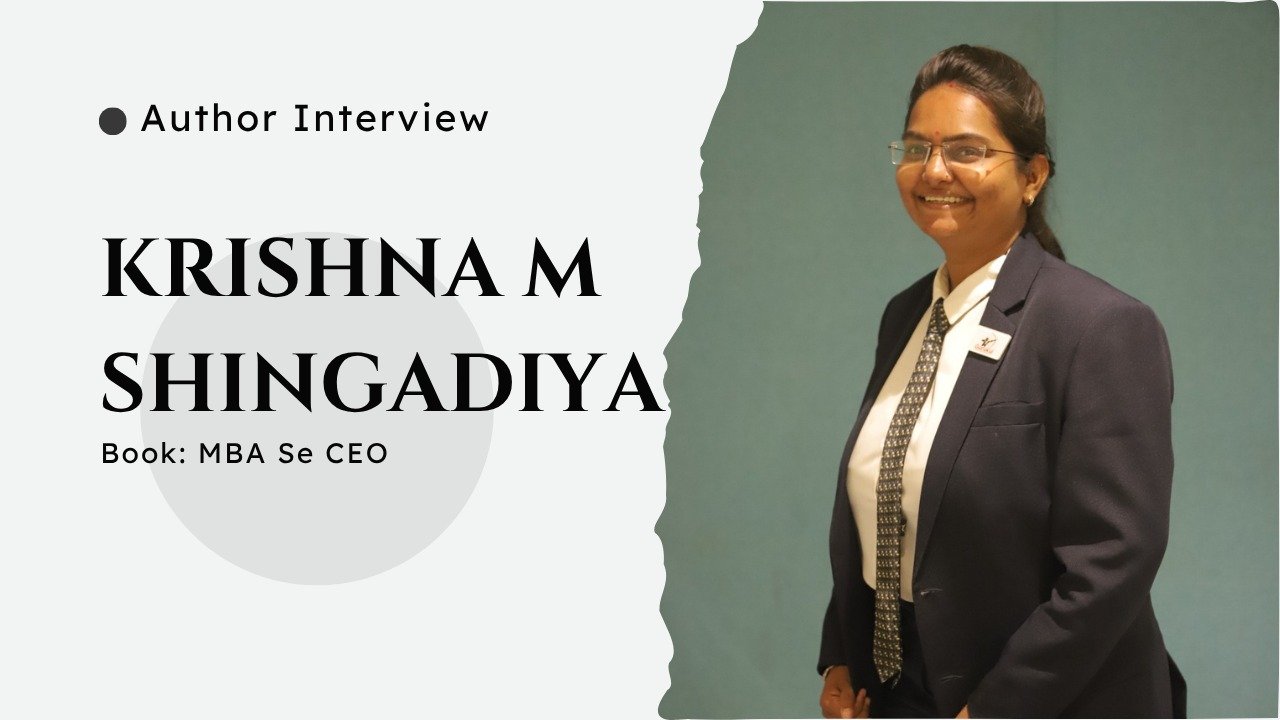
Title: MBA Se CEO: Classroom Se Corner Office Tak
Author: Krishna M Shingadiya
Publisher: Evincepub Publishing
About the Author
Krishna M. Shingadiya is an accomplished Marketing Strategist, Strategic Business Consultant, Author, and Corporate Trainer dedicated to transforming entrepreneurs, startups, and MSMEs into sustainable, growth-driven organizations.
With extensive consulting experience across diverse industries, she has worked with business owners to improve marketing strategies, sales systems, business processes, digital transformation, leadership development, and organizational growth. Her expertise combines practical business consulting with modern digital marketing, enabling businesses to scale in today’s competitive marketplace.
Krishna is also an experienced Digital Marketing and Soft Skills Trainer, having conducted virtual and offline training programs for entrepreneurs, business owners, professionals, and aspiring marketers. Her training philosophy focuses on practical implementation, strategic thinking, and measurable business results rather than theory alone.
As the founder of Krishna Digital Marketing Academy, she is committed to making business education accessible through online learning, social media, workshops, and digital content. Her mission is to equip entrepreneurs with the knowledge, skills, and strategic mindset required to build successful and future-ready businesses.
Krishna is the author of three business-focused books designed to empower the next generation of entrepreneurs and business leaders:
MBA to CEO explores the journey from academic knowledge to executive leadership, providing practical insights on leadership, business strategy, decision-making, and organizational success.
The Skill Revolution highlights the essential future skills required in the age of Artificial Intelligence, digital transformation, automation, and continuous innovation, helping professionals remain competitive in an evolving global economy.
The Startup Blueprint serves as a practical roadmap for entrepreneurs, covering every stage of building a successful startup—from idea validation and business planning to marketing, scaling, fundraising, and long-term growth.
Through her writing, consulting, and training, Krishna aims to bridge the gap between business theory and real-world execution. Her work inspires entrepreneurs to build resilient businesses, embrace innovation, and create lasting impact in their industries.
Professional Expertise
Strategic Business Consulting for MSMEs & Startups
Marketing Strategy & Business Growth
Digital Marketing & Personal Branding
Sales System Development & Customer Acquisition
Startup Mentoring & Business Scaling
Leadership Development & Soft Skills Training
Business Process Improvement & Organizational Growth
Corporate Workshops & Executive Coaching
Mission
“To empower entrepreneurs, startups, and MSMEs with practical strategies, future-ready skills, and transformational business knowledge that creates sustainable growth and lasting success.”
Neel Preet: Your book begins by challenging the belief that a degree guarantees success. What experiences made you realise that the real gap is not between intelligence and opportunity, but between education and execution?
Author: During my journey as an entrepreneur, consultant, and mentor, I had the opportunity to interact with thousands of students, professionals, business owners, and corporate leaders. One observation remained remarkably consistent: the people who achieved extraordinary success were not necessarily the most academically gifted. Instead, they were the individuals who had developed the ability to execute consistently.
Our education system does an excellent job of teaching us what to think, but it spends very little time teaching us how to create value in the real world. Students learn theories of marketing without ever selling a product. They study leadership without leading a team. They understand finance academically without managing their own cash flow.
That disconnect fascinated me.
I realized that the biggest gap in today’s workforce is not between intelligence and opportunity—it is between knowledge and implementation.
Knowledge has potential value. Execution creates actual value.
In today’s economy, employers and customers don’t reward what you know; they reward what you can deliver. A degree may open the first door, but sustained success depends on your ability to solve problems, make decisions, adapt quickly, and create measurable impact.
That realization became the foundation of this book.
Neel Preet: You describe becoming a CEO as a change in mindset rather than merely attaining a senior position. In practical terms, what is the first visible difference between someone who thinks like an employee and someone who thinks like a CEO?
Author: The first difference is ownership.
An employee generally focuses on completing assigned responsibilities. A CEO focuses on creating outcomes, regardless of whether those outcomes fall within a formal job description.
Employees often ask,
“What is my responsibility?”
CEOs ask,
“What is the organization’s biggest challenge, and how can I contribute to solving it?”
That shift completely changes decision-making.
A CEO naturally begins thinking in systems rather than tasks. They consider customer experience, profitability, long-term sustainability, innovation, culture, risk management, and strategic growth simultaneously.
Most importantly, CEOs stop measuring effort and start measuring impact.
Leadership begins the moment a person stops asking for instructions and starts taking responsibility for results.
That mindset can be developed at any stage of a career—it doesn’t require a designation.
Neel Preet: The book repeatedly emphasises value creation. How can a student or young professional identify whether they are genuinely creating value, rather than simply completing the tasks assigned to them?
Author: One of the most powerful questions I encourage readers to ask themselves is:
“If I stopped doing this work tomorrow, what meaningful difference would anyone notice?”
Completing tasks creates activity.
Creating value creates impact.
Value creation can usually be measured in one or more of five ways:
- solving a meaningful problem
- saving time
- reducing cost
- increasing revenue
- improving someone’s experience
If your contribution helps an individual, a customer, a company, or society become better than before, you are creating value.
The future belongs to people who consistently make themselves difficult to replace—not because they work longer hours, but because they solve increasingly valuable problems.
That is the true currency of career growth.
Neel Preet: In your discussion on toppers, you suggest that academic excellence can sometimes create fear of failure, overthinking and analysis paralysis. How can high-performing students preserve their discipline while also developing the courage to experiment, make mistakes and act with incomplete information?
Author: Perfection is often misunderstood as excellence.
In reality, perfection frequently becomes an obstacle to progress because it creates hesitation.
Many academically successful students spend years preparing to begin, while entrepreneurs and leaders begin first and improve along the way.
The business world rewards speed of learning more than flawless planning.
I encourage students to maintain their discipline because discipline builds consistency. However, they must replace the fear of failure with curiosity.
Every experiment generates feedback.
Every failure generates data.
Every mistake improves judgment.
Leadership is built through decisions made under uncertainty.
You cannot develop confidence by avoiding failure.
You develop confidence because you’ve survived failure and learned from it.
The objective should never be to avoid mistakes.
The objective should be to avoid repeating the same mistake.
Neel Preet: You present AI not as a replacement for human capability, but as a tool that future leaders must learn to use intelligently. Where should a young professional draw the line between using AI for efficiency and becoming intellectually dependent on it?
Author: Artificial Intelligence is one of the most transformative technologies of our generation, but every powerful technology requires responsible use.
I believe AI should function as a thinking partner—not a thinking replacement.
Use AI to accelerate research.
Use it to generate ideas.
Use it to automate repetitive work.
Use it to improve productivity.
But never allow it to replace your judgment, creativity, ethics, or critical thinking.
A professional who blindly accepts AI-generated answers becomes dependent.
A leader questions, validates, improves, and contextualizes those answers.
The future will not belong to people who simply know AI tools.
It will belong to people who know how to combine human wisdom with artificial intelligence.
Technology multiplies intelligence.
It does not replace wisdom.
Neel Preet: Your formula for the future CEO combines business knowledge, human skills and AI capability. Of these three dimensions, which one do you believe is most neglected in management education today, and why?
Author: If I had to identify the most neglected dimension, it would undoubtedly be human skills. Ironically, these are the very skills that become more valuable as technology becomes more advanced.
Today’s management education does an excellent job of teaching theories, frameworks, case studies, and increasingly, digital tools. Students graduate with technical knowledge and are becoming familiar with AI platforms. However, when they enter the workplace, they quickly discover that organizations are not run by spreadsheets or algorithms—they are run by people.
A leader’s success depends on the ability to influence without authority, communicate with clarity, negotiate during uncertainty, manage conflicts, inspire diverse teams, and build trust. These capabilities cannot be mastered through lectures alone; they require continuous practice, self-awareness, and real-world experience.
Artificial Intelligence can analyze data, generate reports, and automate repetitive tasks, but it cannot replace empathy, ethical judgment, emotional intelligence, or the ability to inspire people during difficult times. In fact, as AI becomes more accessible, human qualities will become the strongest competitive advantage.
That is why I describe the future CEO as someone who stands at the intersection of business intelligence, human intelligence, and artificial intelligence. Business knowledge helps you understand markets, human skills help you lead people, and AI capability helps you scale both. Neglect any one of these three, and your leadership remains incomplete.
Neel Preet: The book treats freelancing as more than an additional source of income; it presents it as a training ground for sales, client understanding and entrepreneurship. What lessons does freelancing teach that even a strong MBA curriculum may fail to provide?
Author: Freelancing is often misunderstood as merely earning extra income. I see it as one of the most practical business schools in the world because every freelance project forces you to experience the realities of the marketplace.
In a classroom, you may study marketing theories, pricing models, customer behavior, and negotiation strategies. As a freelancer, however, you must apply those concepts immediately. You learn how to identify opportunities, approach potential clients, communicate your value, negotiate fees, manage expectations, deliver quality work, handle criticism, and build long-term relationships. Every project becomes a live case study, and every client becomes a teacher.
Perhaps the greatest lesson freelancing teaches is accountability. In a traditional job, your salary often arrives regardless of whether your contribution is exceptional or average. In freelancing, your income is directly linked to the value you create and the trust you build. If you fail to deliver, the market responds immediately.
Freelancing also develops entrepreneurial thinking. Instead of asking, “How do I complete my assignment?” you begin asking, “How do I solve my client’s problem?” That shift from task orientation to value creation is what transforms professionals into business leaders.
In many ways, freelancing compresses years of business experience into a much shorter period because it teaches resilience, adaptability, communication, financial discipline, and customer-centric thinking simultaneously. Those lessons are difficult to replicate in any classroom.
Neel Preet: You define networking as the creation of long-term relationships based on trust, contribution and mutual development—not merely collecting contacts. How can an ambitious person build a powerful network without making relationships feel transactional?
Author: One of the biggest misconceptions about networking is that it begins when you need something. In reality, meaningful networking begins long before any request is made. It begins with contribution.
People naturally remember those who add value to their lives. That value does not always have to be financial. It may be sharing knowledge, making introductions, offering encouragement, solving problems, celebrating achievements, or simply being genuinely interested in another person’s success.
I often tell young professionals that relationships should never be treated as transactions. A transaction asks, “What can I get?” A relationship asks, “How can we grow together?”
Trust is built through consistency rather than frequency. You don’t need to speak to someone every week, but whenever you interact, your presence should leave a positive impression. Small acts of authenticity over a long period create stronger professional networks than aggressive self-promotion ever can.
Another important principle is diversity. Don’t build a network only with people in your own industry or at your own level. Build relationships across generations, industries, and professions. Innovation often happens at the intersection of different perspectives.
Ultimately, networking is not about increasing the number of contacts in your phone. It is about increasing the number of people who trust your character, respect your competence, and are willing to grow with you over the long term. That kind of network becomes one of the most valuable assets any leader can possess.
Neel Preet: The book covers personal branding, communication, emotional intelligence, productivity, financial literacy and multiple income sources. How should a reader prioritise these areas without becoming overwhelmed by trying to improve everything at once?
Author: Personal growth should never become a race to master everything simultaneously. Sustainable transformation happens through deliberate, sequential improvement.
I encourage readers to think of these skills as building a house. You cannot begin with the roof; you must first build a strong foundation.
The first foundation is self-discipline and productivity, because without consistency, no other skill develops effectively.
The second is communication, since every opportunity in life—whether employment, entrepreneurship, leadership, or relationships—depends on your ability to express ideas clearly and influence others.
The third is emotional intelligence, because technical expertise may get you hired, but emotional maturity determines how far you will grow as a leader.
Once these foundations are established, readers should focus on personal branding. Your reputation is the market’s perception of your value. In today’s digital economy, people often discover your brand before they ever meet you.
Next comes financial literacy. Earning money is important, but understanding how to manage, invest, and multiply it is what creates long-term financial freedom.
Finally, once a stable foundation exists, explore multiple income sources. Diversifying income should be viewed not as chasing money, but as building resilience in an unpredictable world.
The objective is not to improve everything overnight. The objective is to become one percent better every day. Small, consistent improvements eventually create extraordinary transformation.
Neel Preet: Your 90-day CEO transformation plan turns the book’s ideas into measurable action. At the end of those 90 days, what changes should a sincere reader expect to see—not only in their résumé or income, but in the way they think, decide and take responsibility?
Author: The most important transformation after ninety days is not visible on a résumé—it is visible in the way a person thinks.
When readers begin the journey, many are waiting for opportunities, instructions, or permission. By the end of the program, my hope is that they begin creating opportunities instead of waiting for them.
They become more proactive than reactive.
More solution-oriented than problem-focused.
More accountable than dependent.
Their decision-making becomes faster because they stop fearing imperfection and start trusting their ability to learn through action. They become comfortable with uncertainty because they understand that leadership is rarely about having complete information; it is about making thoughtful decisions with the best information available.
Readers also develop a stronger sense of ownership. Instead of asking, “Whose responsibility is this?” they begin asking, “How can I contribute?” That single shift changes careers, organizations, and lives.
Professionally, they will likely notice improvements in communication, productivity, confidence, networking, digital skills, and their ability to create value. Financial opportunities may also increase because the marketplace rewards people who consistently solve meaningful problems.
However, the greatest outcome is a transformation in identity. They no longer see themselves merely as employees, students, or job seekers. They begin seeing themselves as leaders, value creators, and lifelong learners.
That, ultimately, is the purpose of the 90-day transformation—not simply to build a better career, but to build a better decision-maker. Because when the way you think changes, the way you lead, create, and succeed changes with it.