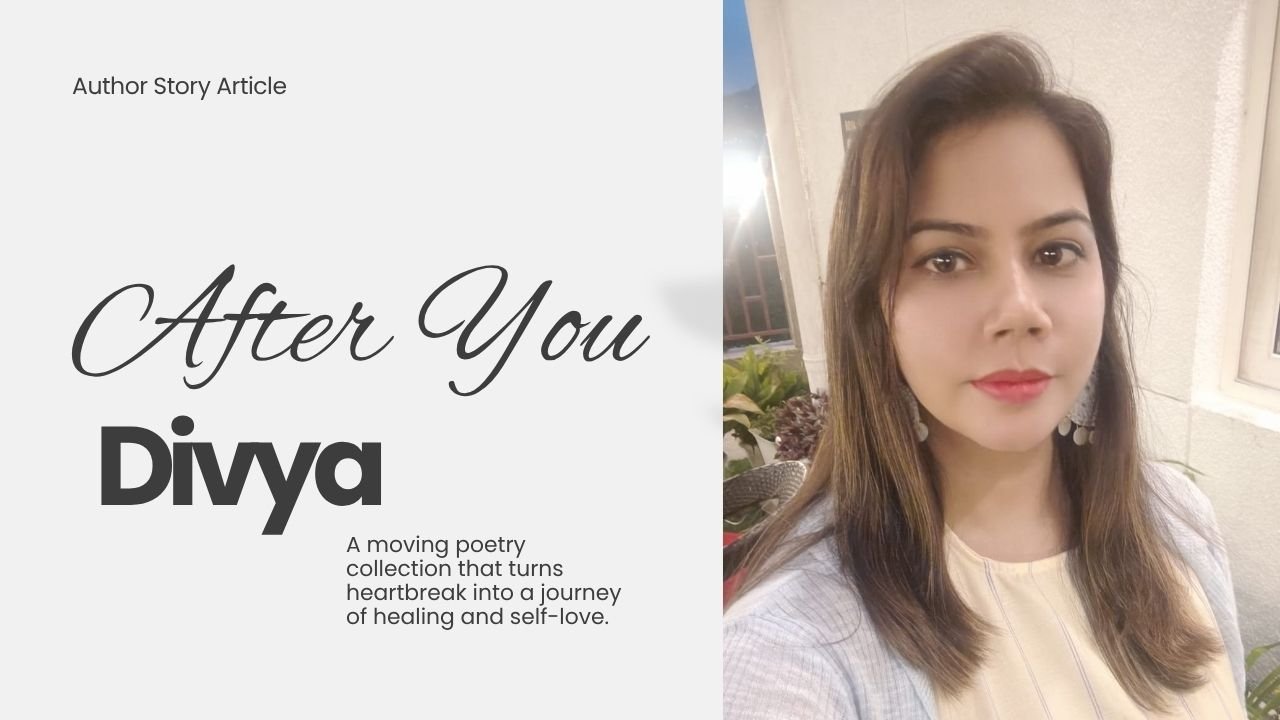
Title: After You
Author: Divya
ISBN: 9789373354941
Publisher: Evincepub Publishing
There are some books that tell a story through events, characters and conversations. Then there are books that tell a story through feelings. After You by Divya belongs to the second kind. It is an emotional poetry collection that takes the reader through love, attachment, heartbreak, loneliness, healing and, finally, self-discovery. What makes the book interesting is that it does not present heartbreak as a single moment of sadness. Instead, it looks at everything that comes after it, the memories that remain, the questions that have no answers, the nights that feel longer than usual, and the slow process of learning how to live without someone who once felt like home. Divya writes from a deeply personal space, but the emotions in her poems are not limited to her own experience. They are feelings that many people have carried silently after losing a relationship, a friendship or even a version of themselves. The book begins with love in its simplest form, through conversations, meetings, shared moments and the comfort of having someone beside you. Poems such as “The First Time”, “Before I Knew”, “The First Time You Held My Hand” and “The Beginning” capture the softness of falling in love. The writing is simple, direct and conversational, which makes it easy for the reader to enter the emotional world of the poet. Rather than using complicated poetic language, Divya often chooses short lines and familiar words. This works well for the kind of story she wants to tell because the emotions remain at the centre. The opening section also creates an important contrast for what comes later. The warmth of love makes the pain of its loss feel more real. As the reader moves forward, the book slowly changes from a story about loving another person into a story about learning to love oneself.
The strongest emotional movement in After You begins with The Breaking, where the happiness and comfort of the earlier poems are replaced by absence, unanswered questions and emotional confusion. This section contains some of the most relatable moments in the collection. “Missing You” captures the strange way memories continue to appear in ordinary situations. A song, a sunset, a joke or even the simple habit of checking a phone can bring someone back into the mind. The poem understands an important truth about heartbreak: sometimes we do not miss only the person, but the life and routine that existed around that person. In “Questions You Left Behind”, Divya explores the need for answers after a relationship ends. The questions are not dramatic. They are the kind of questions people often ask themselves privately, such as when things changed and how a promise of forever became a goodbye. “Betrayal” goes deeper into the pain of discovering that the person who once promised safety has become the source of hurt. “Loneliness” also stands out because it presents loneliness not simply as being physically alone, but as having feelings that no longer have a place to go. This section shows the poet at her most vulnerable. There is no attempt to hide the sadness or make it look beautiful all the time. The poems speak about crying, waiting, missing someone and feeling misunderstood. The simplicity of the language makes these emotions more accessible. A reader does not need to be a regular poetry reader to understand what Divya is expressing. The poems can be read quickly, but many of them leave behind a thought that stays for longer. This is one of the collection’s main strengths. It gives space to emotions that are often difficult to explain in ordinary conversation.
However, After You does not remain a book of heartbreak. Its real purpose becomes clear when the collection enters The Healing. This is where the emotional direction begins to change. The poet does not suddenly become happy or pretend that the past never happened. Instead, she begins to understand that healing can exist even when memories remain. “Learning to Be Alone” is particularly important because it shows the difference between remembering someone and waiting for them. The poem accepts that memories may continue to return, but the speaker no longer allows those memories to decide her future. This is a mature shift in the emotional journey. “Unlearning You” also captures an experience many readers may recognise. Loving someone can happen naturally, but removing that person from daily habits, places, songs and thoughts can take much longer. The poem “The Longest Journey” takes this idea further by suggesting that the most difficult journey was not reaching another person, but finding the way back to oneself after becoming lost in love. This is where Divya’s writing becomes more than a collection about a failed relationship. It becomes a reflection on identity. The poet begins to ask an important question: who are we when we are no longer defined by the person we loved? “No One Knows” and “Nights I Couldn’t Explain” continue this quiet exploration of private pain. These poems show that healing is often invisible. People may see someone going to work, meeting friends or continuing daily life, but they may never know what happens during the silent hours. Divya understands this hidden side of healing and gives it a voice. The poems in this section do not offer quick solutions. Instead, they acknowledge that recovery can be slow, personal and sometimes lonely.
The emotional turning point of the book arrives with The Blooming. The title itself suggests that the poet is no longer simply trying to survive what happened. She is beginning to grow from it. “The Woman in the Mirror” is one of the clearest examples of this transformation. Instead of seeing only the woman who was left behind, the poet begins to recognise a stronger version of herself. The scars are no longer proof of weakness. They become part of her story. “Forgiving Myself” is equally meaningful because heartbreak often brings self-blame. People may question what they did wrong, whether they loved too much or whether they should have noticed certain signs earlier. Divya challenges this kind of thinking by reminding the reader that loving honestly is not something to feel guilty about. “Choosing Me” continues this message with a simple but powerful idea: a person cannot keep giving to everyone else while leaving nothing for themselves. The poem marks the point where self-care becomes more than a popular phrase. It becomes a necessary part of rebuilding one’s life. The final section, The Love Within, takes this transformation even further. “Coming Home to Myself”, “Enough”, “Soft, Not Weak”, “My Safe Place”, “Bloom” and “The Glow Within” all focus on self-worth, confidence and independence. These poems show that the poet’s definition of love has changed. Earlier, love was strongly connected with another person. Now, love begins within. The message is not that relationships are unimportant. Instead, the book suggests that a healthy sense of self should not disappear inside a relationship. The idea of becoming one’s own safe place is particularly strong and gives the collection a positive direction without making the earlier pain feel meaningless.
From a reviewer’s perspective, one of the most appealing qualities of After You is its accessibility. Divya does not try to make her poetry difficult through complicated words or heavy symbolism. Her poems are short, clear and emotionally direct. This makes the collection suitable for readers who enjoy contemporary poetry and for those who may be picking up a poetry book after a long time. Many poems can be read in a few minutes, but they are written around experiences that may take much longer to process. The repeated themes of memories, silence, self-worth, boundaries and personal growth create a sense of continuity throughout the collection. At the same time, the five-part structure gives the book a clear emotional progression. Choosing Me introduces love and connection, The Breaking brings loss, The Healing deals with acceptance, The Blooming presents growth, and The Love Within brings the journey back to the self. This structure makes the collection feel like a complete emotional story rather than a random selection of poems. Some poems are very simple and rely more on the feeling behind the words than on complex poetic techniques. That simplicity is both the style and the strength of the book. The writing feels personal, almost like reading pages from someone’s private journal, yet many of the emotions remain universal. There are also moments where the poet moves from speaking about one relationship to speaking about a larger experience of becoming a stronger woman. This wider movement gives the collection more meaning. The book is ultimately not asking readers to forget the past. It is asking them to understand it, accept what it taught them and continue moving forward.
Divya’s debut as an author is therefore not simply a collection about someone she lost. It is about the person she discovered after the loss. That distinction is what gives After You its emotional value. The book begins with the comfort of finding another person and ends with the comfort of finding oneself. The journey between these two points includes love, disappointment, betrayal, loneliness, self-questioning, acceptance, forgiveness and renewed confidence. As a poet, educator and storyteller, Divya brings an understanding of emotions that is closely connected with everyday human experiences. Her writing reflects the belief that feelings that remain unspoken still deserve a voice. The book can particularly connect with readers who have experienced the end of a meaningful relationship, but its message can also reach anyone who has ever lost themselves while trying to keep someone else happy. The final message of the collection is simple and memorable: an ending can be painful without being the end of one’s story. Sometimes, losing someone forces us to look at the parts of ourselves that we had ignored. Sometimes, the silence that follows a goodbye gives us the space to hear our own voice again. And sometimes, the home we searched for in another person was waiting inside us all along. After You is at its best when it reminds readers of this quiet truth. Divya’s poems do not promise that healing will happen overnight. Instead, they show healing as a collection of small choices: choosing yourself, forgiving yourself, setting boundaries, becoming comfortable with your own company and learning to believe in your worth again. That makes the collection more than a heartbreak diary. It becomes a gentle record of transformation. For readers who have loved deeply, lost painfully or are still learning how to rebuild themselves, After You offers companionship through words. Its final thought, “After you, I found me,” captures the heart of the entire book. It is not a statement of bitterness. It is a statement of growth. And that is what makes Divya’s debut worth reading.