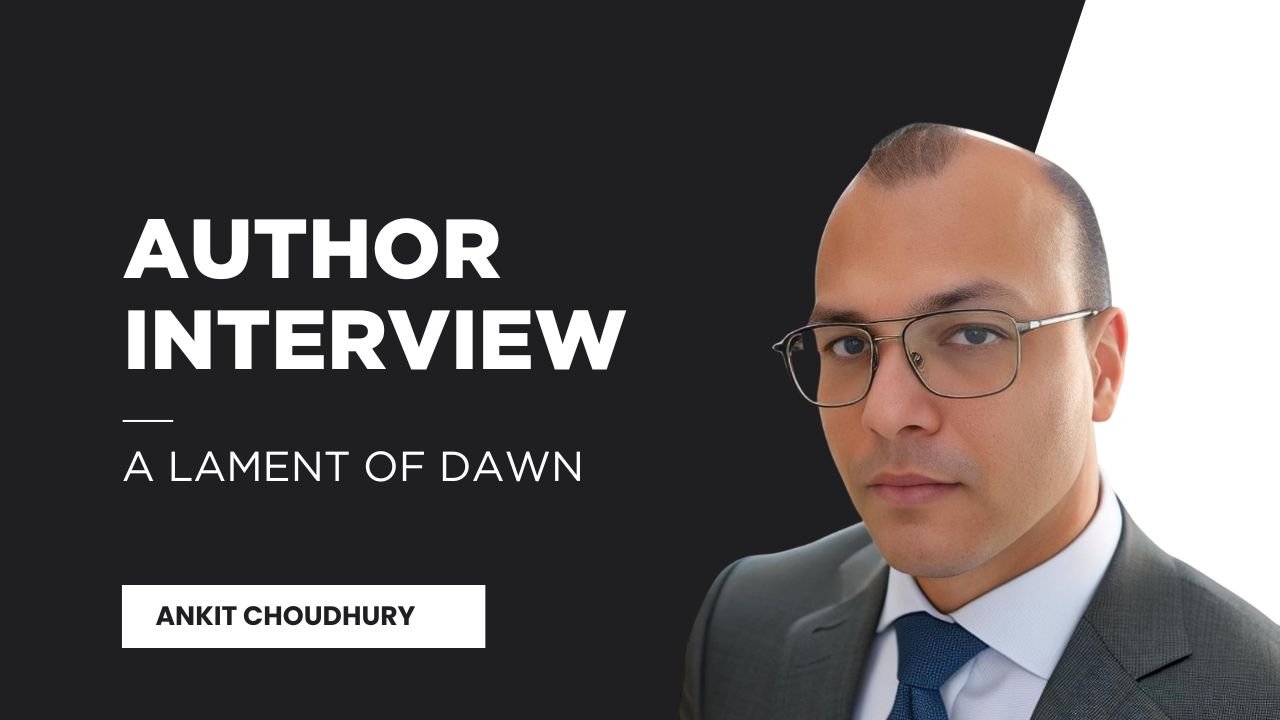
Title: A Lament of Dawn
Author: Ankit Choudhury
ISBN: 9789373357645
Publisher: Evincepub Publishing
About the author: Ankit writes at the fault line between myth and memory.
His work is driven by questions of identity, fracture, ambition, love, loss, and the uneasy truce between order and chaos that most people live with but rarely name. The characters in his stories are mirrors to be endured: minds under strain, hearts negotiating with purpose, intelligence colliding with longing. Power, in his writing, is never abstract—it is psychological, intimate, and costly.
Trained as a software architect, Ankit approaches storytelling the way he approaches systems: by dissecting how things fail, how they adapt, and what remains when structure collapses. He explores consciousness as a terrain—memory as architecture, love as destabilization, and meaning as something forged under pressure rather than discovered whole. The result is fiction that reads as myth on the surface and confession beneath it.
Ankit lives in Pune, India. He is an artist, reader, gamer, lifelong explorer of ideas—and a father, which, more than anything else, keeps him tethered to the human center of his work.
Question – What inspired you to write A Lament of Dawn?
Answer – It wasn’t inspiration in the romantic sense. It was completion. The earlier books were driven by momentum – ambition, rebellion, the belief that intelligence could correct what felt broken. This one began when that belief failed. I wrote it because I needed to understand what remains when victory stops being the goal.
Question – How did you come up with the idea of a world with almost perfect control?
Answer – I didn’t invent it so much as observe it. Most modern systems aim for optimization – emotional, political, technological. We confuse efficiency with wisdom. A world of near-perfect control felt like the logical extension of that impulse. The more we reduce uncertainty, the more fragile we become when something refuses to be managed.
Question – Who is Manu Elaris to you as a writer?
Answer – Manu is the version of intelligence that finally realizes its limits. He isn’t a villain and he isn’t a hero. He’s what happens when someone builds something extraordinary and then discovers it cannot solve the one thing he thought it would. Writing him felt like examining ambition after it has exhausted itself.
Question – What was the most difficult part in writing Manu’s character?
Answer – Letting him be tired. It’s easy to write brilliance. It’s harder to write the moment brilliance understands it cannot win. I had to resist rescuing him with one more idea, one more strategy. The difficulty was allowing him to confront himself without spectacle.
Question – How did you build the emotional relationship between Manu and Lily?
Answer – Through my own experience. I didn’t construct it through dramatic gestures. I built it through restraint. Their relationship exists in what isn’t said as much as what is. Lily is not there to fix Manu. She reflects him – sometimes gently, sometimes painfully. The connection had to feel human enough to destabilize someone who believes he can outthink everything.
Question – Do you relate to any character in the story personally?
Answer – I relate to the parts of Manu that mistake control for safety. And I relate to Lily’s quiet clarity – the kind that doesn’t argue, it simply waits. Most of the characters carry fragments of experiences I’ve lived through, as distillations.
Question – Why did you choose to focus more on inner struggle than action?
Answer – External conflict is canon. External conflict is visible. It is… ordinary. Internal conflict determines everything that follows. I’ve always been more interested in the moment before the decision than the explosion after it. The real battle in this book is psychological – the tension between who we are and who we thought we needed to become.
Question – What message do you want readers to take from this book?
Answer – I don’t aim to deliver a message. If anything, I hope readers feel permitted to stop fighting battles that no longer serve them. Not every ending needs to be framed as triumph. Sometimes peace begins when we stop demanding that life justify itself.
Question – How does this book connect with A Ballad of Chaos series?
Answer – It is the opposite of A Ballad of Chaos. It shares the same thematic spine – order within chaos – but the scale is different. The earlier books moved through myth and war. This one turns inward. It functions less as a continuation and more as a coda. Instead of asking how worlds collapse, it asks how individuals learn to live after collapse.
Question – Why did you choose acceptance over victory in the ending?
Answer – Because victory often disguises avoidance. Acceptance requires honesty. Manu doesn’t lose because he’s defeated. He steps away because he finally understands the cost of continuing. That felt more truthful than another grand solution.
Question – What does “control vs chaos” mean to you in real life?
Answer – Control is the belief that if we manage variables carefully enough, we can avoid pain. Chaos is the reminder that life isn’t an equation. In reality, both exist together. We need structure to function, but we need uncertainty to remain human. The tension between them is not something to eliminate – it’s something to navigate.
Question – How long did it take you to complete this book?
Answer – The drafting took under a year. The emotional preparation took much longer. By the time I wrote the final chapter, I had been circling that ending for years without admitting it.
Question – What kind of readers will enjoy this story the most?
Answer – Readers who don’t need constant reassurance. Those who are comfortable with moral ambiguity and unresolved emotion. It’s a story for people who are more interested in why a decision is made than in whether it wins.
Question – What was your writing routine while working on this book?
Answer – Focused, but irregular. I write in intense stretches rather than daily quotas. When I was deep in this book, I limited distractions and allowed long periods of silence. The past chapters required introspection; the present chapters required precision. I approached them differently.
Question – What can readers expect from you in the future?
Answer – Silence, if there’s nothing honest to say. And if something new demands language, it will arrive naturally. I don’t force stories anymore. I let them form when they’re ready to be told.