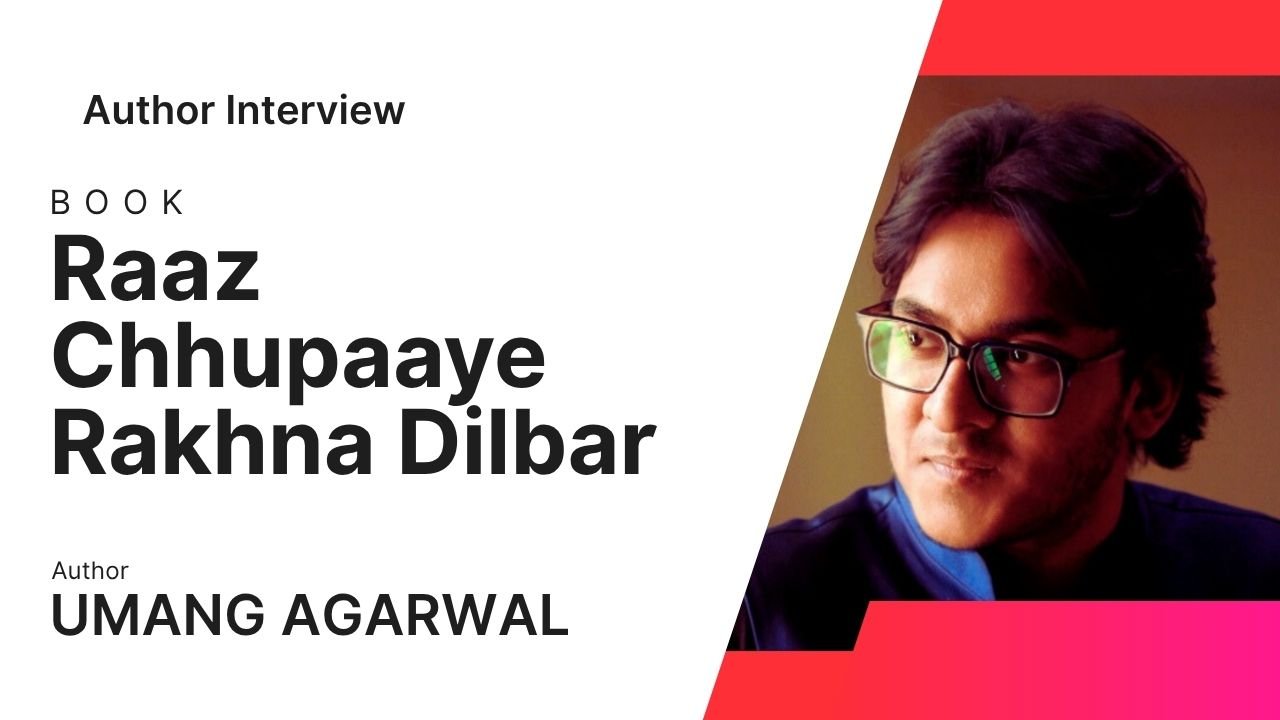
Title: Raaz Chhupaaye Rakhna Dilbar
Author: UMANG AGARWAL
ISBN: 9789373357829
Publisher: Evincepub Publishing
About the Book
“A Peaceful Sanctuary for Restless Dreamers”
Across 4 evocative segments; Raina, Dashamlav, Jheeni, and Aagaaz; this collection weaves together 50 Shers, Nazms, Ghazals, and Poems that capture the emotional landscape of modern youth. Written with a rare blend of simplicity and depth, the pieces sit beside the reader as a gentle companion through heartbreak, longing, and hope. To ensure the beauty of the verse is accessible to all, the book features clear explanations for difficult words and thoughtful transliteration, allowing the reader to experience the poetry in the language that resonates most with them. It also features a special chapter dedicated to the author’s debut song, ‘Reshmi’; including unreleased lyrics; and a curated ‘Mood Playlist’ to set the tone for the journey. By balancing raw honesty with artistic flair, the book provides high value for both time and heart, making it a rare keepsake for any reader, an invitation to own a piece of art that understands one’s unspoken truths and transforms them into a lasting companion.
About the Author
Umang Agarwal is a 23 y/o author from Kolkata. He is a Film & Music Director, Composer, Lyricist, Vocalist and Poet. He is also the Founder-Director of Mrigtrishna Productions Pvt. Ltd., a Film & Music Production company, with song releases available on:
Streaming Platforms: Spotify | YouTube | YouTube Music | JioSaavn | Apple Music | Amazon Prime Music
Social Media: Instagram | Facebook | LinkedIn | X (Twitter)
Neel Preet: Can you tell us about yourself and your journey as a writer?
Umang Agarwal: I am Umang Agarwal; and I sing, I write, I make music, I make films. Ever since I started understanding the meaning of what the lines in the songs meant, I’ve dreamt of writing songs myself; and RCRD (Raaz Chhupaaye Rakhna Dilbar) is a way for me to put my efforts, my memories out there, for the world to read in the form of poetry, so that I can make space for new ones in my heart; and in doing so, make a place for myself in the world of poets.
Neel Preet: What inspired you to write “Raaz Chhupaaye Rakhna Dilbar”?
Umang Agarwal: Libraries, the books, the dusty shelves, the literature classes, the Instagram reels, the songs, the interviews, the podcasts; everything. From Shakespeare to Kamil, from Ghalib to Gulzar, from Rahat Indori to Ruskin Bond.
Neel Preet: Why did you choose this unique title for your book?
Umang Agarwal: It’s the funniest thing; I thought people would find it anything but unique. It was initially titled “Izhaar” for the entire duration of the four and a half years of the drafting. Then I happened to write a sher titled “Raaz Chhupaaye Rakhna Dilbar”, which I loved (and still do) beyond anything; as it resonated with my inner beliefs and in a way reflects upon my journey so far; so I thought of naming my book after it. However, the sher that inspired the title isn’t itself in the book, as I’m keeping it for the next one, if and when that happens, insha’allah! And when I do publish it, I hope people like it as much as I do. For now, I’m just really glad that this title has strung a chord for so many, and so much so, that almost everyone around me knows this phrase and calls me by it; even if they haven’t read the book (yet).
Neel Preet: What does this book mean to you personally?
Umang Agarwal: A dream come true; and a ray of hope for those which are yet to.
Neel Preet: Your book talks about dreams and secrets of youth. How close is it to your real life?
Umang Agarwal: It is much closer than one might think. Each couplet that I’ve written, I’ve felt. And from what I have been seeing from the reviews and messages coming from the readers, they too can relate to much of it, some more than I do. That’s the beauty of sharing; it brings people together.
Neel Preet: How did the idea of using different poetic forms come to your mind?
Umang Agarwal: It isn’t as if one day I sat down and chalked the entire roadmap and plan as to what I want the book to be. Such technical thoughts don’t usually meddle with the mind when it is creating something; something artistic, something for the world. I just kept writing, without even thinking about the form of poetry being invoked. Once I knew I wanted to publish the shers in the form of a book, I started compiling them together, followed by the editing and the heart-wrenching deletion of many couplets from the manuscript. The segregation of the poetic forms is just to provide the book a navigable framework. And after all, which author would want their book to be a bouquet of one, rather than a garden of many flowers.
Neel Preet: Was it difficult to write in so many different styles?
Umang Agarwal: Difficult isn’t the word I’d use for the process. In fact, it helped me break the monotony for myself. It was fun to write one couplet in proper Hindu, one in proper Urdu, and the immediately next one in Avadhi. It kept things fresh, and interesting!
Neel Preet: How long did it take you to complete this book?
UA: 15 years; 10 in dreaming, 5 in writing. And of course, a few countless nights.
Neel Preet: Did you face any challenges while writing this book?
Umang Agarwal: Yes! The biggest one being; Objectivity. Every time I had to proofread the drafts (much to my agony); it became more and more difficult to find even decent writings worthy of publication. I kept removing pieces after the fell prey to my overthinking, so much so, that the compilation began at 100, and now it sits at 50. If I’d have spent a single night proofreading another draft, I’m sure this interview wouldn’t be taking place.
Neel Preet: The book also shows the journey of songwriting. What inspired this concept?
Umang Agarwal: I’ve grown up ardently listening to anecdotes, stories and explanations behind both popular and underrated songs. Songs that have shaped our films, songs that have made their mark in the Indian Film & Music legacy. When ‘Reshmi’ released in 2025, a song written & composed by me, I wanted to tell people exactly what the lyrics intended to portray, the depth they held, and the inspirations behind many of the phrases in the song. The song, thankfully, was appreciated by everyone who heard it, although the appreciation was more inclined towards the beautiful vocals by Nandika Buchasia & Pratyush Roychowdhury (bhaiya); and the overall musicality of it; and less towards the lyrical value. So, I was happy as the composer-director, but I felt that the lyrics deserved a bit more of the spotlight. I had almost locked the manuscript for submission when I realised I wanted to add the 4th Chapter, focused solely on the lyrical value of the song. It took me several nights to actually be able to recollect and put down the thoughts that went behind the song.
Neel Preet: How did you keep the language simple and relatable?
Umang Agarwal: It’s difficult to write simple. I’d like to quote an excerpt from the book;
“The cuisine may be as rich as the entire pantry, the food may surprise the palette as much as it could, but nothing beats water. Artistry is good, poeticism is great, depth is fantastic; but simplicity shall always prevail, above & beyond all.”
The power of simplicity; according to me; beyond language and relatability, comes from honesty. I just write what I think, what I truly feel; and if God is kind, if time favours the tide; people find it easy to relate to.
Neel Preet: Did you ever feel nervous about sharing your personal thoughts with readers?
Umang Agarwal: I believe the world is a place meant for communication. Thoughts are meant to be shared; with, for, and by people. Be it through talking, writing, or reading. I’d have surely felt nervous if feelings were involved, but after 5 years it became impracticable to weigh words with heartbeats.
Neel Preet: Which poem or part of the book is closest to your heart?
Umang Agarwal: Apart from the book’s title and the unreleased sher corresponding to it (which I will be publishing in the next one), I have a really soft corner in my heart for the pieces in Chapter III; ‘Jheeni’, especially that one sher on the chapter’s introductory page. ALSO; I would like to express my outspoken love for those cute little peacock feathers I have put on almost all the pages. I love them, above all.
Neel Preet: Did music play a role while writing this book?
Umang Agarwal: I am a musician first, writer later – so the inherent influence of music in my poetry, was pretty inevitable. In the beginning, I used to share my shers on my Instagram stories, coupled with a song that either matched the vibe of the piece, or matched my mood at the time. It is practically impossible for me to imagine any of my creations without their inherent background music. Some of the inspirations are there in the Mood Playlist for everyone to try!
Neel Preet: What message do you want to give through this book?
Umang Agarwal: Going beyond the very evident message present on the book’s cover, I’d personally feel content about the book if it inspires its readers to start writing. It helps. It helps, to keep your vulnerabilities safe on pages, away from the heart. It helps you sleep; it helps you breathe; it helps those who write, and it helps those who read.