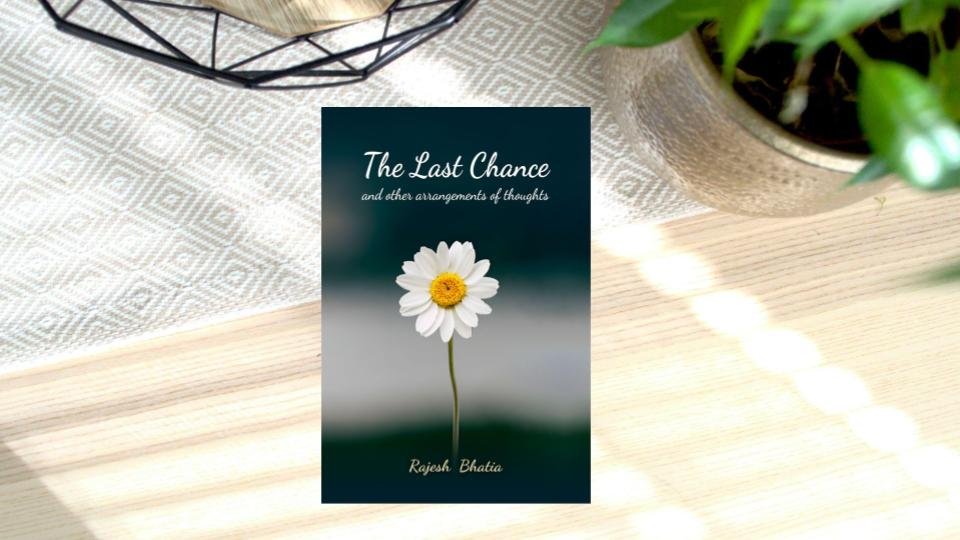
In the book “The Last Chance and Other Arrangements of Thoughts,” the poet, Rajesh Bhatia, takes on a very difficult task: trying to cover almost every major human emotion in just twenty-nine poems. Instead of telling one long story, the book is organized like a bouquet of flowers. This is an important way to look at the collection because it explains why the topics change so quickly. Just like a real bouquet has different colors and types of flowers that don’t necessarily grow in the same place, these poems bring together very different life experiences, like the joy of a wedding and the pain of a breakup, and put them side-by-side. The arrangement of life metaphorically into a bouquet is not only a unique concept but also invites readers to ponder and introspect.
The most noticeable thing about this collection is the variety of subjects. Most poetry books stay in one lane, focusing only on grief or only on love. Sometimes, they would singularly focus on just a few aspects or maybe a couple of them. This collection, however, moves from everyday topics like dating and marriage to much bigger, harder ideas like faith, guilt, and courage. There is even a mention of a time machine, which shows that the author isn’t just looking at the world as it is, but also wondering “what if?” This variety makes the book feel like a complete look at a person’s inner life. It acknowledges that we aren’t just one thing; we can feel nostalgia for the past and fear of the future at the exact same time.
The author made a specific choice to write in what the blurb calls “simple, soulful, and effective English.” In the world of poetry, “simple” is often a brave choice. Many poets use complicated words to hide their feelings or to seem more intellectual. By choosing simple language, the author is making the poems accessible to everyone. You don’t need a special degree to understand what these poems are saying about trust or betrayal. The “fragrance” mentioned in the blurb represents the emotional impact of the poems. Because the language is easy to follow, the feeling of the poem reaches the reader much faster. The focus is on the heart of the message rather than the cleverness of the words.
Another key part of the book is its rhythm. Because the subjects change so fast, moving from “women” to “tempests” to “blessings,” the rhythm is what keeps the reader from feeling lost. It acts like a heartbeat for the book. Even when the subject matter is heavy, like “blame” or “hate,” the rhythmic style helps the reader keep moving forward toward more positive themes like “rising again” and “acceptance.” This balance is what makes the book feel “timeless” and “contemporary” at once. It deals with ancient problems like jealousy and love, but it does so in a way that feels right for someone living in the modern world.
“The Last Chance” is a helpful guide for anyone trying to make sense of their own thoughts. It doesn’t try to be a deep, difficult academic text. Instead, it tries to be an honest arrangement of what it feels like to live, lose, and start over. By calling it “The Last Chance,” the author suggests that every moment of realization is an opportunity to change or to see the world differently. It is a diverse, honest, and very human collection that reminds us that even when life feels like a “tempest,” there is always a way to find “acceptance” and move on to the next chapter.