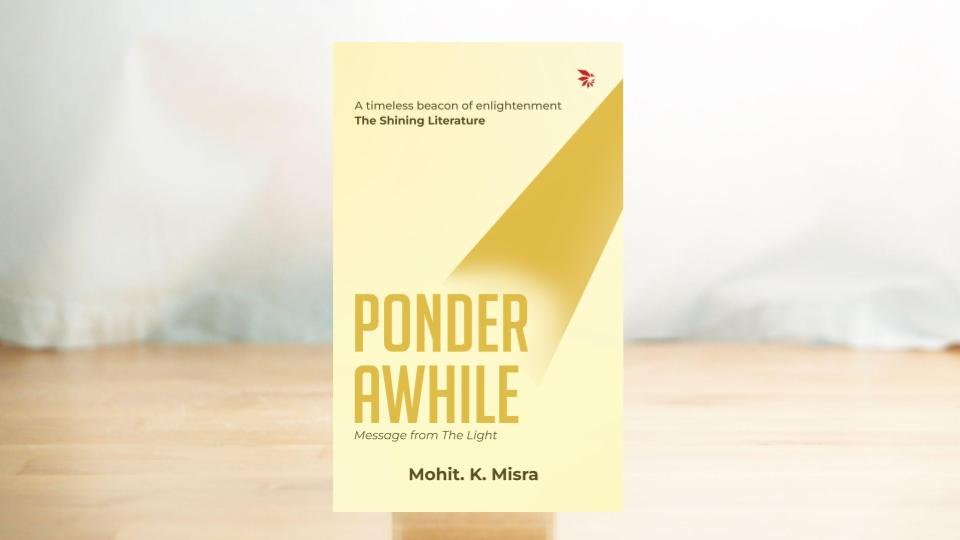
“Ponder Awhile-Message from the Light” is a deeply reflective and spiritually inclined collection of poetry that invites readers to slow down, question deeply, and reconnect with the quieter truths of existence. Comprising 48 poems, the book functions not only as a poetic work but also as a philosophical and spiritual journey, one rooted in the author’s lived experience and unfolding awakening. Mohit K. Misra’s collection is less about offering answers and more about creating a space for contemplation, making it especially resonant in a world often dominated by noise, certainty, and haste.
At the heart of “Ponder Awhile” lies the author’s personal transformation from atheism to spiritual awareness, a shift triggered by a life-changing experience at sea. This origin story subtly informs the tone of the entire collection. Rather than framing spirituality as an inherited doctrine or an unquestioned belief, Misra presents it as something discovered through vulnerability, introspection, and confrontation with one’s own mortality. This approach lends the work authenticity and emotional depth. The poems feel earned, emerging from reflection rather than prescription, and this sincerity is one of the book’s greatest strengths.
Misra’s poetry engages with timeless, universal questions and aims to address the core foundation of human existence in the simplest terms: life and death, and everything in between. The collection takes readers beyond materialistic bounds and reminds them that life is in the little moments and the people we meet along the way. This shared journey dissolves the distance between author and audience, creating a sense of companionship rather than instruction.
One of the most striking aspects of “Ponder Awhile” is its inclusive spirituality. While the poems frequently reference “The Light,” this concept is never confined to a specific religion or belief system. The Light functions as a metaphor for inner awareness, love, compassion, and truth, something universal and accessible to all. It may also be a reference to divine power beyond ordinary comprehension. By doing so, Misra transcends religious boundaries and speaks to a broader human experience. Readers who identify as religious, spiritual but not religious, agnostic, or even skeptical may still find themselves reflected in the questions and emotions explored throughout the collection.
Themes of impermanence and mortality recur throughout the book, grounding its spiritual reflections in the reality of human finitude. Poems like “Death,” “The Master,” “Eternity,” “Life,” “The Ultimate Plan,” and many others serve as sobering reminders of life’s transience. Rather than evoking despair, however, these moments encourage mindfulness and humility. Misra uses mortality as a lens through which meaning becomes sharper, urging readers to live with intention, kindness, and awareness while time allows. This balance between existential gravity and gentle hope gives the collection emotional resonance without heaviness.
Nature plays a significant role in the poems, often acting as both teacher and mirror. The sea, in particular, holds symbolic weight, reflecting vastness, uncertainty, surrender, and transformation. Through natural imagery, Misra suggests that wisdom is not solely found in texts or teachings but also in observing the world around us. Nature becomes a pathway to self-discovery, reminding readers of their place within a larger whole. These moments are quiet yet powerful, reinforcing the book’s meditative quality.
Stylistically, Misra favors simplicity and clarity over elaborate poetic devices. The language is accessible, direct, and emotionally honest. While the poems may not rely heavily on complex metaphors or experimental structures, this simplicity feels intentional. It allows the ideas to breathe and invites readers from all literary backgrounds to engage with the work. The poems often read like short meditations or journal reflections, making them well-suited for slow, intentional reading. “Ponder Awhile” is not a book to be rushed; its impact grows when each poem is given space to settle. One can only experience the intangible calming effect only by reading the poetry.
The pacing of the collection further supports this reflective experience. Each poem stands on its own while contributing to the broader arc of spiritual awakening and self-examination. There is a sense of progression, from questioning and uncertainty to acceptance and inner peace, without a rigid narrative structure. This mirrors real spiritual journeys, which are rarely linear. The poems acknowledge doubt, confusion, and contradiction as natural parts of growth, reinforcing the book’s honesty and relatability.
Another notable strength of “Ponder Awhile” is its emphasis on shared humanity. Misra frequently draws attention to common struggles, fears, and hopes that unite people across cultures and beliefs. Love, compassion, ego, suffering, and forgiveness are recurring motifs, presented not as abstract ideals but as lived experiences. The poems gently encourage readers to look beyond divisions and recognize the Light within themselves and others. In this way, the collection carries a quiet but meaningful ethical undercurrent, promoting empathy and understanding without overt moralizing.
“Ponder Awhile-Message from the Light” is both a personal testament and a universal invitation. It asks readers to pause, reflect, and reconnect with themselves amid the distractions of modern life. The book offers no rigid conclusions, only gentle guidance toward awareness, love, and inner stillness. It is a work that rewards patience and openness, offering moments of solace and insight to those willing to ponder awhile. For readers drawn to spiritual poetry, philosophical reflection, or personal transformation, Mohit K. Misra’s collection provides a calming and thoughtful companion. It reminds us that meaning is not always found in certainty, but often in the courage to question and in the quiet recognition of the Light that already exists within us.