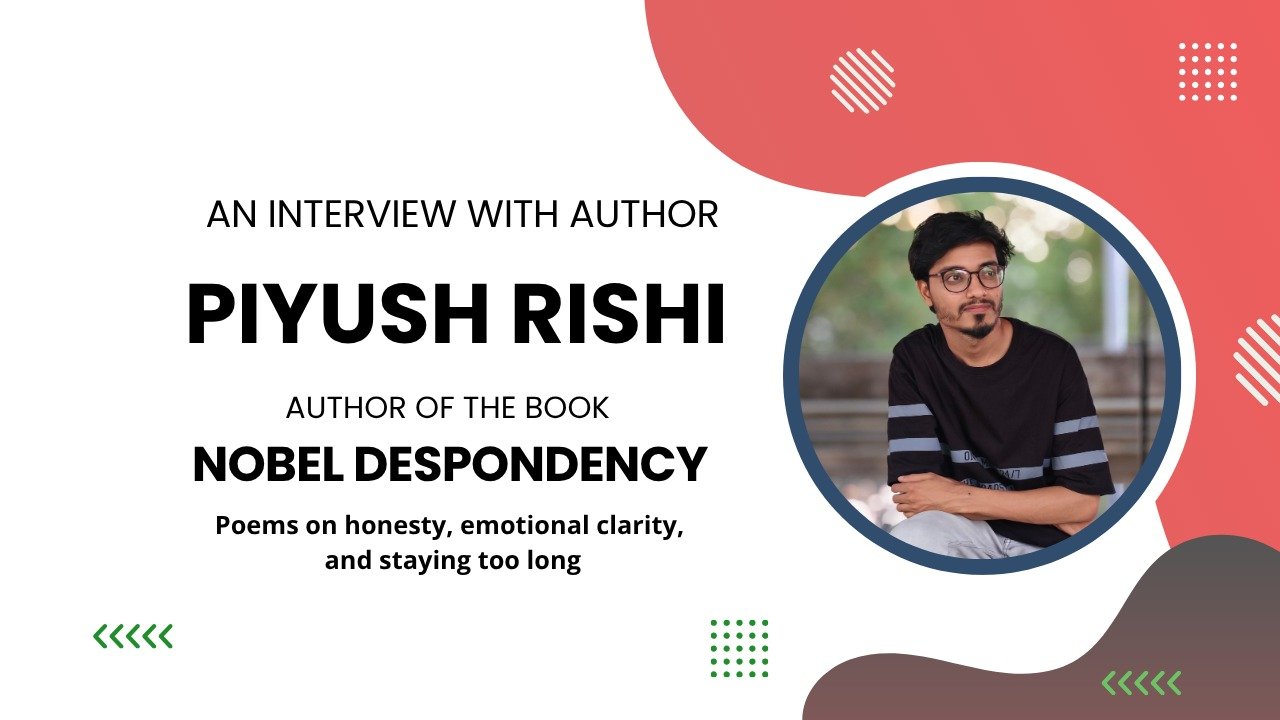
Piyush Rishi is an emerging Indian writer whose work blends poetic intensity with psychological depth. His voice is defined by brutal honesty, cinematic imagery, and a fearless exploration of pain, identity, and emotional collapse. Nobel Despondency is his debut novel, drawn from lived experiences and years-long reflections on loss, betrayal, death, and the violent anatomy of loneliness. His writing reflects a worldview shaped by grief, introspection, and an artist’s sensitivity to the hidden patterns of human behavior. Influenced by Kafka’s surrealism, Plath’s emotional clarity, and contemporary trauma literature, he delivers a narrative that is at once lyrical and devastating. He resides in Pune, India and continues to explore themes of hurt, emotional depth, human fragility, and artistic truth in his work.
Now lets talk about Personal Journey, Philosophy & Reader Connection
Your work reflects deep psychological intensity. How has your personal journey shaped your writing voice?
Author: Over time, I realized that the human mind is deeply psychological. It is a vast and interesting subject with endless scope for improvement.
No one is perfect, and no one can be perfect forever. It’s a continuous practice. Every hour, every day, a person must pay attention to their behavior and live accordingly. Emotional intelligence is extremely important.
Since psychology has so much depth, I believe I won’t stop writing about it anytime soon. Maybe readers connect with my writing because they see themselves in it.
You challenge societal norms and emotional suppression. What message are you trying to give society?
Author: At the very beginning, I wrote: “We’re living in a violent society. Selflessness is rare—it has space to grow, to be remembered.”
The only message I want to give is this: being selfish takes effort and you might end up in irritation, so why not try living effortlessly selflessness? Let society speak harshly, but you remain calm and kind.
The book touches on mental health in a very honest way. What role do you think literature plays in mental health awareness?
Author: I would love it if someone working in mental health awareness reads this book and finds something meaningful in it.
The book revolves around overthinking and a disturbed mind. There are many aspects that can help someone going through similar phases. That would truly matter.
You often portray love as painful rather than comforting. How has your perception of love evolved over time?
Author: Love has never been unkind. I don’t understand how something pure can be painful or associated with hatred.
Love feels painful because of people. It was never love—it was people. The idea of painful love was created because of human behavior.
Love is vast, and we haven’t even touched 1% of it. It doesn’t come with baggage from other emotions.
There is a strong sense of isolation in your writing. Do you believe loneliness is necessary for creativity?
Author: I don’t know for sure. My process is to observe things, sit alone, maybe watch reels, but once I’m on keyboard and thoughts run like anything. Then I’m not me, its something else who does the job.
But yes, creativity needs isolation. That’s when you concentrate and create something meaningful. Whether it’s joy or anxiety, you need a space where only you exist. That’s where honesty enters your art. A time with self always brings something good in hand.
How do you balance vulnerability with strength in your writing?
Author: Honestly, I don’t try to balance it consciously. It just happens when I’m being real with what I feel.
Vulnerability comes when I don’t hide anything from the page. Whatever I’m feeling, I let it be there without filtering it to sound “strong” or “perfect.” And strength, I think, comes from the fact that I’m still choosing to face it, to write it, to not run away from it.
For me, strength is not about sounding powerful in words. It is about staying with the emotion even when it’s uncomfortable. If I can sit with it, understand it, and still express it calmly, that itself feels like strength.
So I don’t separate the two. The more honest the vulnerability is, the stronger the writing naturally becomes.
Your note before the book speaks strongly about humanity and kindness. What does humanity mean to you today?
Author: Humanity is not just about being kind or silent. It is maturity. It is about giving more than taking.
If someone slaps you, humanity doesn’t mean staying silent, but it also doesn’t demand retaliation. Responding with violence is not something I support.
Instead, expressing your point with calm intelligence and making others realize it is what truly matters. Humanity must also demand justice. But we live in a violent society where people prefer aggression—through brutal words or actions.
Did writing this book help you heal, or did it reopen wounds?
Author: There is no complete healing. Memories remain, and acceptance exists alongside them.
It took a lot to place memories and acceptance on the same page. But I will admit one thing—this book has brought humility and a sense of satisfaction into my life.
What kind of readers do you think will connect most with Nobel Despondency?
Author: I think the book is for everyone. The situations in it can happen to anyone.
I’ve mentioned in the disclaimer that it’s not necessary to read the book in one go. If it doesn’t connect, keep it aside and return when life feels heavy. It’s more like someone is talking about what you want to listen to. Like a vibe you can say.
What’s next for you as a writer—can readers expect similar themes, or a different direction in future works?
Author: Let it come. I’m not allowed to talk about it—I’ve learned marketing now (laughs).
But I promise myself and my readers that many relatable things are coming. It’s going to be a good journey—I hope so.
Title: Nobel Despondency – Poems on honesty, emotional clarity, and staying too long
Publisher: Evincepub publishing