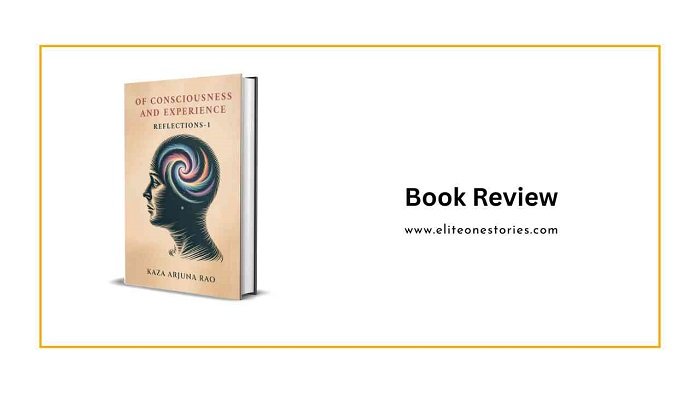
Kaza Arjuna Rao’s Of Consciousness and Experience: Reflections – 1 is a rare philosophical gem that dares to bridge the ancient and the modern, the spiritual and the scientific, the personal and the universal. The book emerges as both a meditation and a manifesto — calling for a renaissance of moral consciousness in a fragmented world.
At first glance, one might assume this is a metaphysical exploration, but the author’s reflections go far beyond theoretical philosophy. The chapters flow like stages of spiritual evolution — beginning with “A New Beginning,” moving through “Genesis,” “Theology,” “Philosophy,” “Psychology,” and “Sociology,” and culminating in “The Future of Consciousness.” Each chapter can stand alone, yet together they form a coherent, expanding vision of existence.
Rao’s central premise is simple yet profound: consciousness is the foundation of reality. Human evolution, he argues, is not complete until it includes moral and spiritual awakening. This proposition sets his work apart from conventional philosophy, which often isolates reason from intuition and ethics from existence. His narrative insists that wisdom must accompany knowledge, and morality must temper progress.
In “A New Beginning,” the author redefines what it means to evolve — not as an outward conquest but an inward journey toward self-understanding. He mourns how modern education and technology have trained humanity to act but not to reflect, to achieve but not to understand. The call for stillness in an age of speed, and for listening in an age of noise, defines his spiritual humanism.
The chapters “Theology” and “God and Religion” invite readers into an examination of divinity itself. Rao does not reject God; instead, he reinterprets the concept as the culmination of spiritual evolution — an inner destination rather than an external ruler. His assertion that “God is not the Creator but the idealized destination of the evolving soul” challenges dogma yet elevates faith to a living experience.
The section on “Paraphysics” is one of the most original. Here, Rao suggests that unseen forces and consciousness fields connect all forms of life. He redefines the supernatural as natural but subtle, insisting that what science cannot yet measure may still profoundly shape reality. The integration of paraphysics with psychology and ethics offers a holistic framework for understanding human potential.
As the text progresses to “Philosophy” and “Psychology,” the author becomes a social critic. He laments that philosophy has become sterile and psychology mechanical. The contemporary world, he says, suffers from “spiritual starvation amid material abundance.” His insight that evil acts faster than good—because it is more dynamic and opportunistic—is a sobering psychological truth.
In “Sociology” and “Human and Society,” Rao extends this argument to the collective dimension. He correlates personal immorality with societal decay, explaining how corruption at the top filters down and infects the moral fabric of entire nations. His diagnosis of global inequality — where 3% of the population holds 80% of wealth — is used not merely as social critique but as moral parable: when greed outpaces conscience, civilization loses balance.
The book culminates in “The Future of Consciousness,” where Rao articulates his vision for the next stage of evolution — the conscious civilization. He argues that humanity’s survival depends on cultivating inner awareness, not artificial intelligence. Technology, he warns, must serve the soul, not dominate it. His closing words — “The survival of humanity is no longer a technical problem; it is a problem of consciousness” — encapsulate the book’s urgent relevance.
Stylistically, Rao writes with poetic clarity and moral conviction. His voice echoes the reflective tone of J. Krishnamurti and the metaphysical sweep of Sri Aurobindo. Yet his perspective remains original — rooted in lived experience rather than academic abstraction. The blend of reason and reverence, logic and intuition, gives the work an almost meditative rhythm.
Ultimately, Of Consciousness and Experience is a mirror held up to the modern soul. It exposes our spiritual exhaustion and offers a path toward renewal — through reflection, compassion, and inner discipline. For readers seeking philosophical depth and moral clarity, it is a book not just to be read but to be lived.