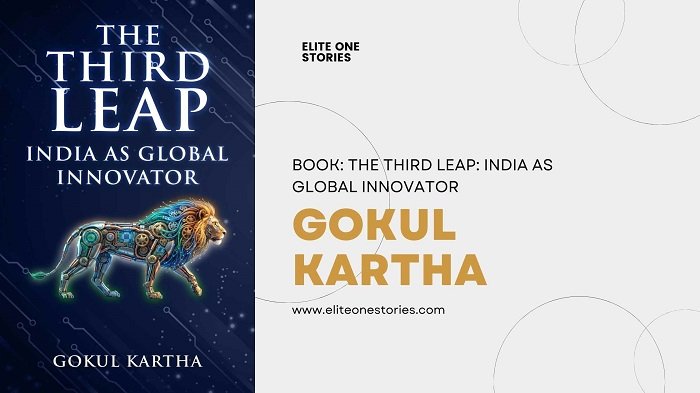
Gokul Kartha’s The Third Leap: India as Global Innovator is a compelling and deeply thought-provoking exploration of India’s technological crossroads. At its core, the book is an urgent call to reimagine the nation’s relationship with innovation, engineering, and long-term strategic capability. Rather than praising India’s existing achievements in IT services or digital scale, Kartha dissects the uncomfortable truth: India excels at participation but has yet to transition into genuine technological leadership. This distinction becomes the framework for a meticulous examination of what India must build—structurally, institutionally, and culturally—if it hopes to shape the next era of global power.
The strength of the book lies in its clarity and honesty. Kartha does not romanticize India’s successes, nor does he indulge in pessimism. Instead, he presents a balanced, precise argument grounded in global trends. The book explores how artificial intelligence, semiconductors, robotics, and quantum systems have become the new instruments of national strength. Nations that produce and control these technologies set the rules; those that import them follow the rules set by others. This geopolitical reality shapes the book’s central thesis: technological sovereignty is the foundation of strategic independence.
What makes The Third Leap profoundly impactful is the way it translates complex systems thinking into accessible insights. Kartha breaks down the invisible machinery behind national technological ecosystems—research universities, manufacturing pipelines, mission-driven institutions, strategic public investment, and long-gestation engineering programs. He argues convincingly that building technological capability is not a sprint but a generational marathon requiring patience, discipline, and coordinated effort.
The book goes beyond critique to offer a blueprint for change. It lays out how India can build AI-native public infrastructure, defence-grade deep-tech pipelines, and a sovereign semiconductor ecosystem. There is a refreshing seriousness in the way Kartha approaches these challenges. He does not treat them as aspirational ideas but as non-negotiable requirements for a future where India is not merely adapting to global technological waves but creating them.
Despite the density of the subject, the writing remains engaging and remarkably clear. The narrative is enriched with insights from engineering, geopolitics, economics, and public policy, yet it never loses sight of its audience. Whether the reader is a policymaker, entrepreneur, educator, or citizen concerned about India’s future, the book offers clarity and direction. It is both intellectually rigorous and emotionally resonant, urging readers to rise above quick wins and think in terms of decades.
Ultimately, The Third Leap is more than a book—it is a strategic mirror held up to the nation. It challenges India to confront its limitations, embrace its potential, and commit to building the deep foundations required for true leadership. It is a must-read for anyone who believes India’s destiny lies not in imitation but in innovation.