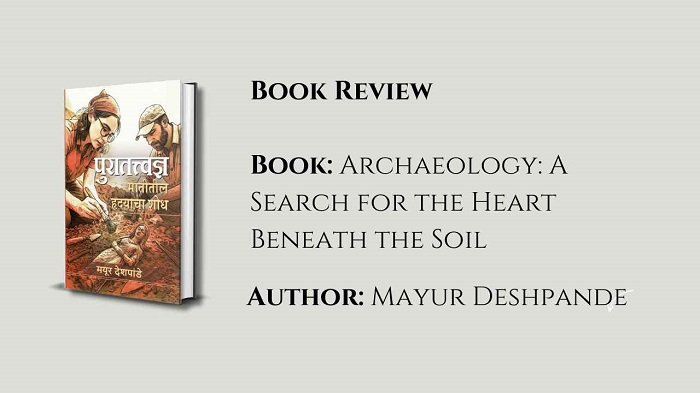
“Archaeology: A Search for the Heart Beneath the Soil” is a novel that speaks softly yet powerfully, weaving together the fragility of ancient artifacts and the even more delicate nature of human emotions. Mayur Deshpande has created an emotionally absorbing narrative where archaeology is not merely a profession—it becomes a metaphor for the ways in which we all uncover, examine, and preserve the pieces of our past. The result is a story that resonates deeply with readers who have ever loved, lost, or left parts of themselves behind in the flow of time. The premise of the novel is deceptively simple: during a small archaeological excavation on the Deccan Plateau, a buried clay figurine is discovered. But as the layers of soil are removed, so too are layers of emotion, memory, and unresolved silence. This figurine, named Maria, is not just an artifact. She represents a voice from the past, sculpted in a time when love and longing were expressed not through speech but through craftsmanship and subtle gestures. With Maria’s reappearance, the past comes alive again—not through words but through the profound emotional energy embedded in her form.
Pruthwij, the young archaeologist leading the excavation, becomes the emotional anchor of the narrative. His interaction with Maria goes far beyond scientific curiosity. As he studies her, he begins to feel the pulse of her silent story—a story of unspoken love, separation, and sorrow preserved through centuries. And with every new detail he discovers, his own buried emotions begin to rise. Pruthwij has his own unfinished narrative: a relationship with Alice, a close companion from his college years. Their connection was deep yet undefined, tender yet restrained, full of emotions that never found a voice. Life nudged them onto different paths, and like Maria, their love became buried—not lost, but hidden beneath the layers of time. The novel’s brilliance lies in this parallel. Maria’s story is from another era, but her emotions mirror everything Pruthwij once felt and continues to feel. Through her, the reader experiences a fascinating interplay between the ancient and the modern, the spoken and the silent, the visible and the hidden.
Deshpande’s prose is remarkably sensitive, enabling readers to feel the depth of each moment. His writing moves slowly, gently, with a sense of reverence—much like the careful hands of an archaeologist brushing soil away from a fragile artifact. The silence in the novel is intentional and profound. It invites the reader to pause, observe, and reflect. Maria never speaks, yet her stillness carries immense meaning. She embodies every emotion that human beings fail to articulate—fear, longing, devotion, resignation. In her silence, readers find echoes of their own experiences. She becomes a symbol of everything that remains unsaid in relationships, of all the emotions people privately harbor but never express.
Pruthwij’s emotional journey is equally captivating. As he begins to interpret Maria’s story, he finds renewed clarity about his feelings for Alice. Their relationship, though incomplete, is not depicted with bitterness or regret. Instead, the novel treats it with tenderness, acknowledging that some connections are left open not because they are weak, but because they are too meaningful to force into closure. Alice’s presence hovers in every thought Pruthwij has, reminding the reader that unfinished relationships often define us more deeply than completed ones. The author’s ability to blend these two emotional timelines—the ancient life represented by Maria and the modern life embodied in Pruthwij—is commendable. The narrative moves seamlessly across centuries, proving that human emotions do not change with time. Love, sorrow, and longing are universal; they do not erode like clay. Instead, they remain preserved within us until something—or someone—brings them back to the surface.
The novel becomes most powerful in its final sections, where the excavation becomes symbolic. Just as archaeologists dig through earth to uncover relics, Pruthwij digs through his memories and emotions to reach a rediscovery of himself. Maria’s emergence becomes a turning point that reunites him not just with Alice but with his own forgotten truths. The ending is both gentle and emotionally intense. It does not offer unnecessary drama or forced closure. Instead, it offers acceptance—a soft, healing acceptance of everything that was, everything that remains, and everything that cannot be changed. It is an ending that feels more like a beginning, inviting readers to unearth their own hidden emotions and find meaning in their personal silences.
“Archaeology: A Search for the Heart Beneath the Soil” is a rare, poetic novel that stays with the reader long after the last page. It is an emotional excavation, a tribute to human vulnerability, and a delicate reminder that we all carry buried stories within us. For anyone who has ever felt the sting of an unfinished relationship or the nostalgia of memories that resurface unexpectedly, this book becomes not just a story but a reflection—a quiet, powerful mirror into one’s own emotional depths.