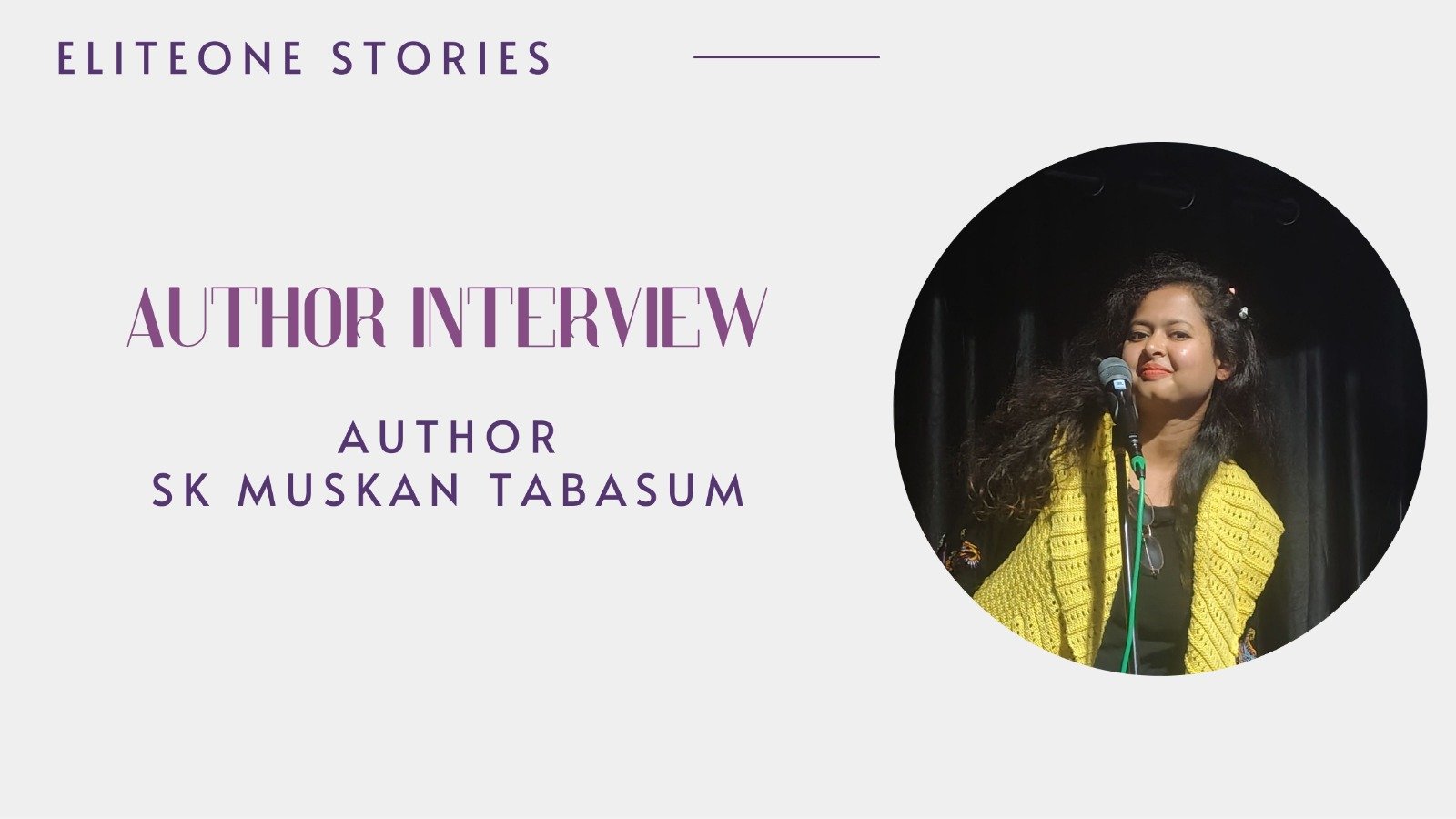
Sk Muskan Tabasum is an emerging poet and writer from Burdwan, West Bengal, known for her fearless engagement with the social, political, and psychological undercurrents of modern life. With a strong literary academic background, she uses poetry not merely as an aesthetic pursuit but as a sharp tool to question hypocrisy, prejudice, and the emotional silences of society. After making her professional debut in 2022 with Breaking Out: Life from Auto Pilot Mode, Muskan continued to explore the grey zones of human behavior, feminism, and social injustice. Her poetry collection Kaliyuga on My Curls stands as a bold commentary on the contradictions of the so-called dark age, blending satire, sensuality, and rebellion to give voice to unspoken battles—especially those lived by women. Beyond the page, Muskan is also a performance poet who believes literature can provoke change, heal wounds, and leave a lasting imprint on the literary timeline.
The Eliteone: Kaliyuga on My Curls challenges the idea of Kaliyuga being the “dark age.” What inspired you to reinterpret this concept so boldly?
Sk Muskan Tabasum: Watching Mahabharata (2013) and reading The Krishna Key by Ashwin Sanghi. That television series had hit me rock-bottom. We all have heard about the tales of Mahabharata and the miracles of those times. And a series of events in today’s world intrigued an idea in my head that whichever idiom we use in Kaliyuga to describe the hollowness of friendships and business dealings are nothing but what people in the ‘good yugs’ have experienced. Whatever is happening in Kaliyuga has nothing new in it- our ancestors have lived the same thing and yet we tend to believe that this age (Kaliyug) is ‘dark’. Well, I believe that this is the age of Kali, and an age which goes by the name of its saviour cannot be the ‘dark age’. The poem in the book, I Saw Kaliyuga Enter My Room, is how I have presented my argument to the idea of Kaliyug vs ‘all other good yugs’. I think, Kaliyuga is a mirror age of who we are and how we chose to become.
The Eliteone: Your poetry blends satire with emotional depth. How do you balance social criticism without losing the personal voice in your poems?
Sk Muskan Tabasum: Satire comes with emotional depth itself. Satire is the form of poetic expression where ‘beating behind the bush’ is not an option. Two to four years ago, it was one of my paternal uncles who identified that ‘I am mastering satire’. There is a sharp rebuke with a soft hope in my poems. When I write on a theme, I tend to adopt a voice not only to criticise the reality but to become the voice of oppressed emotions and subvert the oppression itself. So, it is just the beginning. My personal voice is shaping my poems and my poems are sharpening the voice of the author.
The Eliteone: The section titled ‘women’ is one of the most sensual and powerful parts of the book. What does sensuality mean to you in the context of women’s empowerment?
Sk Muskan Tabasum: Thank You, for calling it most powerful. Well, the section in the book is visually presented as Wo(Men). From a visual context that represents that the word ‘men’ is an incomplete fragment from Women. It is not about whether men complete women or not. The fact is like earth is a part of the Universe, ‘men’ are a part of women.
From a sensual side, the section delves on different aspects of womanhood- selfishness, resilience, her physical shape, the impact of ‘male gaze’ and how society looks at a successful woman and questions the integrity of her success. I have used sensuality not as to bring forward the physical attractiveness of women, but to show that the wit and brains of a women travel farther than her body. Wo(Men) shows that ladies cannot be categorised into good and bad. We have a range of emotions and a larger spectrum of personas. Womankind needs to accept her wholesomeness without asking for approval.
I was brought up by a very powerful lady- My mother, the strongest soul in my family. This book is a dedication to my grandmother who I look up as the ‘ideal heroine of Kaliyuga’. Thus, my growing up has made me realise that patriarchy only exists if we keep fighting it. Once, women are done tolerating patriarchy, and accepting herself above the male dominated perception of ‘beauty’, patriarchy can’t harm us anymore.
The Eliteone: You portray feminism as resistance against prejudice rather than against men. Why was this distinction important for you to make?
Sk Muskan Tabasum: I am one of the few lucky people in the world who can proudly say, that most men in my life are good. And the range of good covers the words like encouraging, decent, fun-loving, bro-code people and protective. Most men in my life are good, and a few of them come with their own prejudices. They do not allow their prejudices against ‘female beings’ to cloud their judgement, but at the end of the day it stays. It is like no matter how old you grow, you cannot forget A-B-C-D.
So, when I portray feminism in my poetry, it is gender neutral. I do not have to target men. I only have to target the ideas that come as a compliment or rebuke and develop a picture of women which seems inadmissible. One of my teachers, used to end up complimenting me, “I’ am so proud that you are my student, Muskan you are beauty with brains”. The remark seemed elevating until the day I thought, “what do you mean, women can have either beauty or brains? Is it not natural for us to have both? And if it is natural, why is it a compliment?” So, you see, Sir was appreciating me. But his compliment was stained with age old prejudices against women. Besides, men are not anti-heroes. I have seen some of my aunts scolding their sons, “don’t cry like a girl”. If to a woman, crying like a woman is a weak trait, I deny the idea that feminism has anything to do with protesting against men.
The Eliteone: Many of your poems touch on war, politics, and social injustice. Do you believe poetry has a responsibility toward society?
Sk Muskan Tabasum: I am a movie bug. And a bigger bug of the Dead Poets Society. Poetry is not just about rhyme, metre, rhythm and cute expression of love. Poetry is about power, and passion. And as a ‘member of human race’, I have chosen poetry as my expression of power. Poetry is direct, it does not need an extensive characterisation to paint a pricking truth of society. It is short and it can peel off fake morality like we peel off the skin off potato or cucumber. Besides, of all the forms of expression I could adopt, I find poetry the most compelling.
The Eliteone: How did collaborating with illustrator Pritha Ghosh shape the final experience of Kaliyuga On My Curls?
Sk Muskan Tabasum: Amazing. Finding a person who knows the picture in your head while you can only give them absurd ideas, it is rare these days. On days it did not work between us, I would say, “it’s not you, it’s me” Lol. Pritha gave the best from her end, from what she could realise. But on some days, I would not like my own description for the images. So, Pritha was not just following what I said or had written, she also had to tap into the actual feeling of the poems that I could not describe to her. Before her, I did approach a few people and it made up to nothing. Pritha just dropped into my life- the right person at the right time. So, it was amazing. Yes.
The Eliteone: Your writing often confronts discomfort and contradiction. Was there any poem in this collection that felt especially difficult to write?
Sk Muskan Tabasum: There is a sentiment by Wordsworth which says that to write, we must have a “spontaneous overflow of powerful feelings”. But, this idea is tied with the fact that “emotion must be recollected in tranquillity”. The very idea of creation itself becomes contradictory here, does it not? Feelings must be spontaneous and powerful, but the environment, mind and body must be in peace, away from chaos. So yes, my writing works do have a lot of contradiction in them and I pick up the pen when I want to expose or challenge these contradictions of society. There are three poems in the book that have put me in a state of discomfort
First is ‘Wake up, You Homeless’. That poem was inspired by the sight of a group of poor families, cooking their food and making their bed, under an overbridge in my city near the railway station. I saw them for a couple of days, regularly and on one fine day I thought- ‘beghar ka ghar kahan hai, besharam ka sharam kahan hai’. But you see, having a question and then writing a political satire are not really the same thing. The poem The 21st Century was edited and discarded five to six times, as far as I remember. I wanted to convey the idea how ‘not all of us live in the same era, even if we all are living in the twenty-first century’. However, that was the most chaotic poem ever. I found it difficult to present the picture of the entire globe, raise the most important issuesand yet keep it concise. Another such poem was Diseased or Deceased? The poem questions the subject of war but from the point of aftermath. I am proud of the output, but yes that was a bit unsettling.
The Eliteone: Having transitioned into professional writing in 2022, how has your relationship with creativity changed since Breaking Out: Life from Auto Pilot Mode?
Sk Muskan Tabasum: When I was writing Breaking Out, I did not know I was writing a book. Now it is ten to eleven years. It was a fine morning and a not-so-fine person. I can recall that event as a person who took the pen to let her pain flow away. I thought I did not have the right words to express what I was going through. I did not know, I had just the right words to turn my pain into power. In 2022 when Breaking Out: Life from Auto Pilot Mode came out, the first time the master copies were delivered on my door step- well that is an uncanny experience. I don’t think you can ever explain how it feels to become a published author from a ‘yes, main bhi thoda bohot likhti hu’. Before that, I won’t let anyone read from my diaries or journals, now I am performing, publishing and presenting. My relationship with creativity has not really ‘changed’ in terms of expression, but now I know my voice is not constrained within pages itself. When I wrote Breaking Out: Life from Auto Pilot Mode I was writing for myself, when I compiled the poems for Kaliyuga on My Curls, I knew what I was heading at, and how I need to plan things on the way.
The Eliteone: As a performance poet, how does audience interaction influence the way you write or revise your poems?
Sk Muskan Tabasum: The journey of an artist is not as simple as it seems. The yearning to be read, seen or heard is the most underrated emotion on this side of art. Most people focus on how a writing or painting would support your lifestyle. However, at this side of the scene what matters most is reaching the right audience, at the right time. Social media has taken over so fast, if something is not viral, it is not visible and is definitely non-existential to the masses. But, live performances are giving me a direct stage where people would just not read me, they can see the mind, emotion and stories behind each piece I am writing. During stand-up shows, the best part is the sudden opportunity to become the life of the evening and watching emotions change in people’s face as each word is spoken. Every time I stand up for ‘my time’, as we call it in open mics, my poems come out of the pages. They get a voice and sometimes, they get extended as well. I do not really revise my poems, but the emotions that I catch through my audiences evokes some very important musings, always.
The Eliteone: You’ve spoken about wanting to leave an indelible mark on the literary timeline. What kind of legacy do you hope Kaliyuga on My Curls will create?
Sk Muskan Tabasum: A book that carries both literary and social legacy. I want people to remember Kaliyuga on My Curls as a book that gave them power. I am not offering a solution to their problems. However, the book is meant to be read, revisited and strike how their perspective is clouded by social prejudices and life is better than they have pictured it till now. I am looking forward to see that Kaliyuga on My Curls is remembered as a collection of truth, power and courage.