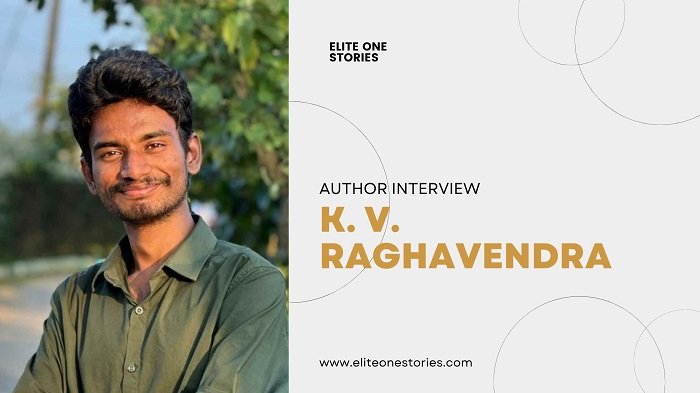
K. V. Raghavendra is a novelist, filmmaker, and software engineer whose storytelling is driven by deep emotional exploration. Born and raised in Hindupur, Andhra Pradesh, his journey took him through Hyderabad, Bangalore, and eventually Mumbai, where he currently works as a Software Engineer. While academically strong, college life became a turning point that opened him to creativity, cinema, and human emotions beyond textbooks. A passionate film enthusiast, Raghavendra has written multiple screenplays and created short films, discovering that writing allows one to experience emotions far beyond personal reality. Remains of Her, his debut novel, grew organically from a simple emotional question into a powerful story of love, loss, and remembrance, reflecting his belief that storytelling is both an intense and healing journey.
The Literature Times: Remains of Her explores love and loss with deep emotional intensity. What inspired the core idea behind this story?
K. V. Raghavendra: Initially, there was no plan to write a book or novel. I have a habit of listening to music late at night, and music often becomes a source of inspiration for me. While listening to an emotional song one night, I felt the urge to write a love story and film it, and naturally, it leaned toward a tragic tone.
The first thing that came to me was the climax. I didn’t just imagine it, I deeply felt the emotion and expression, and I knew it touched something universal. Before I began writing, I realized how delicate love is. For some, losing it once is unbearable, which led me to wonder, what if someone loses it twice? That question became the emotional foundation of Remains of Her.
The Literature Times: Ajay and Amritha are contrasting personalities. How did you shape their characters and dynamic?
K. V. Raghavendra: In a character-driven story, character development becomes crucial. It’s not just about who the characters are, but how they evolve through different situations and how they emotionally respond to them.
While writing Ajay and Amritha, I first experienced them within myself. Ajay represents who I was before college, more restrained, introspective, and emotionally guarded. Amritha reflects who I became during college, more open, expressive, and emotionally aware. In a way, they are two different souls carrying two phases of the same personality. Their dynamic grew naturally from this contrast, allowing their relationship to feel honest and deeply human.
The Literature Times: The novel asks whether love truly ends after death. What does this question mean to you personally?
K. V. Raghavendra: For me, the answer is very clear, love never truly ends. It doesn’t disappear; it only changes its form. Love keeps increasing and decreasing over time, but it is never cut off completely. We don’t stop loving, we simply transfer that love into memories, and the way we continue to live. That belief lies at the heart of Remains of Her
The Literature Times: The story began as a short film idea. What made you decide it was better suited as a novel?
K. V. Raghavendra: Yes, it began as a short film idea. But as I started writing, the story kept expanding. Even after reaching nearly a hundred pages, it still felt emotionally incomplete. The depth of emotion I wanted to convey needed more time and space than a short film could offer,especially given the practical limitations I had at that moment.
A novel allowed that emotional freedom. Readers connect to emotions in their own ways, and I wanted to give them the space to feel, interpret, and experience the story personally. That said, storytelling evolves, and who knows , Remains of Her might find its way to the big screen someday.
The Literature Times: Grief and memory play a strong role in the narrative. How did you approach writing these delicate emotions?
K. V. Raghavendra: Writing grief and memory was one of the most challenging parts of the novel, and it took a great deal of time to understand and shape those emotions. Grief and memory affect every individual differently, and I wanted to respect that emotional complexity.
While writing, I deeply immersed myself in the characters’ inner worlds. For a while, I lived as them, I became Ajay, Amritha, Meera, and every other character. By placing myself in their situations and emotional states, it became easier to understand what they would truly feel, how they would react, and what choices they would make. That emotional immersion guided the authenticity of their grief and memories.
The Literature Times: Your background in filmmaking is evident in the storytelling. How has cinema influenced your writing style?
K. V. Raghavendra: Cinema has played a major role in shaping my writing style. Growing up watching films naturally influenced the way I perceive stories, emotions, and human relationship and how the story progress. I tend to visualize scenes while writing, how a moment unfolds,how emotions linger beyond dialogue. That cinematic sensibility helps me structure scenes with rhythm and emotional flow, even on the page.
The Literature Times: You mention that writing helps explore emotions one may never experience. Did this book change you emotionally as a person?
K. V. Raghavendra: Yes, writing this book changed me emotionally. Living with the characters for long time and their emotions made me more empathetic and emotionally aware. It helped me understand feelings like love, loss, and silence more deeply, even those I may never experience personally.
The Literature Times: Music seems important to you creatively. Did it play a role while writing Remains of Her?
K. V. Raghavendra: Yes, definitely, music played a huge role in the writing process. I would honestly credit nearly half of the emotional depth of the book to music. It helped me write more intense scenes and maintain a strong emotional connection with the reader. There were moments when music allowed me to sit and write a single emotion for nearly ten hours straight.
While writing, I often blended the scene with the music I was listening to. If the music deeply moved me while I was writing a scene, I knew that moment worked. That feeling gave me the confidence that the scene was emotionally true.
The Literature Times: As a debut novelist, what challenges did you face in turning a personal idea into a published book?
K. V. Raghavendra: I faced several challenges, particularly during the writing and editing phases. I initially wrote the story very organically, focusing more on emotion than grammatical structure. When I decided to publish the book, the editing process became the most demanding part,it took nearly three continuous months to refine the language and ensure clarity.
Fortunately, the publishing process itself was smooth, allowing me to focus entirely on shaping the final version of the story.
The Literature Times: What do you hope readers feel or reflect upon after finishing Remains of Her?
K. V. Raghavendra: More than anything, I want to understand how readers emotionally respond,especially after the twist that leads into the climax. That moment carries the emotional core of the story. I hope it makes them pause, reflect, and sit with their feelings for a while. If the climax stays with them beyond the final page, making them think about love, loss and what truly remains,then I believe the story has reached them in the way it was meant to.