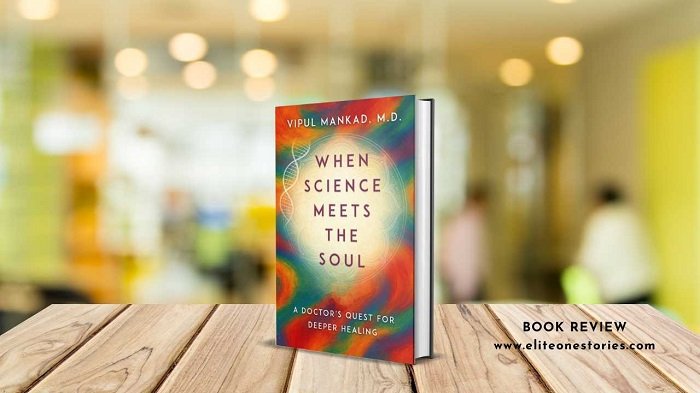
When Science Meets the Soul by Dr. Vipul Mankad is an insightful and deeply reflective work that blends memory, science, and spirituality with a rare sense of balance. The book is not simply a retelling of a life; it is an exploration of what it means to be human, to evolve, to question, and ultimately, to understand oneself beyond the layers of identity that society imposes. Dr. Mankad approaches this journey with honesty, clarity, and intellectual depth, making the book both emotionally moving and intellectually stimulating.
What stands out immediately is the author’s ability to take readers across time and geography with remarkable vividness. His childhood in a newly independent India forms the emotional foundation of the narrative. He draws the reader into a world of humble living, strong values, and a family that prioritized education and moral integrity despite economic constraints. His father, portrayed as a devoted doctor and a selfless human being, becomes one of the central inspirations in the book. Through these memories, Mankad brings alive the India of the 1940s and ’50s—an India struggling with its colonial wounds yet filled with hope, ambition, and cultural richness.
The account of his migration to the United States in 1968 is equally compelling. The cultural shock he recounts—from unfamiliar food habits to the open displays of affection, from modern airports to the diversity of races—creates a vivid picture of the emotional turbulence faced by a young Indian stepping into a completely different world. But the journey is not presented as a simple story of adaptation. For Mankad, migration becomes the catalyst that pushes him to ask deeper questions about identity. Who was he beyond his nationality, religion, or profession? What part of him would change, and what part would remain untouched? These reflections elevate the personal narrative into a universal one.
A significant strength of the book lies in its multidisciplinary approach. Mankad draws from archaeology, linguistics, genetics, history, and philosophy to build a holistic understanding of human evolution and cultural identity. His chapter on the genomics of the Indian population is particularly eye-opening. By examining the scientific evidence behind human migrations and genetic mixtures, he challenges rigid notions of purity and identity that have shaped societies for centuries. This scientific grounding adds credibility to his broader argument: that humans are far more interconnected than we realize, and our inherited identities are complex tapestries shaped by migration, cultural evolution, and historical events.
As the book transitions into its spiritual dimension, the tone becomes meditative yet remains grounded. Mankad’s lifelong engagement with Hindu philosophy, yoga, and meditation is presented not as religious instruction but as a personal experience of growth. He does not preach; instead, he reflects. His approach to spirituality is inclusive, rational, and free from dogma. He explores Bhakti, Karma, and Jnana as pathways to understanding the self, but he does so with humility, acknowledging that each person must find their own way.
The chapters on consciousness and the mind are among the most fascinating. Blending scientific perspectives with spiritual insights, Mankad discusses consciousness not as a mystical abstraction but as the core essence of existence. He carefully examines what modern science knows—and does not know—about the brain, perception, and awareness. His argument that consciousness is fundamental, not secondary, resonates strongly in today’s world, where people seek meaning beyond material success and technological advancement.
What also makes the book engaging is Mankad’s honesty about his own doubts. He questions religious rituals, challenges inherited beliefs, and openly discusses the conflict between scientific skepticism and cultural devotion. This makes him relatable to readers who may be navigating similar internal struggles. His reflections on why he remains a Hindu, even after decades of rational inquiry, are thoughtful and nuanced. He concludes that identity is not about rigid definitions but about understanding one’s roots while remaining open to new perspectives.
Emotionally, the book is powerful because it is deeply personal. Mankad writes about his family, his patients, his failures, and his transformation with sincerity. The stories of the seriously ill children he treated—children who, in many ways, became his teachers—are particularly touching. They offer profound lessons on resilience, compassion, and the fragility of life.
Overall, When Science Meets the Soul is a graceful reminder that the search for meaning is a lifelong journey. It is a book that bridges continents, generations, and disciplines. It encourages readers to look inward, question fearlessly, and embrace both reason and spirituality as partners rather than opposites. Thoughtful, informative, and deeply humane, this book has the power to shift perspectives and inspire a more mindful way of living.